

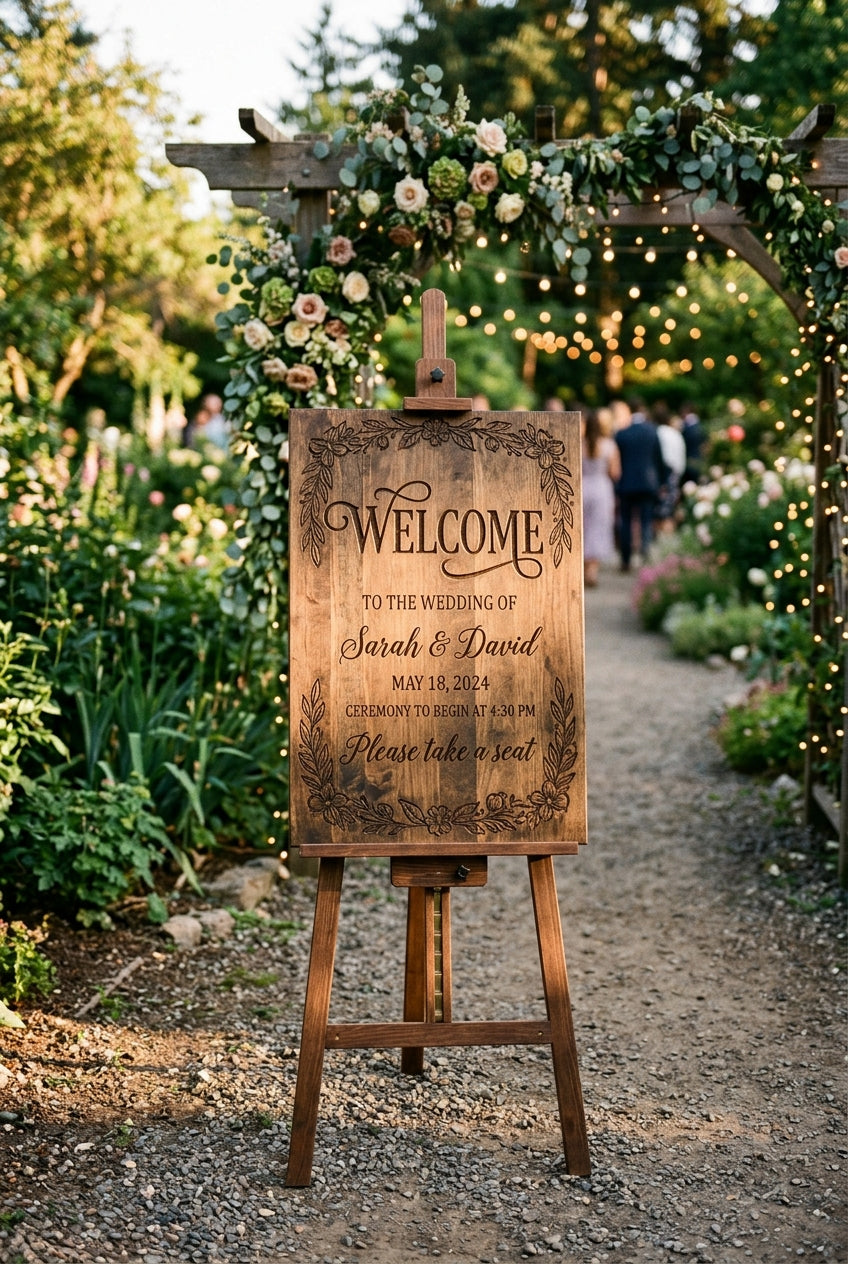

The standard wedding welcome sign size is 24×36 inches, and it's standard because it works: big enough to read from fifteen to twenty feet as guests approach, proportioned for a standard easel, and roomy enough for names and a date without crowding. Intimate venues and short approach paths do fine with 18×24, while grand entrances and outdoor ceremonies with long sight lines justify stepping up to 30×40. If you're deciding blind, 24×36 is the safe answer.
We make wedding signs, and size is the question every couple asks — usually followed by mild panic that the sign will look either lost or enormous at the venue. It won't, if you size it against two real measurements: how far away guests first see it, and what's holding it up. Here's the whole decision.
The three standard sizes and who they're for
18×24 inches suits intimate weddings and tight spaces — a restaurant foyer, a garden gate, a doorway where guests pass within six or eight feet. On a tabletop easel beside the guest book it looks intentional; at the end of a fifty-foot walkway it looks like a postcard. Keep the text minimal at this size: names, date, one line of welcome.

24×36 inches is the standard for a reason. Guests read it comfortably from the fifteen-to-twenty-foot range where an entrance sign actually gets seen, it fills a full-size easel properly, and it carries a welcome line, both names, and the date at letter sizes that hold up. Most of the welcome signs we build are this size, and none of them have ever looked too big at the venue.
30×40 inches and up earns its space at large venues: long outdoor approaches, barn entrances seen across a lawn, hotel ballroom doors at the end of a wide corridor. The rule of thumb from our letter height visibility chart applies directly — lettering needs about an inch of height per ten feet of reading distance — and a long approach simply demands bigger letters, which demand a bigger board.
The quick venue test: stand where guests first spot the sign's future location and pace off the distance. Under ten feet, 18×24 works. Ten to twenty-five feet, take the 24×36. Beyond that, go large — or move the sign closer to the path.
Letter size matters more than board size
A welcome sign is typography first and board second, and the sizing that actually governs readability is the lettering. For a 24×36 sign read at fifteen to twenty feet: the couple's names want to be the biggest element at roughly 2.5 to 4 inches, the welcome line reads fine at 1.5 to 2 inches, and the date can drop to an inch because guests read it up close, on approach. Elegant script — the near-universal choice for names — reads smaller than its measured height because of its thin strokes, so when a script font is non-negotiable, size the names toward the top of the range. That trade-off between delicate lettering and reading distance is the same physics covered in our letter height chart, and it's the reason we'll sometimes talk a couple into one size larger when their chosen font is especially fine.
Less text is the other half of readability. The signs that photograph best and read best carry a welcome line, two names, and a date — five to ten words. Every additional line shrinks everything else on the board.
What's holding it up
Size and support have to be decided together, because a sign leaning on the wrong stand fails in front of a hundred guests.
A standard wooden or metal display easel handles 18×24 easily and carries 24×36 well, provided the easel is a display easel and not a lightweight artist's sketching tripod — a solid wood 24×36 sign runs eight to eleven pounds, and flimsy easels have dropped plenty of them. For 30×40 and larger, use a heavy A-frame easel or lean the sign deliberately: against a wall, a fence, a hay bale, an antique door — leaning welcome signs are a style of their own and sidestep the easel problem entirely.
Outdoors, wind is the design constraint nobody budgets for. A 24×36 solid board is a sail. Leaning beats an easel in any breeze, a sandbag over the easel's back leg is cheap insurance, and a sign that will stand outdoors all day at a summer ceremony also wants a finish that tolerates sun — we cover that side in our guide to the best finish for outdoor wood signs.
Orientation and one honest style note
Vertical (portrait) is the default for welcome signs and suits the standard name-stack layout: welcome, names, date, top to bottom. Horizontal formats work for wide entrance tables and for signs that will hang above something rather than stand beside it. There's no rule beyond the layout logic — but easels hold vertical signs more securely than horizontal ones, which tip sideways more easily in wind.
And the honest note: couples sometimes size the sign for the photos rather than the guests — a small, delicate sign that looks precious in close-up detail shots but functionally greets nobody. Decide which job the sign is for. If it's truly a photo prop, size it for the photo. If it's greeting a hundred people arriving down a gravel path, the letter height math wins.
Frequently Asked Questions
What size should a wedding welcome sign be? 24×36 inches is the standard and suits most weddings — readable from fifteen to twenty feet, proportioned for a full-size easel, with room for a welcome line, names, and date. Intimate venues where guests pass close can drop to 18×24, and long outdoor approaches justify 30×40 or larger.
How big should the letters be on a wedding welcome sign? On a 24×36 sign, the couple's names read well at 2.5 to 4 inches tall, the welcome line at 1.5 to 2 inches, and the date at about an inch. Lettering needs roughly one inch of height per ten feet of viewing distance, and thin script fonts read smaller than their measured size, so size script names generously.
Will a 24×36 sign fit on a normal easel? Yes — 24×36 is the size full-height display easels are built around. Make sure the easel is a sturdy display model rather than a lightweight sketching tripod, since a solid wood sign at this size weighs eight to eleven pounds, and weight the easel or lean the sign instead when it stands outdoors in wind.
Share:
How to Hang a Wood Sign: The Right Hardware for Every Weight and Wall
What Do Couples Argue About in the Bedroom — Temperature, Blankets, Light | Bluegrass Gifts