
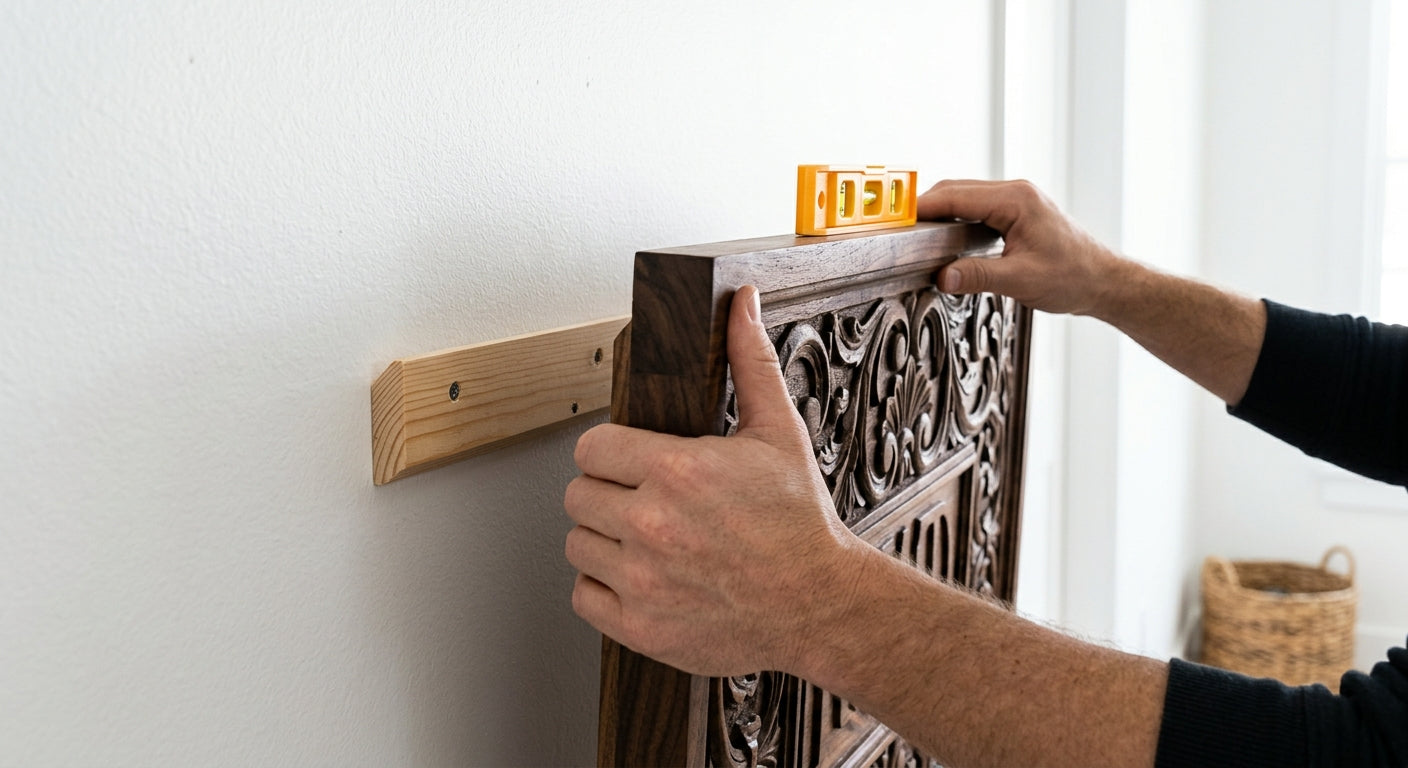

Match the hardware to the sign's weight: sawtooth hangers for signs under about five pounds, keyhole slots or D-rings with wire for the five-to-fifteen-pound middle, and a French cleat for anything heavier or wider than two feet. On the wall side, a screw into a stud beats any drywall anchor, and for hollow drywall a toggle-style anchor is the strongest option. Weigh the sign first — a bathroom scale works — because every hanging failure we've ever heard about started with guessed weight.
We build solid-wood signs, which means our customers hang real weight: a 12×36 pine sign runs four to six pounds, a 24×36 around ten, and inch-plus statement pieces can pass fifteen. Here's the full decision, sign side first, then wall side.
Sign side: the hardware on the back
Sawtooth hangers are fine for small, light pieces and nothing else. The failure mode is honest: a narrow strip of stamped metal held by two tiny nails, carrying everything. Under five pounds, hung on a proper hook, they're fine for decades. We stop trusting them beyond that, and so should you.

Keyhole slots — carved recesses in the back that swallow a screw head — are the clean choice for medium signs because the sign sits flush against the wall with nothing visible. Their demand is precision: the screws in the wall must match the slot spacing exactly. The trick that makes it painless: lay painter's tape across the back, mark the keyhole centers on the tape, peel it onto the wall, level it, and drive the screws through your marks.
D-rings with wire are the forgiving standard. Two D-rings on the side rails about a third of the way down from the top, braided picture wire between them, and the sign hangs from one or two hooks with room to nudge level. Use two hooks a few inches apart rather than one — the sign stops tilting every time someone bumps the wall. Skip the wire and hang each D-ring directly on its own hook when you want the sign to never move at all.
A French cleat is the answer for heavy and wide signs, and honestly it's the most under-used hanging method in home decor: two strips of wood or aluminum beveled at 45°, one screwed across the sign's back, the mate screwed level into the wall — ideally into studs — and the sign drops on. The cleat spreads the load across its whole width, makes hanging a heavy sign a one-person job, and lets the sign lift off for cleaning. Anything over fifteen pounds, wider than two feet, or hanging where a falling sign could hurt someone gets a cleat.
Wall side: what's actually holding everything
The hardware on the sign only matters if the wall connection holds. In order of strength:
A stud is the answer whenever you can get one. A single #8 screw driven an inch and a half into a wood stud holds more than almost any drywall anchor made. Find studs with a finder or the tap test, and remember they usually sit every 16 inches — a French cleat crossing two studs is effectively permanent.
Drywall anchors vary enormously and their package ratings assume perfect installation. Plastic expansion plugs are the weakest and belong under light signs only. Self-drilling threaded anchors (the big screw-in type) handle the medium range well. Toggle and snap-toggle anchors — which open behind the drywall and clamp the whole panel — are the strongest hollow-wall option and the only anchor style we'd trust under a genuinely heavy sign that can't reach a stud. Whatever the package promises, using half the rated load is the habit that prevents surprises.
Brick and masonry: the choice between drilling mortar or brick depends on the sign's weight. For light signs, drill the mortar joints — mortar drills easily, holds light loads fine, and repoints cheaply if you ever move the sign, while a hole in a brick face is forever. For heavy signs, solid brick is the stronger material and holds sleeve and expansion anchors better than aging mortar can; drill the center of a solid (not cored or hollow) brick with a masonry bit and use anchors sized to your screws. Either way, go slow, without hammer mode until the bit seats, and vacuum the dust before setting the anchor.
Adhesive strips tempt renters, and for light signs on smooth clean paint they can work — but follow the manufacturer's weight rating exactly, use more pairs than you think you need, and accept the honest caveat: temperature swings and textured walls defeat them, and we don't recommend trusting an heirloom piece to adhesive anywhere it would hurt to fall.
Hanging outdoors
Outdoor hanging adds two rules. First, every screw, hook, ring, and chain must be stainless steel or coated exterior-grade hardware — plain zinc hardware streaks rust down a sign's face within a year or two. Second, leave the sign room to breathe: hang it proud of the wall on spacers or from hooks rather than flat against siding, so rain drains and air moves behind it. A sign trapped wet against a wall rots from the back, where nobody sees it until it's done. For hanging signs — porch and post-mount styles — use two hanging points, not one, unless you want it swinging in every breeze, and check chain and eye hardware yearly, because hardware fails before wood does.
Getting it level and keeping it there
Two-point hanging beats one-point for staying level. For keyholes and cleats, level is built in at installation — use an actual level, not your eye, because porch ceilings and door frames are rarely as straight as they look and the eye levels signs against them. For wired signs, small rubber bumpers on the bottom corners keep the sign from wandering and protect the wall. And hang signs at eye level unless there's a reason not to: on a crowded gallery wall, the sign people should read first should sit closest to 57–60 inches from the floor, the height galleries hang art for a reason.
On the weight question, for our own signs: the Small at 16 by 3.5 inches sits well under five pounds, so a sawtooth is plenty. The Large at 30 by 7.25 is the one worth a D-ring and wire. If you are still choosing the sign itself rather than the hardware, they are all in the shop in three sizes and twenty stains.
Frequently Asked Questions
How do you hang a heavy wood sign? Use a French cleat: two 45°-beveled strips, one screwed across the back of the sign and the mate screwed level into the wall, into studs where possible. The cleat spreads the sign's weight across its full width, makes installation a one-person job, and holds far more than sawtooth hangers or picture wire. For hollow walls without stud access, toggle-style anchors are the strongest alternative.
Can you hang a wood sign without nails? Light signs can hang on adhesive strips if the wall is smooth, clean-painted, and the sign's weight stays under the manufacturer's rating — use extra pairs for margin. Adhesive fails on textured walls and in temperature swings, so heavier or irreplaceable signs should use screws into studs or proper wall anchors instead.
How do you hang a wood sign on brick? For light signs, drill the mortar joints with a masonry bit and use masonry anchors — mortar drills easily and can be repointed if you remove the sign later. For heavy signs, drill into solid brick instead, since brick is stronger than aging mortar and holds sleeve and expansion anchors more securely; just confirm the brick is solid rather than cored before drilling.
Share:
Best Finish for Outdoor Wood Signs: What Actually Survives Weather
Wedding Welcome Sign Size: What Actually Works at the Venue