

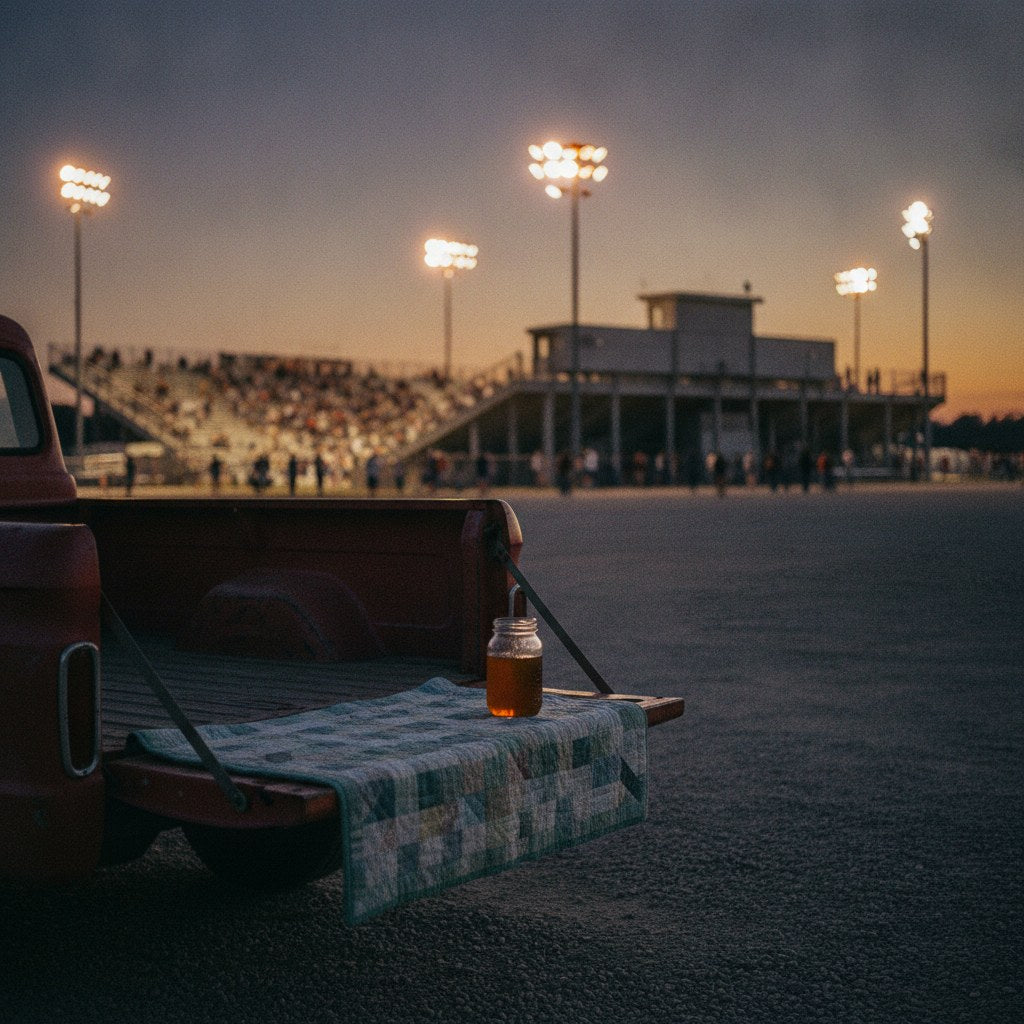
What Friday Night Lights Actually Mean in a Small Town
The friday night lights meaning that most people carry around comes from a book or a TV show — the drama, the pressure, the kid trying to escape a town that expects everything from him. That version is real enough. But it's not the whole thing, and it's not why the tradition keeps going in places where the team hasn't won a district title since 2003.
In a small town, friday night lights are a civic function dressed up as a football game. The scoreboard matters to the players and to maybe forty people in the stands. What matters to everyone else is that the stands are full — that the hardware-store owner is sitting three rows behind the school principal, that the woman who graduated in 1987 drove forty minutes to be there, that the kid selling concessions recognizes half the crowd by name. The game is the excuse. The gathering is the point.
That distinction is worth holding onto, because it explains why homecoming in particular refuses to die even when everything else about small-town institutional life is contracting.

How the Friday Night Lights Tradition Actually Works
Homecoming is structurally different from a regular-season game. A regular game draws the faithful — parents, students, the retired coaches who never really left. Homecoming draws everyone else. It pulls in people who haven't been back since their own graduation, people who moved to Louisville or Nashville or Columbus and tell themselves they've outgrown the place, people who show up because their mother called and said she'd like to see them.
The mechanism is simple and it's been the same for about a hundred years:
- An alumni hook — homecoming exists explicitly to bring former students back, which gives people who left a socially acceptable reason to return without it feeling like defeat.
- A ceremony within the game — the court presentation, the halftime recognition, the crowning — that turns the event into a ritual with roles and meaning beyond the athletic contest.
- A fixed place on the calendar — late September or October, year after year, so it functions like a reunion that nobody has to organize individually.
- A physical anchor — the stadium, the field, the press box that looks exactly the same as it did thirty years ago — that makes the past feel present in a way that's hard to manufacture anywhere else.
Each of those elements does a specific job. The alumni hook solves the activation problem — people need a reason to come back that doesn't require them to admit they miss the place. The ceremony gives the evening weight. The fixed calendar date removes friction. The physical anchor triggers memory in a way that makes people feel, briefly, like time is less linear than it usually seems.
Strip any one of those elements and the thing still limps along. Strip two or three and you have a football game, which is fine, but it's not homecoming.
◆ From the Workshop: When you're smoothing a curved surface with a cabinet scraper and the tool starts to skip and chatter on the concave sections, the problem is that you're holding it flat — a flat scraper only contacts a curve at one point and rocks. Old instrument makers kept a set of curved scrapers, each ground to a slightly different radius, so the cutting edge matched the hollow they were working. The scraper that fits the curve doesn't chatter at all; it just hisses. Traditions work the same way: a ritual that's shaped to the specific contours of a community fits without resistance. Transplant it somewhere it doesn't fit and it rattles.
Frequently Asked Questions
When did high school homecoming traditions actually start in the United States?
The University of Missouri claims the first organized homecoming in 1911, and the tradition spread to high schools through the 1920s and 1930s as communities adopted the returning-alumni concept. By mid-century it was embedded in rural school culture across the South and Midwest, often tied to harvest season scheduling — which is why so many homecoming games still fall in late September or October.
Do small schools with declining enrollment still hold full homecoming weeks, or do they scale back?
Most do scale back the week's events — fewer class floats, a combined court rather than class-by-class royalty — but the game itself and the halftime ceremony almost always survive. School consolidations are the real threat: when two small schools merge, one community's homecoming tradition typically disappears entirely, and that loss tends to hit harder than the merger itself.
Is there research on whether community rituals like homecoming actually affect civic health in rural areas?
Robert Putnam's work in Bowling Alone (2000) documented the broader collapse of civic participation in America and linked it to measurable declines in community trust and wellbeing. While Putnam didn't study high school homecoming specifically, his framework maps directly: shared rituals that bring people together repeatedly over years are exactly the kind of 'social capital' activity his research identified as protective. Rural sociologists at land-grant universities have since applied that lens to school-based community events with similar findings.
Why the Alternatives Keep Failing
Every decade or so, someone proposes a replacement for the homecoming game — a fall festival, a community cookout, a downtown block party. These are good ideas. They almost never stick.
The problem isn't the format. It's that they lack institutional memory. The high school football game has been happening in the same place, on the same kind of October night, for longer than most living residents can remember. That continuity is load-bearing. It means that when a sixty-year-old woman walks through the gate, she's not just attending an event — she's walking into a place where her own seventeen-year-old self is still somehow present. A block party started in 2019 can't do that. It hasn't earned the weight yet.
There's also the school itself as an institution. In a small town, the high school is often the only organization that touches every family regardless of religion, income, or politics. The church down the road draws one congregation. The civic club meets on Tuesdays and skews older. The school draws everybody, and homecoming is the one night a year when that breadth is visible all at once. You can look around the bleachers and see the whole town in one glance. That's genuinely rare, and people feel it even when they can't articulate it.
I've written about Sunday dinner traditions in the South and the same logic applies there — the ritual survives not because it's the most efficient way to eat, but because it's doing social work that nothing else has stepped up to replace.

What Gets Lost When a Small Town Stops Showing Up
The towns that have lost their friday night lights tradition — usually through school consolidation, sometimes through population collapse — tend to describe the loss in terms that sound disproportionate to a football game. They say the town lost its center. They say people stopped knowing their neighbors. They say something went quiet that hasn't come back.
That's not nostalgia talking. It's a fairly accurate description of what happens when a community loses its primary gathering ritual. The informal relationships that form in bleachers and parking lots and concession lines — the ones that make people feel accountable to each other — those don't transfer to a Facebook group. They require physical proximity, repeated over years, in a context that carries shared meaning.
Robert Putnam spent a career documenting what he called social capital — the connective tissue of civic life — and his central finding was that it's built through exactly this kind of repeated, low-stakes, shared experience. A homecoming game is low stakes for the community even when it's high stakes for the players. That's what makes it work. Nobody is asking you to agree on anything. You just have to show up.
The lost art of porch sitting is a smaller version of the same thing — the idea that unstructured time in a shared space does work that we only notice when it's gone.
The Practical Implication: Show Up While You Still Can
If you grew up in a small town and you've been meaning to make it back for homecoming — this year, next year, eventually — the practical implication of everything above is that eventually is doing a lot of heavy lifting. School consolidations happen fast. Enrollment drops, budgets get cut, two schools become one, and the homecoming that anchored your October for eighteen years becomes a memory inside of a single school board meeting.
That's not a prediction. It's just a pattern that's been repeating across rural America for forty years, and it doesn't show signs of slowing.
Showing up is the thing. Not because the team needs your noise — though they do — but because the town needs the count. Every person in those bleachers is evidence that the place still matters, that people still come back, that the lights are worth turning on. That's the friday night lights meaning that doesn't make it into the TV version: it's not about glory. It's about presence.
The southern-life signs in our entryway and porch collection tend to say things out loud that small-town people feel but don't usually announce — and if you want something on the wall that carries a little of that weight, this carved hardwood sign about living your best life is the kind of thing that reads differently after a homecoming night than it does any other time of year.
Go back. Sit in the bleachers. Eat the concession-stand nachos that are somehow both overcooked and undercooked. Watch the kids on the field who have no idea yet how much they'll miss this. The friday night lights will be on. That's enough.
Share:
Hearts and Home: The Surprisingly Personal History of Kitchen Wall Decor
How to Oil a Cutting Board (And Every Other Wood Surface in Your Kitchen) | Bluegrass Gifts