

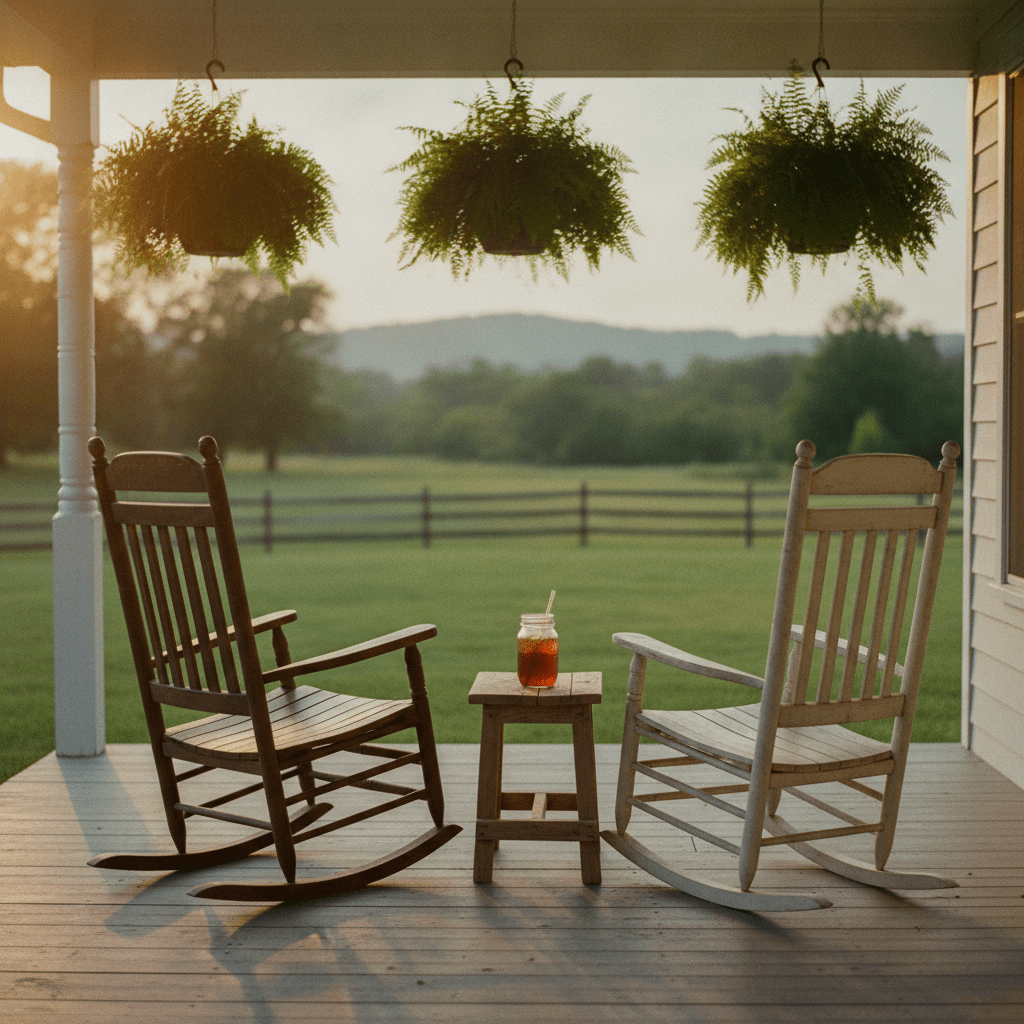
Nothing Easy Is Worth Doing — Except This: Why Porch Sitting Is Easy Worth Doing
You've got seventeen tabs open, a to-do list that keeps reproducing, and a nagging feeling that you should be doing something. And right outside your front door there's a porch. Just sitting there. Empty. Nothing easy is worth doing, the old saying goes — but that saying has been used to justify a lot of unnecessary suffering, and it has never once applied to a good chair and a slow afternoon. Porch sitting is easy worth doing. It costs nothing, requires nothing, and the research says it's quietly one of the better things you can do for your health.
We lost the porch somewhere around the time air conditioning became standard and screens became portable. The front porch used to be the living room, the news feed, and the therapy office all at once. Now it holds a dusty rocking chair and some potted plants we keep meaning to water. That's a shame. Let's fix it.
The Lost Art of Porch Sitting: Why Doing Nothing Is Good for You
Before central air, Southern families built porches the way engineers build pressure valves. The deep overhanging roof kept the sun off. The elevation caught the breeze. The orientation — almost always facing the street — was deliberate. You sat where you could see your neighbors, and your neighbors could see you. That visibility was the whole point.
Sociologists call this kind of low-stakes social contact "ambient community." You're not hosting a dinner party. You're not making plans. You're just present in a shared space, available without obligation. It turns out that kind of contact — a wave, a slow conversation about somebody's garden, watching a kid chase a dog down the sidewalk — is genuinely good for you. Loneliness and isolation are associated with measurably worse health outcomes. The porch was the original preventive medicine.
The covered front porch also has a specific psychological quality that a backyard deck doesn't quite replicate. You're sheltered but not enclosed. You're in public but not performing. It's a threshold space, and threshold spaces give the brain permission to downshift in a way that neither fully indoors nor fully outdoors seems to manage on its own.
What Your Brain Is Actually Doing When You Sit Still
Here's the part that surprises people. When you sit on the porch and do what looks like nothing — watch the light change, listen to the birds, let your thoughts drift — your brain is not idle. It's running what neuroscientists call the default mode network. That's the mental state associated with creativity, self-reflection, emotional processing, and the kind of loose associative thinking that produces your best ideas in the shower.
We've spent twenty years treating that state like a bug. We fill every quiet moment with a podcast or a scroll. The result is a brain that never gets to consolidate what it's learned, never gets to process what it's feeling, and never gets to wander far enough to find something genuinely new. The porch forces the pause. The porch is, in this sense, productive in exactly the way we refuse to credit it for being.
There's also the straightforward matter of stress hormones. We've written before about the physical mechanics of slowing down — the breath, the nervous system, the whole cascade — and the short version is that outdoor stillness lowers cortisol in ways that indoor rest often doesn't. The combination of natural light, ambient sound, and the absence of task-pressure is a specific recipe. The porch delivers all three.
◆ From the Workshop: There's a lesson in woodworking that applies here. When you're fitting a tenon and it's just a hair too tight, the amateur reach is for sandpaper — but sanding end grain removes material unevenly and rounds the shoulder, ruining the fit for good. The right move is one careful pass with a shoulder plane across the cheek of the tenon: an even, measurable shaving the full length of the joint, and suddenly it closes perfectly. A shoulder plane costs more than sandpaper, but it's the difference between a joint that looks right and one that actually is right. Slow and deliberate beats fast and rough every time. The porch already knew that.
Frequently Asked Questions
How long do you actually need to sit on the porch to get a mental health benefit?
Research from the University of Michigan suggests that as little as 20 minutes in a natural outdoor setting measurably lowers cortisol levels. You don't need a full afternoon — though nobody's stopping you. The key is that you're not staring at a screen and you're not multitasking. Just sitting, watching the yard, letting your mind wander. Twenty minutes is a real threshold, not a suggestion.
What if you don't have a covered porch — can you get the same effect from a stoop, a back deck, or even a balcony?
Mostly yes. The covered front porch has a particular social quality — you're visible to the neighborhood, which creates a kind of gentle accountability to stay put — but the mental reset comes from the outdoor exposure and the deliberate idleness, not the architecture. A back deck works. A fire escape works. A camp chair in the driveway works. The porch is the ideal; the point is getting outside without an agenda.
Is there a best time of day for porch sitting, or does it not matter?
Early morning and late evening both have strong cases. Morning porch time — before the phone gets loud — sets a calmer baseline for the whole day and gives you natural light exposure that regulates your sleep cycle. Evening sitting, especially after supper, has a long Southern tradition for a reason: it's a physical signal to your nervous system that the workday is over. If you can only do one, pick whichever you're more likely to actually do consistently.
How to Actually Do It — Because Apparently We Need Instructions Now
The fact that we need a how-to for sitting down says something about where we are as a culture. But here we are. A few things that make porch sitting stick as a habit rather than a one-time experiment:
- Leave your phone inside. Or at least face-down and silenced. The whole point is the absence of demand. One notification and your cortisol is back.
- Pick a specific time and treat it like an appointment. Early morning before the house wakes up, or after supper when the light goes gold — both work. The ritual matters more than the duration.
- Have something in your hands that isn't a screen. Coffee. Sweet tea. A book you're not in a hurry to finish. The hands-occupied brain is calmer than the hands-free brain that starts reaching for a phone out of habit.
- Invite someone, occasionally. The ambient community effect is real. A neighbor who stops to talk for ten minutes, a spouse in the other rocker — that social texture is part of what the porch was designed to provide.
- Let it be boring. Boredom is not the enemy. Boredom is the gateway. The brain that has nothing to do will eventually start doing something interesting entirely on its own.
There's also a case to be made for making the porch itself worth sitting on. Not elaborate — a clean surface, a chair that doesn't hurt your back, maybe something on the wall that makes you smile when you walk past it. Our piece on front porch decor and entryway ideas covers the practical side of that without requiring a renovation budget.
The Southern Tradition That Was Never Just About Leisure
Porch culture in the South wasn't laziness dressed up in rocking chairs. It was community infrastructure. Before phones, before social media, before the evening news, the porch was how information moved through a neighborhood. Who was sick. Who needed help. Who had extra tomatoes. The porch was where you learned that your neighbor's husband had come home from the war, and where you sat with her when he hadn't.
That's not nostalgia for a simpler time — it's a recognition that some of what we've replaced with technology was actually load-bearing. The easy worth doing is often the thing that looks like nothing: showing up, being present, staying visible to the people around you. The porch made that effortless because it was built into the architecture of daily life.
There's a reason finding your happy place at home so often involves a specific spot — a chair, a window, a corner of the yard. We're wired to anchor peace to a place. The porch is one of the oldest and most reliable of those anchors.
If your porch could use a little personality to match the intention, a carved solid-wood welcome sign is the kind of thing that sets the tone before anyone sits down — the sort of thing our entryway, porch, and yard signs are made for. And if you want something specific that captures the whole spirit of this — the slow living, the good life, the deliberate choice to enjoy it — this carved solid-wood living-our-best-life sign is exactly the kind of thing you hang where you'll see it every time you step outside.
Nothing Easy Is Worth Doing — Until You Remember What Easy Worth Doing Actually Costs
The old saying means well. Hard work matters. Effort is real. But somewhere it got twisted into a justification for never stopping, never resting, never letting the afternoon just be an afternoon. The porch is a corrective. It asks nothing of you and gives back more than you put in, which is a pretty good return on investment by any measure.
Sit down. Let the day do what it's going to do. Watch the light move across the yard. The work will still be there when you go back inside. It always is. But so will you — and that's the part worth protecting.
Share:
Anniversary Meanings: The Strange, Sweet History of How Each Year Got Its Symbol | Bluegrass Gifts
Do Bears Mate for Life? Bear Facts That Will Change How You See Them | Bluegrass Gifts