

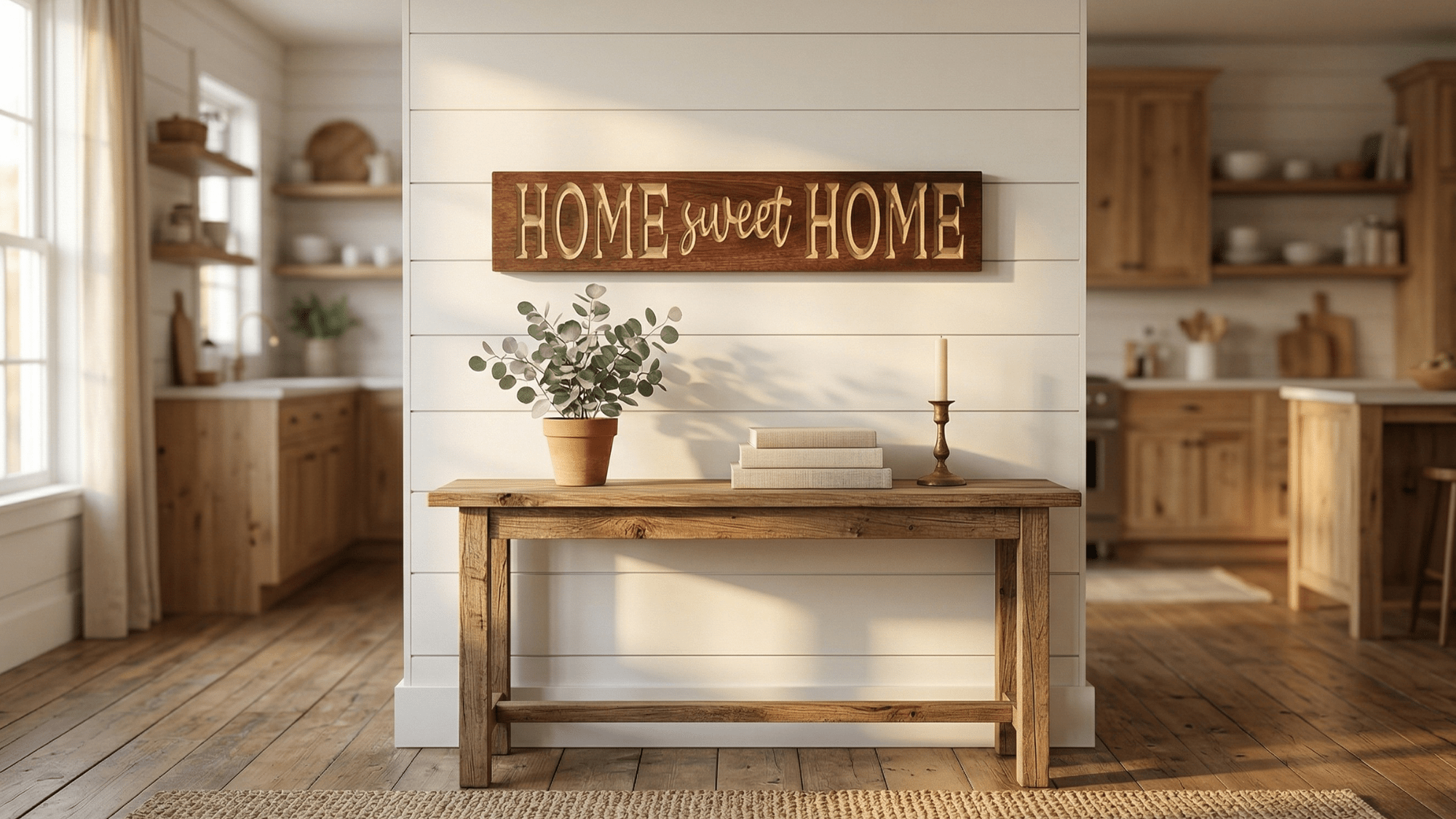
The Complete Farmhouse Home Decor Guide (Room by Room)
Farmhouse style has been the most searched home decor aesthetic for nearly a decade running — and it isn't hard to figure out why. It's not because it's trendy. Trends come and go like a spring storm. It's not because the right television show made it famous at the right moment, either, though that certainly helped introduce it to folks who might never have thought about shiplap before. Farmhouse style has held its ground because it solves something real — something most homeowners feel before they can even put a name to it.
That something is the gap between what a house looks like and what a home actually feels like. The cold kitchen that's technically fine but doesn't feel warm. The bedroom that looks like a nice hotel room but doesn't feel like yours. The living room you've lived in for three years that still doesn't quite feel settled. A paint color won't close that gap. New furniture won't either, at least not on its own. What farmhouse style offers is a different way of thinking about materials entirely — that the most beautiful things in a room are the honest ones. Wood that looks like wood. Cotton that feels like cotton. A worn edge that earned itself over time rather than being faked at the factory.
This guide covers every room in the house, from the kitchen where the family gathers every morning to the front porch that speaks before you ever say a word. We'll talk about what actually works in real homes — not staged ones, not magazine spreads — and why natural wood is the single material that ties every room in the house together. Let's start from the front door and work our way in.
What Farmhouse Style Actually Is — And What It Isn't
Ask a room full of people to describe farmhouse style and you'll get answers that are all partly right. Shiplap. Mason jars. Galvanized metal. Chalkboard paint. Chicken wire. Signs with words on them. These are the surface markers — the things that got attached to the style when it went mainstream — but none of them is the actual point.
The point is materiality. Farmhouse style is a commitment to things made from something real. Cotton instead of microfiber. Cast iron instead of nonstick-coated aluminum. Wood instead of laminate that's meant to look like wood but doesn't quite fool anyone. The aesthetic came from working traditions — the old farmhouse was a practical place, and its beauty came not from decoration for decoration's sake, but from the fact that everything in it was built to be used, built to last, and built from materials that improved with age rather than deteriorating into ugliness.
What it isn't is maximalism. Farmhouse style is not a mandate to cover every surface with signs and stuff every shelf with mason jars until a room looks like a home goods store had a yard sale. The version of this style that ages best in real homes is always edited. There is breathing room. The pieces that made the cut are there because they earned their spot. If you're just getting started and want to understand the range of what works, our handcrafted wood sign collection is a good place to begin seeing what honest materials look like in finished form.

The One Material That Ties Every Room Together
Walk through any well-decorated farmhouse-style home and you'll notice one material showing up in more forms than any other — natural wood. It's in the floors, the furniture, the shelves, the frames, and most deliberately, on the walls. Wood is the through-line. It's what makes different rooms that were decorated at different times with different budgets still feel like they belong to the same house rather than to a sequence of separate decorating decisions someone made while they were bored.
Of all the ways wood shows up in a room, a wood sign is the most singular piece. It's the one item that does two things at once: it brings the warmth and texture of natural material, and it says something specific. A wooden bowl is beautiful and says nothing. A wooden frame holds something else. But a hand-carved wood sign carries a message in the homeowner's own chosen words, in a material that will hold its finish and its form for years without anyone having to fuss over it.
The signs that hold up best over time are CNC-carved from real wood — oak, walnut, cherry, maple — rather than printed on faux-wood surfaces or painted on MDF. The carving catches light in a way that a flat surface physically cannot. On a sunny morning, a carved solid-wood sign reads almost three-dimensional, the letters throwing tiny shadows that shift as the angle of the light changes through the day. That quality cannot be manufactured into a flat piece, no matter how good the print. It's what you get when you cut into real wood.
❖ From the Workshop: In the workshop, the difference between a piece that looks good and a piece that ages well comes down entirely to the base material. Solid wood — real boards, not composites — holds carving detail for years without the edges softening or the finish crazing the way softwoods and engineered materials tend to do. A sign carved from genuine wood at year one looks essentially the same at year ten, maybe better, because the finish has settled and the grain has developed a little character. That's not magic. That's what an honest material does when it's worked correctly from the start.
The Kitchen: Where Every Farmhouse Journey Begins
Most people start their farmhouse decorating in the kitchen, and it makes all the sense in the world. The kitchen is where the family assembles every single morning before the day gets started. It's where the coffee gets made before anyone's quite awake, where the after-school chaos lands at three-thirty every afternoon, where Sunday dinner happens and the whole house smells right for the first time all week. A room that holds that much daily life in it deserves to look like somebody put some thought into it.
Here's the part most folks don't realize: the farmhouse kitchen doesn't ask you for a renovation. It doesn't require new cabinets, a farmhouse sink, or a single weekend with a sledgehammer. It requires wall decor that has some weight to it, a texture or two that feel natural rather than synthetic, and the willingness to leave some counter space empty rather than filling every inch with something that's been there so long you stopped seeing it. A single well-placed kitchen wood sign can shift the entire feel of a kitchen that hasn't had a tool taken to it in fifteen years.
→ Full guide: Farmhouse Kitchen Decor Ideas That Don't Require a Renovation
The Home Bar: Give It a Personality
A home bar should feel like a destination. It should be a spot people gravitate toward because it has a personality, not just because that's where the bottles happen to be stored. Walk into a bar that works — the kind where guests end up without ever quite deciding to go there — and you'll notice something before you notice the liquor selection or the barstools: the walls did the work. They're what made the room a room.
Most home bars fail at this because most home bars have nothing on the walls. They're functional. There's a shelf, some bottles, some glasses, maybe a barstool that's slightly too tall or slightly too short. But the walls are blank, and a bar with blank walls is a shelf that someone put barstools next to. The walls of a bar are where the room decides what it is. A good bar sign isn't decoration — it's a declaration. And it's the first thing anyone reads when they walk in.
→ Full guide: How to Decorate a Home Bar on a Budget
The Bathroom: The Best Return on the Smallest Investment
The bathroom is the most overlooked room in any decorating project. It's small, it's functional, it doesn't get the foot traffic the kitchen does, and it tends to get skipped every time someone starts a decorating sweep because the living room and kitchen feel more pressing. The result is that most bathrooms in most homes are technically complete and completely impersonal — they do their job without saying a single thing about the people who use them.
This is actually an opportunity, because the bathroom is the easiest room to transform for the least money. Small rooms operate on a completely different principle than large ones. In a small space, one right piece doesn't compete with anything — it takes over the room. A sign that would disappear on a kitchen wall is exactly right on the wall across from a toilet. And a bathroom is one of the few places in a house where everyone actually reads what's on the wall, every time, because there's nowhere else to look and they have a minute.
→ Full guide: Rustic Bathroom Decor Ideas That Make Small Spaces Feel Cozy
The Laundry Room: The Most Underestimated Canvas in the House
Nobody volunteers to be in the laundry room. It's not on anyone's list of favorite places to spend an afternoon. But most people will spend somewhere between 150 and 250 hours a year in it — folding, switching loads, hunting for the sock that went missing three weeks ago — and it almost never has a single interesting thing on the wall. The research on this isn't subtle: the physical environment affects how people feel about a task. A bare utility room with nothing on its walls communicates exactly one thing: chore. A decorated one communicates something different.
Funny laundry room signs have become their own decorating category not because they're a trend, but because they work. They take the particular low-grade resentment of folding the same shirts for the thousandth time and turn it into thirty seconds of genuine relief. That's not a small thing when you're looking at another load in the dryer.
→ Full guide: Laundry Room Decor: How to Make the Most Hated Room in the House Look Good
The Bedroom: The Room That Has to Do the Most
The farmhouse bedroom is one of the most searched aesthetics in home decor for good reason — it solves the bedroom's hardest problem. A bedroom needs to be restful enough to actually sleep in, personal enough to feel like yours, and visually settled enough that it doesn't create a low-grade sense of unease every time you walk in. These three things don't always cooperate. The farmhouse bedroom navigates all three by leaning on restraint — fewer pieces, more considered, in materials that feel genuinely warm rather than aspirationally warm.
The wall above the bed is the single most important decorating decision in the room. It's the first thing you see when you walk through the door and the last thing you see before you close your eyes. A single overscaled wood sign — a meaningful word, a verse, a phrase the people who sleep there chose because it means something real to them — is the most reliable piece for that wall in almost any home style.
→ Full guide: Farmhouse Bedroom Wall Decor Ideas (Without Going Overboard)
The Front Porch: Your House's First Word
Your front porch speaks before you do. Before a guest has knocked or rung the bell, before anyone has been welcomed through the door, they've already formed their first impression — from the ten steps between their car and your door. They noticed whether the porch looks like someone cared about it or whether nobody ever thought about it. They noticed whether there's something on the wall beside the door or whether that wall has been blank since the previous owners left. A porch that has been thought about communicates something a blank porch never can, and the difference isn't about money spent.
A front porch sign is the highest-return decorating decision most homeowners never make. A family name carved in real wood above the door is a statement of place — this is who lives here, and they want you to know it before you even knock. Browse our entryway and porch wood signs to see the full range, including styles built to hold up through every season in real outdoor conditions.
→ Full guide: Front Porch Decor Ideas for a Welcoming Entryway
When Rustic Meets Modern: The Style Most People Actually Live With
Pure farmhouse style — the all-in version with distressed everything and mason jars covering every shelf — lives mostly on Pinterest and in staged homes. The version that real people actually live with is almost always a blend. The clean-lined kitchen with one carved wood sign above the stove. The modern sofa with a linen throw and a natural wood coffee table. The bedroom with smooth, minimal furniture and one statement piece above the headboard that carries all the warmth the room needs. This is the style most homes actually end up with once the idealized vision runs into the reality of what you already own.
The blend has specific rules, and getting them wrong is how homes end up looking like two different people decorated different rooms without speaking to each other. Getting them right produces something that feels warmer than modern and cleaner than rustic. We walk through the specifics in our guide to mixing rustic and modern decor without it looking messy — it's the post that makes every other decorating decision in this silo easier once you've read it.
→ Full guide: How to Mix Rustic and Modern Decor Without It Looking Messy
Where to Start When You Don't Know Where to Start
The most common farmhouse decorating mistake isn't a stylistic one. It's a sequencing one. Somebody decides they want the look, buys six things at once because they're all on sale, and ends up with a room that has farmhouse elements scattered across it rather than a room that actually feels farmhouse. The pieces compete with each other because no single one of them was allowed to establish the direction first.
The right sequence is simple, and it's worth saying plainly: pick one room. Pick one wall in that room. Put one thing on it — not three, not a gallery wall, one. A single well-chosen wood sign above the stove. A single meaningful verse above the bed. A family name sign on the porch. Live with it for a few weeks. If it makes the room feel better every time you walk in — if it earns its wall — then add the next thing. If it doesn't, the mistake is small and easily fixed.
The homes that look the most put-together aren't necessarily the ones where the most money was spent. They're the ones where every single piece made the cut.

Keep the Story Going
Each room in this guide has its own full post. Start with the space you spend the most time in, or the one that's bothered you the longest.
→ Farmhouse Kitchen Decor Ideas That Don't Require a Renovation
→ How to Decorate a Home Bar on a Budget
→ Rustic Bathroom Decor Ideas That Make Small Spaces Feel Cozy
→ Laundry Room Decor: How to Make the Most Hated Room in the House Look Good
→ Farmhouse Bedroom Wall Decor Ideas (Without Going Overboard)
→ Front Porch Decor Ideas for a Welcoming Entryway
→ How to Mix Rustic and Modern Decor Without It Looking Messy
Frequently Asked Questions
What's the difference between farmhouse style and shiplap and mason jars everywhere?
Shiplap and mason jars are decorations, not the style itself. Real farmhouse decor is about materiality — choosing wood over laminate, cotton over microfiber, cast iron over coated aluminum. Those surface markers became shorthand for the look once it went mainstream, but a room full of signs and jars misses the point entirely. The point is honest materials that age well, not clutter.
Is farmhouse style still in style or is it outdated now?
It's held on for nearly a decade of searches, which tells you it's not a passing trend. Farmhouse style solves a real problem — the gap between a house looking finished and actually feeling like home. That's a need paint colors and new furniture alone can't fix, so the style keeps mattering long after the television shows that popularized it have moved on.
What material ties farmhouse decor together in every room of the house?
Natural wood. It shows up in the kitchen, the bedroom, the living room, and the front porch, and it's the one material that reads as honest in every setting without trying too hard. Wood earns its wear over time instead of faking it, which is the whole idea behind farmhouse style — real materials that get better looking the longer you live with them.
Share:
Mother's Day Gifts for Grandma — Funny & Sentimental | Bluegrass Gifts Kentucky
Farmhouse Kitchen Decor Ideas That Don't Require a Renovation | Bluegrass Gifts