

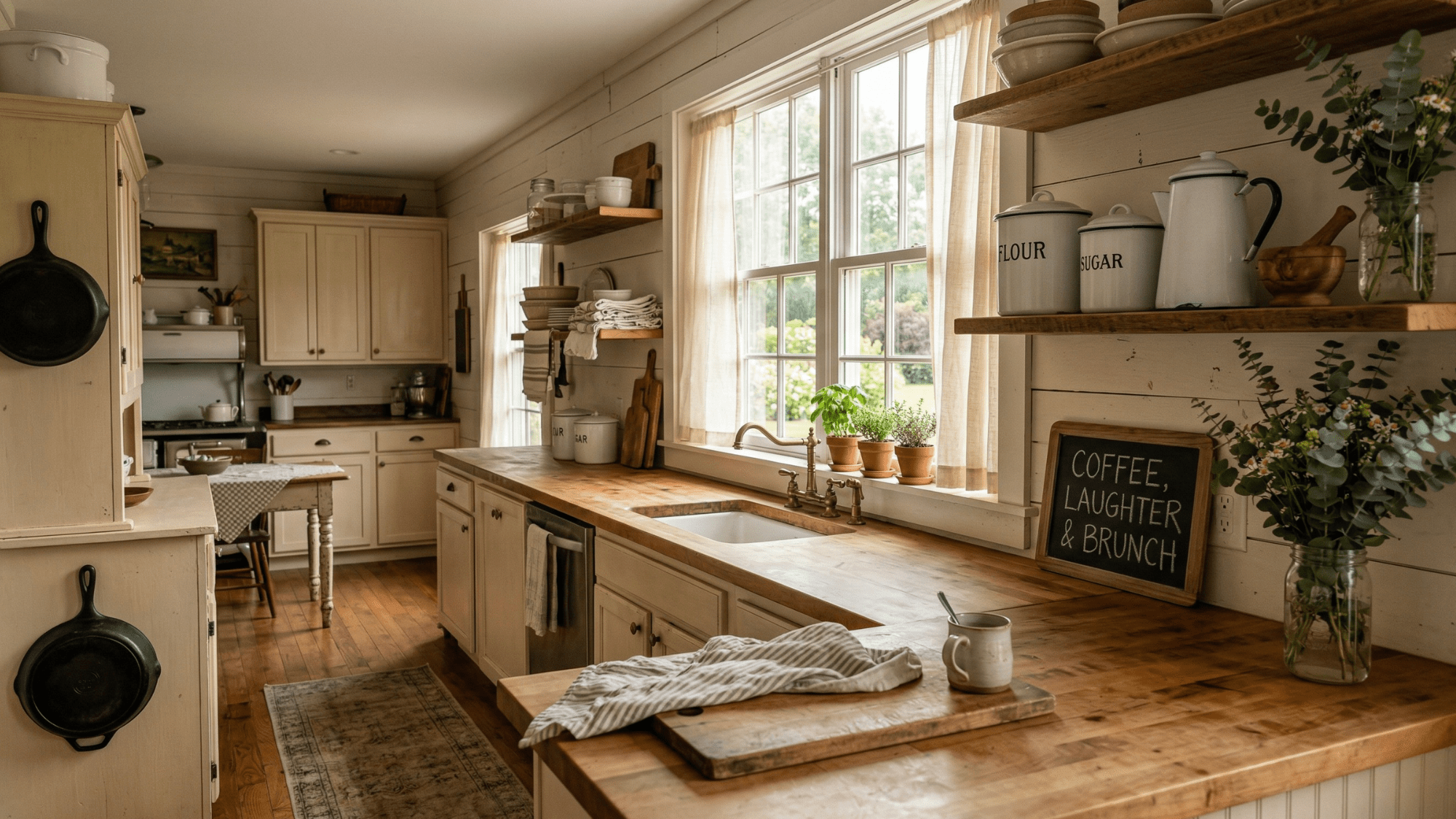
Farmhouse Kitchen Decor Ideas That Don't Require a Renovation
Here's the thing nobody says out loud about farmhouse kitchens: the ones that look best in real homes — not staged ones, not listing photos, not the ones on television — almost never involved a renovation. They involved a decision. A decision that the walls had been blank long enough, that the room feeding everyone in the house every single day deserved to feel like it was put together with some care and intention. If you're approaching this as part of a whole-house update, our complete room-by-room farmhouse home decor guide lays out the full framework before you dig into any individual space.
You don't need shaker cabinets or a farmhouse apron sink. You don't need to retile, open up the layout, or take a weekend off work to swing a sledgehammer at perfectly functional walls. You need wall decor with some weight to it, a couple of textures that feel honest rather than synthetic, and the willingness to stop filling every inch of counter space just because the counter happens to be there. The farmhouse kitchen is not a remodel. It's a point of view.
Why the Kitchen Walls Are More Important Than Any Appliance
Every kitchen that gets used — really used, daily, by a real family — becomes a command center. The coffee station is set up by six-thirty. The homework gets done at the kitchen table because that's where mom is. The mail lands on the counter by the door. The table never fully clears because somebody's always about to sit back down. This room is where the family actually lives, and it looks like it, which makes decorating it a different kind of project from decorating a living room that mostly exists to be looked at.
The mistake most people make is treating the kitchen walls as something to address once the functional stuff is settled. But here's the practical reality: the counter changes every hour. The table gets cleared, covered, and cleared again. The appliances are moved and rearranged when things get shuffled around. The wall above the stove, though — that wall is the same at seven in the morning as it is at seven at night. Whatever is on it gets seen by everyone in the room on every visit. That is the most reliable decorating opportunity in your kitchen, and most homeowners have left it blank for years.

The Wall Above the Stove: Prime Real Estate You're Probably Wasting
If you have a range hood or a tile backsplash behind your stove, you already own the most visible wall in your kitchen — you may just not have thought about it that way. This wall is seen from the kitchen table, from the living room if your plan is open, from the entry if the kitchen is near the front of the house. It gets seen constantly, at a distance, by people who are sitting or standing still and have time to notice what's there. That means whatever goes on it needs to read clearly from across the room, not just when you're standing right in front of it.
A horizontal wood sign works especially well above a range because it mirrors the horizontal line of the stove or hood beneath it, and because the natural grain of real wood reads beautifully against tile or a painted wall. The words matter here: something that refers to the kitchen and what happens in it — gathering, feeding people, cooking with care — feels specific and intentional. Something generic doesn't earn the wall.
Here's the sizing question people ask us most: how wide should the sign be? For a wall above a standard 30-inch range hood, plan on a sign that's at least 24 inches wide — anything narrower disappears at distance. For a larger range or a 36-inch hood, go 30 to 36 inches. Go as wide as the space allows before you hit cabinetry or a corner. The instinct is always to go smaller than the space actually calls for, and it almost always reads as undersized once it's on the wall. Browse the kitchen signs collection">kitchen signs collection — each listing includes full dimensions so you can measure before you order.
Light Changes a Wood Sign the Way It Changes Nothing Else
Most kitchens have a window above the sink, and the wall on either side of that window is some of the best-lit real estate in the house. This is where a CNC-carved wood sign does something that printed art or framed photos simply can't: the depth of the carving catches the changing angle of the light throughout the day. At nine in the morning with flat overcast light, a carved sign reads clean and warm. At four in the afternoon with low western sun cutting across it, the same sign looks almost three-dimensional — the letters throwing small shadows that give the piece a whole different character. You get a sign that's a slightly different object at different times of day, and after a few weeks of living with it, you start to notice it fresh again on a good afternoon.
If the window wall is taken, the next-best location in most kitchens is the wall that's visible from the main entry into the room — the wall your eyes go to first when you walk in. Whatever is on that wall sets the tone for the entire kitchen before you've even looked at anything else. A blank wall there communicates that nobody finished the job. One right piece communicates the opposite.
❖ From the Workshop: There's a concept in cabinet-making called the "show face" — the side of a piece that the person who lives with it sees every single day. Everything that matters about the craft is concentrated there: the grain selection, the finish, the joinery. The walls of a kitchen are the show faces of the room. The cabinets are the support structure. When you decide what goes on those walls, you're deciding what your kitchen says about the people who cook in it. Take that decision as seriously as you'd take picking the right cabinet hardware. It deserves the same attention.

Open Shelves: The Farmhouse Element That Goes Wrong Most Often
A kitchen sign handles the walls. Everything else in a farmhouse kitchen is about surface — what sits on the counter, what lives on the shelves, what gets displayed rather than hidden. The farmhouse approach here is simple and worth stating plainly: if it's made from a real material and it's functional, it's allowed to be visible. A wooden cutting board propped against the backsplash. A ceramic crock holding utensils. A cast-iron pan stored on the stove rather than buried in a cabinet. Items that are built from honest materials and beautiful enough that hiding them would actually be a waste. This same principle of honest materials carries into other rooms — the rustic bathroom applies it the same way, with a wooden tray on the vanity doing the same work as a cutting board on the counter.
Open shelving is the farmhouse kitchen's most visible element outside of the walls, and it's the easiest to get wrong. The rule is strict and worth applying without mercy: put on open shelves only what you'd be comfortable showing a guest who walked in unannounced. Everything else belongs in a cabinet. A shelf with twelve items crowded together isn't picked — it's clutter at a slightly higher elevation. Three items, well chosen, with actual breathing room between them, is what picked actually looks like in practice.
Caring for Your Kitchen Wood Sign
Wood signs in a kitchen are in a more demanding environment than anywhere else in the house — heat from the stove, cooking steam, occasional splatter. Here's what actually keeps a quality solid wood signs looking right over time. Wipe it down with a barely damp cloth when it needs cleaning — never soak it or spray anything directly onto the wood. Keep it at least twelve inches above an active cooking surface where steam and heat rise steadily. Once a year, a light coat of furniture wax or beeswax-based polish keeps the finish conditioned and prevents the wood from drying out. A well-cared-for solid wood signs will outlast the kitchen cabinets around it.
One more practical note: if you're mounting above a gas range, make sure the sign isn't directly in the heat column above the burners. The wall beside the hood or the wall above the range hood vent is a better location than directly above the open flame. Common sense here, but worth saying — and a reason to mount at least 18 to 24 inches of clearance above any open burner.
The Change That Does the Most for the Least
If there is one change in a kitchen that costs the least and changes the most, it is putting something real on the most visible wall in the room. A blank wall is a sentence with a word missing. The kitchen has a counter, appliances, cabinets, a table, chairs — everything it needs to function. The wall is the only element that can say something about the people who live there. This same logic holds in every functional room in the house, including the laundry room, which we cover in its own full guide. Fill the wall with something that earned its place.
Everything else — the linen runner, the ceramic containers, the cutting board, the herb on the windowsill — those are the second paragraph. The sign is the first sentence. Write it clearly.

Keep the Story Going
If the kitchen is your starting point, the rest of the house gets easier once you get one room right.
→ The Complete Farmhouse Home Decor Guide (Room by Room) — Hub Post
→ Rustic Bathroom Decor Ideas That Make Small Spaces Feel Cozy
→ Laundry Room Decor: How to Make the Most Hated Room in the House Look Good
Frequently Asked Questions
How do I make my kitchen look farmhouse without renovating it
Focus on the walls, not the cabinets. A weathered wood sign, a set of iron hooks, or a big piece of wall decor above the stove does more for the farmhouse look than new counters ever will. Add a couple of honest textures like galvanized metal or real wood, then pull back on counter clutter. That's the whole formula, no contractor required.
What should I put on the wall above my stove
Something with real weight and texture, not a flimsy print. Think a carved wood sign, a vintage-style scale, hanging copper pots, or a small shelf with a few crocks. This wall gets seen constantly from the table and the living room, so it earns something substantial rather than an afterthought purchase from the clearance aisle.
Do I need a farmhouse sink or shaker cabinets for a farmhouse kitchen
No, and that is honestly the biggest myth out there. The farmhouse look comes from decor decisions, not structural ones. Wall pieces with real texture, a few honest materials like wood and iron, and less stuff crowding the counters will get you there. Shaker cabinets and apron sinks are nice, but plenty of great farmhouse kitchens never had either one.
Share:
The Complete Farmhouse Home Decor Guide — Room by Room | Bluegrass Gifts
How to Decorate a Home Bar on a Budget — Signs, Lighting & Style | Bluegrass Gifts