

Front Porch Decor Ideas for a Welcoming Entryway
There's something about a front porch in the South that goes beyond curb appeal. A porch isn't just architecture — it's an invitation. It's the place between the street and the door where the transition happens, where the outside world gives way to something that belongs to a specific family. A porch that has been thought about communicates that. A porch that hasn't communicates something different, and visitors notice the difference before they've ever raised their hand to knock.
Before anyone has rung the bell, before you've said a word, your front porch has already spoken for you. It's told your guests whether the people inside are the kind who pay attention to the small details, who made choices about the space beyond their door on purpose. In our room-by-room farmhouse home decor guide, the porch is treated as the introduction — the sentence that establishes the character of everything that comes after it.
The Three-Second Window
First impressions of a space happen in approximately three seconds. This isn't a metaphor or an approximation — it's a well-documented feature of how visual perception works. The brain processes what it sees in broad strokes before the conscious mind begins analyzing details: warm or cold, cared-for or neglected, welcoming or indifferent. By the time a visitor reaches your front door, they've already completed their first-pass read of the space. Everything that happens after that is either confirming or revising it.
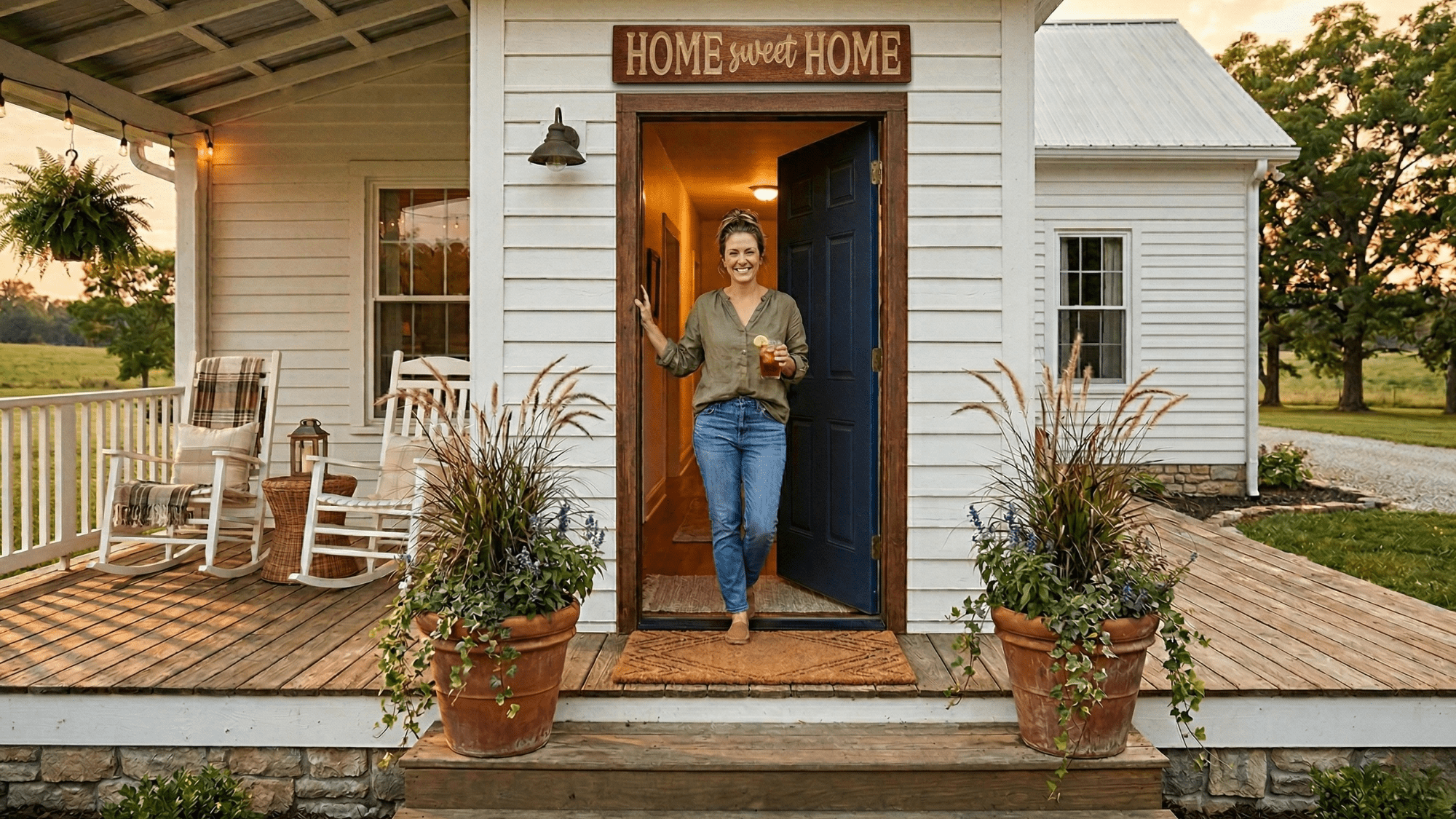
The most effective porch decor works with that three-second window rather than against it. A family name sign above the door reads in an instant: someone lives here, and they wanted you to know their name before you knocked. A welcome sign beside the door delivers its message before conscious thought has to process it. A pair of matching planters flanking the door creates a visual frame — the entrance is an entrance, not just a hole in the wall that happens to have a handle on it. These are immediate impressions, which is exactly what the three-second window calls for.

The Porch Sign Is Different From Every Other Sign in the House
Every other sign in a home is interior — seen only by the people you've already invited in. A porch sign is exterior. It's the only decorating decision you make for everybody, not just the people you welcome through the door. The neighbor walking by reads it. The delivery driver reads it. The person who hasn't met you yet reads it. In that sense, it's your home's public statement — the only piece of decor that speaks to strangers. Where the bedroom sign is the most private piece in the house, seen only by the people who sleep in that room, the porch sign is the most public — and that distinction matters for what it should say.
Interior signs can be personal, funny, specific to the household's private culture. A porch sign should say something that works for anyone who sees it — something that communicates welcome, identity, or belonging without requiring context to understand. A family name does this perfectly. It's the most honest possible statement: these people live here, this is their place, and they're not keeping it a secret. A welcome sign does it with warmth. An established date — "Est. 2014" — does it with permanence, suggesting that whatever this is, it has been here a while and intends to stay.
❖ From the Workshop: Every building presents a face to the world, whether or not the people inside have thought about what that face communicates. In woodworking, the difference between a piece with a properly finished face and one without is apparent from the first moment you see it. The finish is not the most structurally important part of the piece. But it's the most humanly important part, because it's the part that greets the person who encounters it. Your front porch is the finish of your home. Everything you put there — or leave off — shapes what the house says before you ever open the door
Where to Put It: Placement Options for Every Porch Type
Placement on a front porch is more specific than in interior rooms, because the options are genuinely limited by architecture. There are essentially three good locations: above the door, beside the door at eye level, and on or near the porch railing or against the house wall beside the steps. Each has a different character and calls for a different kind of sign.
Above the door is the most visible location from a distance and is ideal for family name signs or short, bold text that needs to read clearly from the sidewalk or driveway. This position calls for a sign wide enough to span the door frame with comfortable breathing room — too narrow and it gets lost against the siding; too wide and it overhangs in a way that reads as out of scale. Lettering should be large enough to read clearly from fifteen to twenty feet away, which means at least two-inch-tall letters for most viewing distances.
Beside the door at eye level is the most personal location — seen up close, at the exact moment of arrival. This spot is ideal for a welcome sign, a family motto, or a seasonal piece you swap out through the year. Browse the entryway and porch signs collection to see the full range of sizes — each listing includes mounting recommendations for above-door versus door-adjacent placement so you can match the sign to the specific location you have in mind.
Outdoor Durability: What Actually Holds Up
A covered front porch is a relatively forgiving environment for a quality solid wood signs. If the sign is under a roof and protected from direct rain, a finish coat of exterior-grade poly or spar urethane will hold up well through multiple seasons in most climates — including hot Southern summers and wet springs. For Southern humidity specifically, allow some airflow around the sign rather than mounting it flush against a wall with no gap. Wood breathes, and a little space behind the sign prevents moisture from building up between the back of the piece and the siding.
Direct weather exposure — a sign on a post at the end of a driveway, or mounted on the face of a mailbox structure with no roof overhead — requires a heavier hand with the exterior finish and more frequent maintenance. If the sign is going somewhere that sees direct rain and sun, plan to refresh the top coat every year or two with a light sanding and a fresh coat of exterior finish. The wood itself will outlast any finish coat; it's the finish you're maintaining, not the sign.

What Goes Around a Porch Sign
The sign is the anchor. What goes around it either supports it or competes with it. The simplest composition that works across the broadest range of house styles: two matching planters on either side of the door, a natural fiber doormat, and the porch sign above or beside the door. This arrangement creates a frame around the entrance without demanding that any individual element be perfect. It reads as composed from a distance and welcoming up close.
Plants do the most work alongside a sign because they bring the one thing carved solid-wood can't provide on its own: movement and life. A planter with one upright plant and one trailing or spreading plant creates visual interest at multiple heights and softens the structural elements — the sign, the door, the architectural lines of the house. Seasonal changes in the planters keep the porch looking current without requiring you to change anything else. This principle of pairing a statement piece with organic elements and breathing room applies just as directly to the farmhouse bedroom decor guide — one anchor, natural supporting textures, and space for everything to settle.
Keep the Story Going
The porch is where your house greets the world. The bedroom is where you greet yourself. Both are worth the same attention.
→ The Complete Farmhouse Home Decor Guide (Room by Room) — Hub Post
→ Farmhouse Kitchen Decor Ideas That Don't Require a Renovation
→ Farmhouse Bedroom Wall Decor Ideas (Without Going Overboard)
Frequently Asked Questions
What should I put on my front porch to make it welcoming?
Start with three things that work fast: a family name sign near the door, matching planters to frame the entrance, and a welcome sign that reads clearly from the walkway. These pieces do their job in the three-second window before anyone knocks. Skip clutter. A porch that says something clear beats one that says a little of everything.
What should a front porch sign say?
Keep it simple and personal, since a porch sign is the one piece of decor strangers actually read. A last name, an established date, or a short phrase works better than anything long or clever. The goal is instant recognition, not a paragraph. Think of it as your porch introducing your family before you've said a word.
Does front porch decor really matter for first impressions?
Yes, and the research backs it up. People form a first impression of a space in about three seconds, reading it as warm or cold, cared-for or neglected, before they consciously notice a single detail. Your porch makes that read before a visitor ever rings the bell, so what's out there is already speaking for the people inside.
Share:
Farmhouse Bedroom Wall Decor Ideas — Without Going Overboard | Bluegrass Gifts
How to Mix Rustic and Modern Decor Without It Looking Messy | Bluegrass Gifts