

Laundry Room Decor: How to Make the Most Hated Room in the House Look Good
Nobody chooses to be in the laundry room. It's not a destination anyone lists when somebody asks what they like about their house. It's a requirement — a room that shows up on the schedule several times a week whether you want it there or not, that claims an hour of your time without asking, and that offers nothing pleasant in return except clean clothes and the small satisfaction of having crossed something off the list.
And yet most people spend somewhere between 150 and 250 hours a year in it. That's a significant chunk of life in a room with nothing on the walls, institutional lighting, and the particular low-grade dread that comes from a task you cannot defer indefinitely. There is a simple and practical case to be made that this room deserves some attention — the same case our complete farmhouse home decor guide makes for every functional room in the house: the rooms you use most, not the rooms you show off most, are the ones worth decorating first.
Here is that case, and here is exactly how to make the most of it.
What Your Brain Does in a Room With Nothing on the Walls
The effect of the physical environment on how people feel and perform is not a soft concept — it's well-documented and not subtle. People work better, feel less stressed, and perceive tasks as less effortful when the space they're working in is pleasant rather than institutional. This is why good hospitals spend real money on their waiting rooms. It's why office designers know that windows and plants and daylight increase productivity in measurable ways. The environment is not separate from the experience of being in it — it is part of the experience, whether or not you're consciously aware of it.
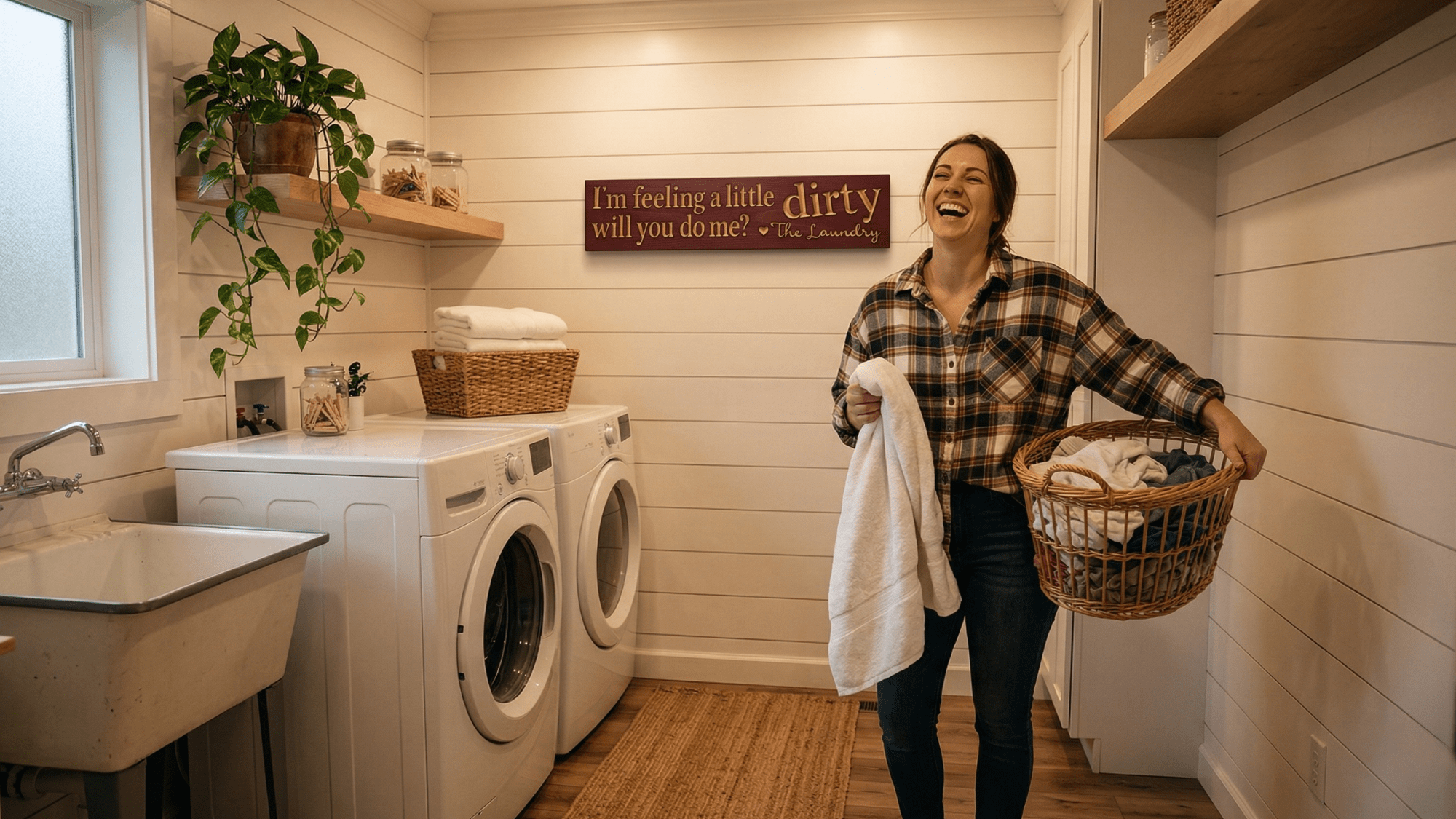
The laundry room version of this is straightforward. A bare utility room with white walls and overhead fluorescent light communicates exactly what it is: a chore in architectural form. A room with a rug on the floor, a sign on the wall, and warm lighting instead of institutional light communicates something different — that someone cared enough to make a decision here. That is not a trivial shift. This is the same logic that explains why a single farmhouse kitchen sign above the stove changes how a whole kitchen feels — the environment signals intention, and intention changes how we experience the space.
 wood sign reading "I'm Feeling a Little Dirty Will You Do Me The Laundry" centered on white shiplap above white front-load washer and dryer, wicker basket of neatly folded white towels on dryer top, small succulent in terracotta pot on floating wood shelf, natural jute runner on floor, warm natural window light" style="float: none;">
Why Humor Is Exactly the Right Tone for This Room
The laundry room is one of the rare spaces in a home where the correct emotional register is humor — and not in a generic, mass-produced way. In an honest way. In the way that takes what this room actually is and what actually happens in it — the cycle that never ends, the socks that vanish without explanation, the pile that comes back faster than you can get through it — and names those things directly, with the kind of specificity that only comes from someone who has been folding laundry for years.
The reason humor works in this room specifically is that the task is resistant to inspiration. A motivational quote about excellence doesn't land in a laundry room. Beautiful abstract art doesn't land here either. What lands is the thing that names the experience accurately — that takes the low-grade resentment of folding the same shirts for the thousandth time and turns it into a shared joke. A sign that makes you genuinely laugh every time you go in to start a load is a small but real gift. Multiply that by 150 visits a year and it adds up to something worth noticing.
❖ From the Workshop: In the workshop, there is a category of work called repetitive work — the cuts and passes and setups you do fifty times in an afternoon, not because any individual one is interesting, but because they add up to something. The craftsman who figures out how to make that repetitive work bearable — through rhythm, through a good audiobook, through the specific satisfaction of watching a rough pile of lumber turn into something finished — is the one who actually completes the piece. The laundry room is repetitive work. The sign is the thing that helps you pick up the rhythm instead of dreading the pile.
What Good Laundry Room Humor Actually Sounds Like
The best laundry room signs aren't the ones that are most shocking or most irreverent. They're the ones that are most accurate. The ones that name something so specifically true about the laundry experience that anyone who reads it — which is everyone who has ever done a load of laundry — has an immediate reaction of pure recognition.
The disappearing sock is always true. The pile that regenerates before you finish the last one is always true. The question of whose turn it was is always true. The fact that the machine can wash and dry the whole thing but somehow can't fold is always and infuriatingly true. Signs that land in laundry rooms hit one of these notes with specificity rather than generality. Browse the laundry room signs collection with that filter in mind — you'll know which ones have the quality of recognition and which ones are just filling wall space.

The Four Changes That Transform a Laundry Room
The sign is the most visible change. The other three that cost the least and do the next most work are lighting, flooring, and shelving. Swap the overhead bulb — or the whole fixture if you can — to a warm-toned LED in the 2700 to 3000 Kelvin range. This single change converts the room from institutional to human for the cost of about six dollars. The difference between cool fluorescent and warm LED light in a small utility room is not subtle. It's the difference between a room that feels like a chore and a room that doesn't.
A simple jute or cotton runner in front of the machines defines the working space visually and adds enough physical softness underfoot to make the standing-and-folding part less punishing on the legs and back. If the floor is cold tile, this matters more than it sounds. And if space allows, open shelving above the machines gives detergent, dryer sheets, and a small plant an actual home rather than just piling on top of the machines. A shelf is not glamorous, but it is the difference between a counter with three things stacked on it and a room where things are actually stored. This is the same four-element formula that works in a rustic bathroom makeover — a sign, warm lighting, a rug, and a shelf with something personal on it.
These four things — sign, warm light, a rug, a shelf with something real on it — constitute a laundry room that is fundamentally different from the one most people have. None of them require renovation. All of them are reversible. All of them together make the room that holds the most involuntary hours of your week feel like a choice rather than a sentence.
Keep the Story Going
The laundry room and the kitchen are the two functional rooms most people ignore. Both benefit from the same principle: a wall with something on it says someone was paying attention.
→ The Complete Farmhouse Home Decor Guide (Room by Room) — Hub Post
→ Farmhouse Kitchen Decor Ideas That Don't Require a Renovation
→ Rustic Bathroom Decor Ideas That Make Small Spaces Feel Cozy
Frequently Asked Questions
What is a good funny sign for a laundry room
Something that plays on the chore itself works best, like a sign about getting things dirty or losing socks. Puns about detergent, folding, or the never-ending pile of clothes land well because everyone doing laundry has felt that exact frustration. Keep the wording short so it reads fast from across the room, not like a paragraph on the wall.
How do I make my laundry room look less like a utility room
Swap the overhead fluorescent for a warmer bulb, add a rug on the floor, and hang one wood sign above the machines. Those three changes cost little but signal that someone made a decision in that space instead of leaving it bare. A small shelf with a plant or folded towels finishes the look without cluttering a room you still need to work in.
Is it worth decorating a room you only use for chores
Yes, because you likely spend 150 to 250 hours a year in that room, which is more time than most people give their guest room. Research on physical spaces shows people feel less stressed and find tasks less effortful in pleasant environments versus institutional ones. A laundry room gets used constantly, which makes it a better candidate for decor than a room saved for company.
Share:
Rustic Bathroom Decor Ideas That Make Small Spaces Feel Cozy | Bluegrass Gifts
Farmhouse Bedroom Wall Decor Ideas — Without Going Overboard | Bluegrass Gifts