

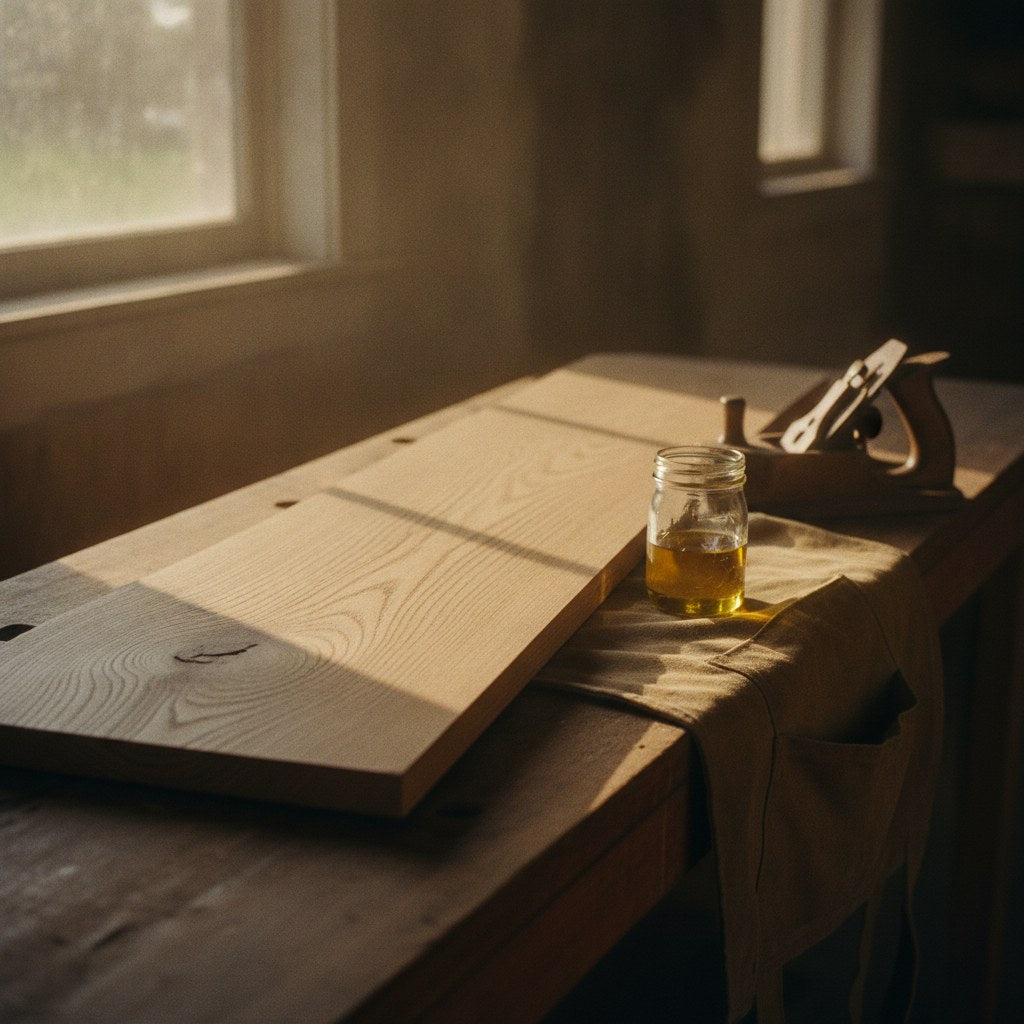
What Wood Grain Patterns Are Actually Telling You
Pick up any board and you're holding about a hundred years of weather, competition, and slow decisions made by a tree that had no idea it would end up in your hands. Wood grain patterns are the physical record of all of it — every drought year, every good rain, every branch that fell and left a knot, every decade the tree leaned slightly toward the light. Most people look at grain and see decoration. Makers look at it and see information.
Learning to read wood grain is not a mystical skill. It's pattern recognition, and once you know what the patterns mean, you can't un-see them. You'll start reading every tabletop in a diner, every hardwood floor in a church, every board at the lumber yard before you've even picked it up. That's the point.

The Difference Between Straight, Interlocked, and Wild Wood Grain
Straight grain is what most people picture when they think of wood — parallel lines running cleanly along the length of the board. Trees that grow fast and vertical in open conditions tend to produce it. It's cooperative wood. It planes easily, splits predictably, and finishes without much drama. Ash and poplar are reliable straight-grain species. So is most construction-grade pine, for better or worse.
Interlocked grain is where it gets interesting. Some tropical species — and occasionally domestic ones like elm — grow fibers that spiral around the trunk in alternating directions, layer by layer. When you rip a board from that trunk, the grain on the surface appears to run one way, then reverses a few growth rings later. This is why elm splits so badly and resists being riven (split along the grain). The tree did that on purpose, structurally speaking. It makes the wood almost impossible to split cleanly, which is exactly why elm was historically used for wheel hubs — the interlocked grain kept the hub from splitting under load.
Wild or irregular grain shows up around crotches, knots, burls, and anywhere the tree had to redirect growth around an obstacle or injury. The fibers swirl and compress and do what they need to do to keep the tree standing. The resulting patterns can be visually spectacular — burl veneer exists because of this — but they're also the most unpredictable to work. A tool that's cutting beautifully in one direction will tear out catastrophically two inches later when the grain reverses on you.
If you want to go deeper on how different species behave under tools and finish, our post on walnut versus oak wood personality covers the species comparison in more practical terms.
How to Read the Growth Rings and What They Reveal
The growth rings visible on the end grain of a board are the tree's annual report. Each ring represents one year — a light band (earlywood, grown in spring when the tree is putting on mass quickly) and a dark band (latewood, grown in summer when growth slows and the wood gets denser). Together they make one ring. Count them and you know roughly how old the tree was.
But the spacing tells you more than the count. Tight rings mean slow growth — a tree crowded by competitors, growing on a rocky slope, or surviving a stretch of dry years. Wide rings mean good conditions: open canopy, reliable rainfall, deep soil. A board with very tight rings is generally denser and harder than one with wide rings from the same species, because the latewood makes up a higher proportion of each ring. That's why old-growth lumber — cut from trees that spent centuries growing slowly in a closed forest — is famously harder and more stable than second-growth lumber from trees that shot up in thirty years on cleared land.
Knots are where branches were. A tight, dark knot means the branch was alive when the tree was cut — the wood fibers curve around it and lock it in place. A loose knot with a dark ring around it means the branch died while the tree kept growing, and the trunk simply grew around the dead stub. That second kind will eventually work its way out of a board. Plan accordingly.
◆ From the Workshop: When you're rounding the edge of a board with a hand plane and the shaving keeps tearing instead of coming off clean, check which direction you're working around the curve. On a convex edge, the grain climbs and dips as you move around the profile — what cuts perfectly on one side of the arc will tear on the other. Rotate the plane to follow the grain downhill and the shaving goes from ragged to ribbon in a single stroke. Old chairmakers called it 'chasing the grain around the corner,' and it's the whole reason a curved edge takes more attention than a flat one.
Frequently Asked Questions
Can the same species of tree produce dramatically different grain patterns in different boards?
Yes, and more than most people expect. Two boards ripped from the same log can look almost unrelated depending on where in the log they came from and at what angle. A board cut through the center (through the pith) will show wide, cathedral-arch grain; one cut from the outer edge of the same log might show tight, nearly parallel lines. The tree is consistent — the cut is the variable.
Does wood grain direction affect how a finish absorbs into the wood?
Significantly. End grain — where you're looking straight down the length of the wood fibers — absorbs stain and finish much faster and deeper than face grain, which is why end grain often goes almost black while the face stays lighter. If you're finishing a piece with exposed end grain, sealing it first with a diluted coat of finish before your main coats will even out the absorption and prevent that dark blotchy look.
What is 'figured' wood, and is it the same thing as unusual grain?
Figured wood is a category of unusual grain, but not all unusual grain qualifies as figured. Figure specifically refers to optical patterns — chatoyance, shimmer, ripple — caused by irregular fiber growth that reflects light differently at different angles. Curly maple, quilted maple, and bird's-eye maple are classic examples. Unusual grain might just mean the lines run at an odd angle; figured wood actively moves when you tilt it in the light. It's also why figured lumber costs considerably more.

How to Use Wood Grain to Choose the Right Board Before You Cut
This is where reading grain pays off in actual time and money saved. The goal before any cut is to understand what the board wants to do — because it will do it whether you planned for it or not.
Start at the end grain. Look at how the growth rings curve across the end of the board. This tells you which face of the board is the crown side (rings curve upward, like a smile) and which is the pith side (rings curve downward). When wood moves with humidity changes, the crown side tends to cup upward. Knowing this lets you orient boards deliberately — in a glue-up, alternating crown-up and crown-down boards helps the panel stay flat. In a tabletop, you want to know which face will be up so you can plan for the movement instead of fighting it after the fact.
Then look at the face grain — the long surface of the board. Run your hand along it lightly and watch how the grain lines behave near the edges. If the lines angle toward the surface as they run toward one end of the board, that's the direction a hand plane should travel to avoid tearout. The old rule is to plane so the grain lines angle away from you and downward into the wood — you're cutting downhill, with the grain, not uphill against it. This is less critical with power tools, but it still matters when you're doing final passes or working figured wood.
- Sight down the face of the board in raking light — any twist or cup will show itself immediately.
- Check both faces for grain direction — they can differ, especially in wide boards.
- Mark the 'good face' and the grain direction with chalk before you start, so you don't have to re-read the board mid-project.
- On quartersawn lumber, the growth rings run nearly perpendicular to the face — this makes the board more dimensionally stable and often reveals ray fleck patterns (especially in oak) that flat-sawn boards won't show.
Quartersawn oak, for what it's worth, is one of the more satisfying woods to work with precisely because it's so stable and so honest about what it is. The medullary rays — those silvery flecks that catch light at an angle — are only visible because of how the log was oriented when it was sawn. Same tree, different cut, completely different character. That's the whole argument for learning to read wood grain before you buy lumber, not after.
When the Grain Tells You to Stop
There's a version of this skill that's less about technique and more about restraint. Some boards, when you really look at them, are telling you not to cut them at all — or at least not the way you planned.
A board with a dramatic burl figure running through one section might be begging to be a panel, not a structural member. A piece with a knot right in the center of where you planned to cut a mortise is telling you to move the joint. Wild grain near the end of a board that you were planning to use as a long-grain glue surface is telling you that joint won't hold as well as you think — the fibers are already running at an angle, and the glue surface is partly end grain whether it looks like it or not.
I've scrapped more than a few plans because the board had a better idea. That's not a loss. That's the material doing its job.
Wood ages beautifully when it's been worked with rather than against — something we wrote about in the context of how handmade wooden pieces change over time, if that's the direction your thinking is going. And if you're the kind of person who appreciates wood that's been read carefully before it was touched — the kind of hardwood sign where the grain is part of the design, not an afterthought — our hardwood sign collection is where we put that thinking to work. Specifically, this carved farmhouse wood sign is a good example of what happens when the grain gets to be part of the piece rather than something to hide under paint.
The grain never lies. It just requires you to slow down long enough to listen to it.
Share:
Siblings Quotes and the Stories Your Sister Actually Remembers | Bluegrass Gifts
How Dogs Became Duck Hunters: The Ancient Partnership Behind Every Duck Hunting Labrador | Bluegrass Gifts