

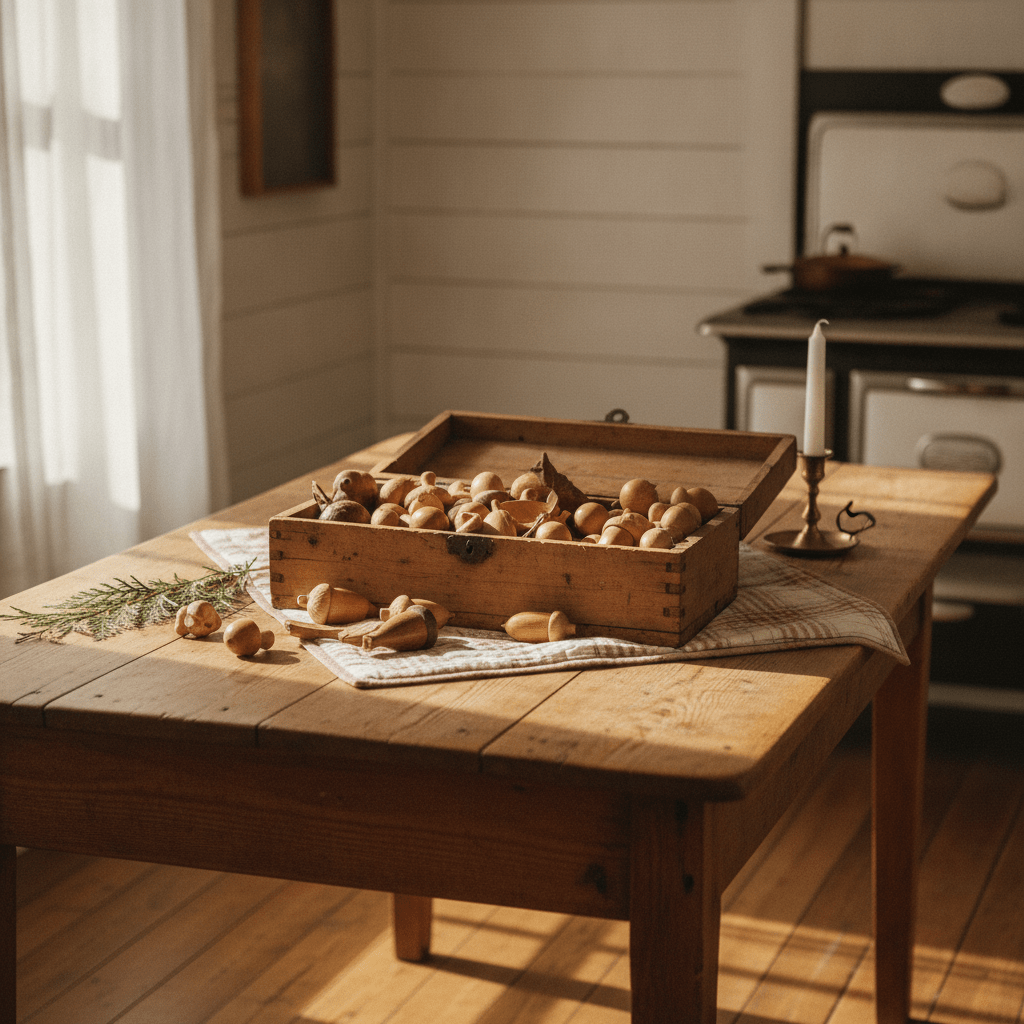
Handmade Wooden Ornaments and the Quiet Truth About Wood Getting Better With Age
You pull a handmade wooden ornament out of the box — one your grandmother hung on her tree, or one you bought the first Christmas in a new house — and it looks better than you remember. Not worn out. Not faded. Just richer, somehow. Deeper. That is not nostalgia playing tricks. That is the wood doing exactly what wood does, and it is one of the stranger and more satisfying facts in the material world.
No other common material pulls this off. Plastic yellows and gets brittle. Metal corrodes or oxidizes into something you have to work around. Fabric thins and pills. Stone holds its own, sure, but it doesn't improve — it just endures. Handmade wood is the only thing that genuinely gets more beautiful the longer it sits in your life, and there are real, specific reasons why.

The Chemistry Happening Inside Every Handmade Wood Piece
Wood is not inert once it's cut and dried. The cell walls, the resins, the tannins — they keep reacting, slowly, with light and air and the oils from human hands. This process is called oxidation, and in wood it works in your favor.
Cherry is the most dramatic example. A freshly milled piece of cherry is pale, almost pinkish-blonde. Give it a year of light exposure and it shifts to a warm amber. Give it a decade and it looks like dark honey held up to a lamp. The color comes from within the wood itself, not from any finish applied on top. The finish just protects the surface while that transformation happens underneath.
Walnut goes the other direction — it starts dark and actually lightens slightly over time, settling into a warm chocolate tone that has more visual depth than the raw wood ever did. Oak develops what's called a patina, a surface quality that comes from the interaction of tannins in the grain with oxygen. You cannot buy that look at a paint store. You have to wait for it.
- Cherry: pale blonde to deep amber over 5-10 years
- Walnut: dark chocolate that lightens and warms with age
- Oak: develops tannin-driven patina that deepens the grain contrast
- Maple: stays light but gains a subtle warmth and translucency
- Pine: yellows into a honey tone that farmhouse decorators spend real money trying to fake
The appeal of real wood in a farmhouse setting is not accidental — people are drawn to that aged warmth without always being able to name what they're looking at. Now you can name it.
Why Handmade Wood Objects Age Better Than Factory-Produced Ones
This is where it gets practical. Not all wood ages the same way, and a big part of that comes down to how the piece was made in the first place.
Factory-produced wood items are often made from MDF, particle board, or veneers — thin slices of real wood glued over a composite core. The veneer might be a quarter-inch thick. When that surface oxidizes and develops character, there's nothing underneath to support it. Sand it once to refresh the surface and you're into fiberboard. The aging process on these pieces tends to look like deterioration because, structurally, it is.
Solid handmade wood — the kind cut from a single piece of solid lumber — ages all the way through. The patina on the surface is continuous with the material beneath it. You can refinish it, sand it back, oil it, and the wood underneath still has decades of life and character stored inside it. That's not a small distinction. That's the difference between something that lasts a generation and something that lasts a lease.
The grain structure in solid wood also means the piece moves slightly with humidity and temperature, which sounds like a problem but is actually part of what keeps it alive-looking. It breathes. Composite materials don't breathe — they swell and crack and delaminate. Solid wood just settles in.
◆ From the Workshop: Ash is the wood of choice for baseball bats and tool handles because it carries an unusually high ratio of strength to weight — but the real secret is in how it fails. When ash finally breaks under load, it splits along the grain in long, clean fibers rather than shattering. That controlled failure is why a broken ash handle splinters predictably instead of exploding, which matters considerably when you're swinging it at speed.
Frequently Asked Questions
Does the finish on a wooden piece affect how it ages — and can you re-finish it years later?
Yes, and yes. Oil-based finishes like tung or linseed actually penetrate the wood fibers and continue to cure over time, which is part of why the surface deepens in color rather than just yellowing on top. Film-forming finishes like polyurethane sit on the surface and can be sanded back and recoated without stripping the piece down to bare wood — though a light sand and a fresh coat every decade or so goes a long way. The short answer: the finish matters, but the wood underneath is doing most of the aging work regardless.
Are some wood species better suited to indoor aging versus outdoor aging?
Dramatically so. Indoors, almost any hardwood — cherry, walnut, maple, ash — will age gracefully because humidity swings are modest and UV exposure is limited. Outdoors is a different negotiation entirely. Teak, white oak, and black locust have high natural oil content and silica levels that resist moisture and rot. Cedar grays beautifully in open air. Most domestic hardwoods used in furniture and decor are best kept inside or under a covered porch, where they'll reward you for decades without the fight.
Can you speed up the patina process on new wood without making it look fake?
You can nudge it, but you can't fake the real thing without it showing. Steel wool dissolved in apple cider vinegar creates a chemical reaction with the tannins in oak and walnut that produces a convincing aged gray-brown — it's a legitimate technique used by furniture makers. Ammonia fuming works on white oak specifically, darkening it in ways that mimic decades of age. What doesn't work well is simply painting something brown and calling it patina. The grain has to move, the surface has to have some texture, and the color has to vary the way real aging varies — which is why genuinely old wood is hard to replicate and easy to spot.

The Role of Human Touch in How Wood Develops Over Time
There is a Japanese concept called wabi-sabi — the beauty of imperfection and transience — and wood is its most cooperative material. Every scratch, every small dent from a dropped key or a coffee mug set down without thinking, every darkened spot where hands have rested: these don't diminish a wooden object. They record it.
The oils from human skin actually feed certain wood finishes and work into the grain over years of handling. Old wooden tool handles develop a polish that no factory process can replicate. The grip of a well-used wooden spoon gets smoother and more comfortable over decades. Antique dealers have a word for this: patina. Auctioneers have a different word for it: provenance. Either way, it adds value.
This is part of why handmade wooden ornaments become heirlooms when plastic ones become landfill. The wooden one carries the years. You can see them in the surface. The plastic one just gets brittle and eventually snaps. There's no story in that.
We wrote about why custom wood signs are becoming the new heirloom — and the same logic applies here. Objects made from real materials accumulate meaning in a way that manufactured goods simply don't.
What to Look For If You Want Wood That Actually Ages Well
Not all hardwood is equal, and not all sellers are honest about what they're selling. Here's what actually matters if you want a piece that improves over time rather than just sitting there.
- Species matters. Cherry, walnut, white oak, ash, and hard maple are the workhorses of beautiful aging. Softer woods like poplar and pine can age well too, but they dent more easily and the character reads differently — more rustic, less refined.
- Grain orientation matters. Quarter-sawn lumber (where the growth rings run roughly perpendicular to the face) is more dimensionally stable and shows a tighter, more consistent grain that ages with more elegance. It costs more because it wastes more of the log. Worth it.
- Finish matters. An oil or wax finish lets the wood breathe and develop naturally. A thick polyurethane film protects the surface but can yellow and peel, trapping the wood underneath rather than letting it evolve.
- Source matters. Amish-milled lumber, for instance, tends to be properly air-dried and cut from older-growth timber with tighter rings — that density is what gives old-growth wood its reputation for aging so gracefully.
Here in Kentucky, we cut our signs from solid lumber that's been sourced and dried the right way, because the finished piece is only as good as what you start with. That's not a sales pitch — it's just the honest reason we care about the supply chain.
If you're drawn to pieces that carry this kind of character over time, the full sign collection is a good place to wander — solid wood, meant to outlast the nail it hangs on.
The One Thing Wood Does That No Other Material Can
Here is the bottom line, said plainly. Every other material you bring into your home is in a slow negotiation with time, and time is winning. Wood is the one exception. Given reasonable care — keep it dry, give it light, oil it occasionally — hardwood doesn't just hold on. It improves.
The handmade wood piece you hang on the wall today will be more interesting in fifteen years. The grain will have more depth. The color will have more warmth. If it's something that gets handled — a serving board, an ornament passed around every December, a sign that gets touched every time someone walks past — it will carry the record of all that handling in its surface, and that record will make it more beautiful, not less.
That is not true of anything else you own. Not your phone. Not your couch. Not your car. Just the wood. That's worth knowing, and it's worth choosing accordingly.
If you want the real thing on your own wall, the Faith Over Fear Sign — Carved Wood Christian Farmhouse Decor is the one folks pick first.
Share:
Christmas Holiday Inspirational Quotes and the Controlled Chaos We Call Home | Bluegrass Gifts
The Mini Bar in Living Room Has Deep Southern Roots | Bluegrass Gifts