

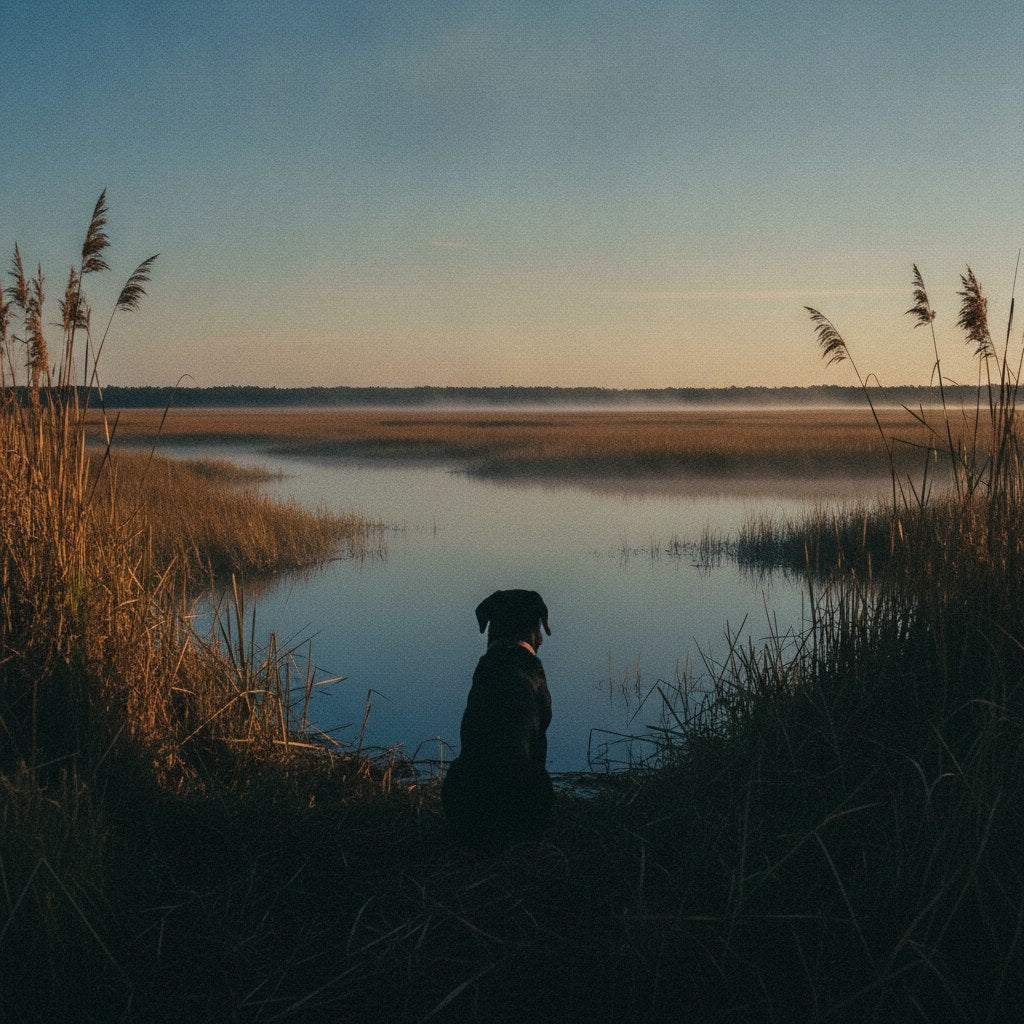
The Duck Hunting Labrador Didn't Happen by Accident
Every duck hunting labrador you've ever watched launch off a blind into thirty-eight-degree water — ears flat, eyes locked on the fall — is running a program that took roughly four hundred years to write. That's not a metaphor. The breed exists because specific people in specific places needed a dog to do a very specific job, and they were meticulous enough to keep only the ones that did it right. Understanding that history doesn't just make for good conversation at the blind. It changes how you think about training, selection, and why your dog behaves the way it does before you've even touched the call.
Most people assume retrievers were bred by hunters. The actual starting point is more interesting than that.

Newfoundland Fishermen and the Dog That Came First
The labrador retriever's direct ancestor wasn't bred on an English estate. It came out of the fishing communities of Newfoundland, Canada, sometime in the 1500s — a medium-sized working dog the settlers called the St. John's Water Dog. These weren't hunting dogs. They were dock dogs. Fishermen used them to retrieve lines and nets that had slipped into the harbor, to haul ropes between boats, and to retrieve fish that had flopped off the deck. The job demanded a dog that loved cold water, had a soft enough mouth not to damage the catch, and would work all day without being told twice.
Those are, almost exactly, the qualities that make a great duck dog. The fishermen didn't know they were building a retriever. They were just keeping the dogs that worked.
By the early 1800s, English sportsmen traveling to Newfoundland noticed these dogs and brought several back. The transition from fishing dock to duck marsh turned out to be a short one. The Second Earl of Malmesbury is usually credited with establishing the first serious breeding program in England, crossing the imported St. John's dogs and selecting hard for water work. His letters describe dogs that retrieved from the sea in conditions that would have stopped most breeds cold. He called them Labrador dogs — the name stuck, even though the breed has almost nothing to do with the Labrador peninsula.
What the Breed Standard Actually Selected For — and Why It Matters at the Marsh
When the Kennel Club formally recognized the Labrador Retriever in 1903, the standard that emerged wasn't aesthetic vanity. Every physical trait in a working duck hunting labrador was pressure-tested in the field first:
- The otter tail — thick at the base, tapered, and covered in dense fur — acts as a rudder in moving water. It's not decorative. A Lab with a thin, whippy tail loses steering in current.
- The double coat — a dense, weather-resistant outer layer over a soft, insulating undercoat — sheds water the way a good waxed canvas jacket does. The dog doesn't get wet to the skin the way a pointer or a setter would.
- The soft mouth — originally selected so dock dogs wouldn't chew through fishing nets — is what lets a Lab carry a mallard drake without bruising the breast. You can eat what your dog retrieves. That matters.
- The broad skull and strong jaw — built to carry large, heavy birds over long distances without dropping them.
- The blocky, muscular body — optimized for swimming, not coursing. Labs are built like linebackers, not sprinters, because the water is where the work happens.
None of this was accidental. Four centuries of selection pressure left a very clear fingerprint on the breed, and you can read it in your dog's body if you know what you're looking for.
◆ From the Workshop: This is only tangentially related to dogs, but it's the kind of thing that sticks with you once you know it — when you're drilling into hardwood with a spade bit and the bit suddenly grabs and tries to spin the whole board out of your hands, you've hit the transition from earlywood to latewood, the dense dark growth ring laid down at the end of the growing season. That ring is dramatically harder than the pale wood on either side of it, and the wide flat shoulders of a spade bit can't ease into it gradually. Old timber workers called it 'hitting the ring,' and the fix is simple: slow down just before you feel the resistance change, or switch to a bit with a steep lead screw that pulls itself through instead of relying on your grip to hold the line. The reason it belongs here is that it's the same principle — understanding the material's history, the way it was built, tells you exactly how to work with it.
Frequently Asked Questions
Can a labrador that has never been trained still show retrieval instincts around water?
Yes — and often dramatically so. Labs carry what trainers call 'biddability' and a strong prey drive that express themselves even without formal conditioning. A puppy that has never seen a decoy will frequently pick up a thrown object from water and return it to hand. The instinct is there; formal training just channels and sharpens it. That said, an untrained dog around live hunting situations can be dangerous for itself and disruptive to the hunt, so instinct alone is never a substitute for steady, patient work with a professional or an experienced hunter.
What's the difference between American and English labrador lines for waterfowl hunting?
American-line Labs (sometimes called field or working lines) are generally leaner, higher-energy, and more intensely driven — bred specifically for hunt-test and field-trial performance. English-line Labs are blockier, calmer, and often easier to manage as house dogs, but they can lack the raw drive that long, cold retrieves in heavy cover demand. For serious waterfowl hunting — especially big-water situations or late-season cold — most guides and competitive hunters prefer American field lines. For a family dog that also hunts occasionally on weekends, an English-line Lab is often a better fit.
At what age should you start water-retrieve training with a labrador puppy?
Most professional retriever trainers begin introducing puppies to water between eight and twelve weeks — not for formal drills, but for positive exposure. Shallow, warm water, no pressure, and lots of praise. Structured water retrieves with marks and blinds typically begin around six months, once basic obedience is solid. Starting too early with formal pressure can create water-shy dogs, which is almost impossible to fully undo. The general rule: let the puppy love water first, then teach it to work in water.

How the Duck Hunting Labrador Became the Standard — Not Just One Option
Through the early twentieth century, waterfowl hunters in North America used a wide range of retrievers — Chesapeake Bay Retrievers, Flat-Coated Retrievers, Golden Retrievers, and Irish Water Spaniels all had their advocates. The Lab's dominance wasn't inevitable. It was earned, slowly, through a combination of trainability, physical toughness, and temperament that proved unusually consistent across litters.
The trainability piece is worth pausing on. Labs have what behaviorists call high biddability — a genuine desire to work in cooperation with a handler rather than independently. Pointers and flushers are bred to range and make their own decisions. Retrievers are bred to watch you, take direction, and defer to the mark you call. For blind retrieves in heavy cover, that handler-focus is everything. A dog that decides on its own where the bird fell is a problem. A dog that holds a line you set and trusts it even when its nose is pulling it left — that's what you're paying for in a well-bred Lab.
The American Kennel Club recognized the breed in 1917. By mid-century, the duck hunting labrador had largely displaced every other retriever in serious waterfowl circles across the country. Today, the Lab has been the most registered breed in the United States for over thirty consecutive years. That's not because they're cute — though they are, insufferably so. It's because the breed does what it was built to do with a reliability that's hard to argue with.
We wrote a piece on the science of how retrievers actually process a retrieve — the scent work, the memory, the way they triangulate a fall — if you want to go deeper on the mechanics of what's happening inside that broad skull.
What Four Centuries of Selection Looks Like on a Tuesday Morning
Here's the part that I find genuinely remarkable. Your dog — the one currently eating something off the kitchen floor — is running behavioral software that was written by Newfoundland fishermen before the American Revolution. The reason it locks onto a thrown object and can't quite let the impulse go, the reason it stands at the edge of any body of water and looks at you like it's waiting for permission, the reason it carries things around the house with an almost ceremonial seriousness — all of that is the St. John's Water Dog still running in the background.
That's not sentiment. That's selective breeding doing exactly what it was designed to do, across four hundred years and two continents, with remarkable fidelity.
The dogs that didn't retrieve reliably didn't get bred. The dogs that refused cold water didn't get bred. The dogs with hard mouths, poor focus, or weak drives didn't get bred. What's left — what's sitting on your couch right now — is the cumulative result of thousands of individual decisions made by people who needed the dog to work and had no patience for the ones that wouldn't.
That's a lineage worth knowing. And if you're the kind of person who marks that lineage — on a wall, on a sign, in the way you set up a room — the Marsh Madness duck hunting dog shirt is the kind of thing that says it out loud without requiring a speech. For the wall itself, our carved hardwood pet signs — made here in Kentucky from Amish-sourced lumber — are built to last about as long as the breed has.
The dog earned the wall space. Four hundred years is a long time to prove a point.
Share:
The Grain Never Lies: How to Read Wood Grain Patterns and What They Tell You About the Tree | Bluegrass Gifts
Top 7 Teacher Retirement Presents (Rated by Actual Usefulness)