

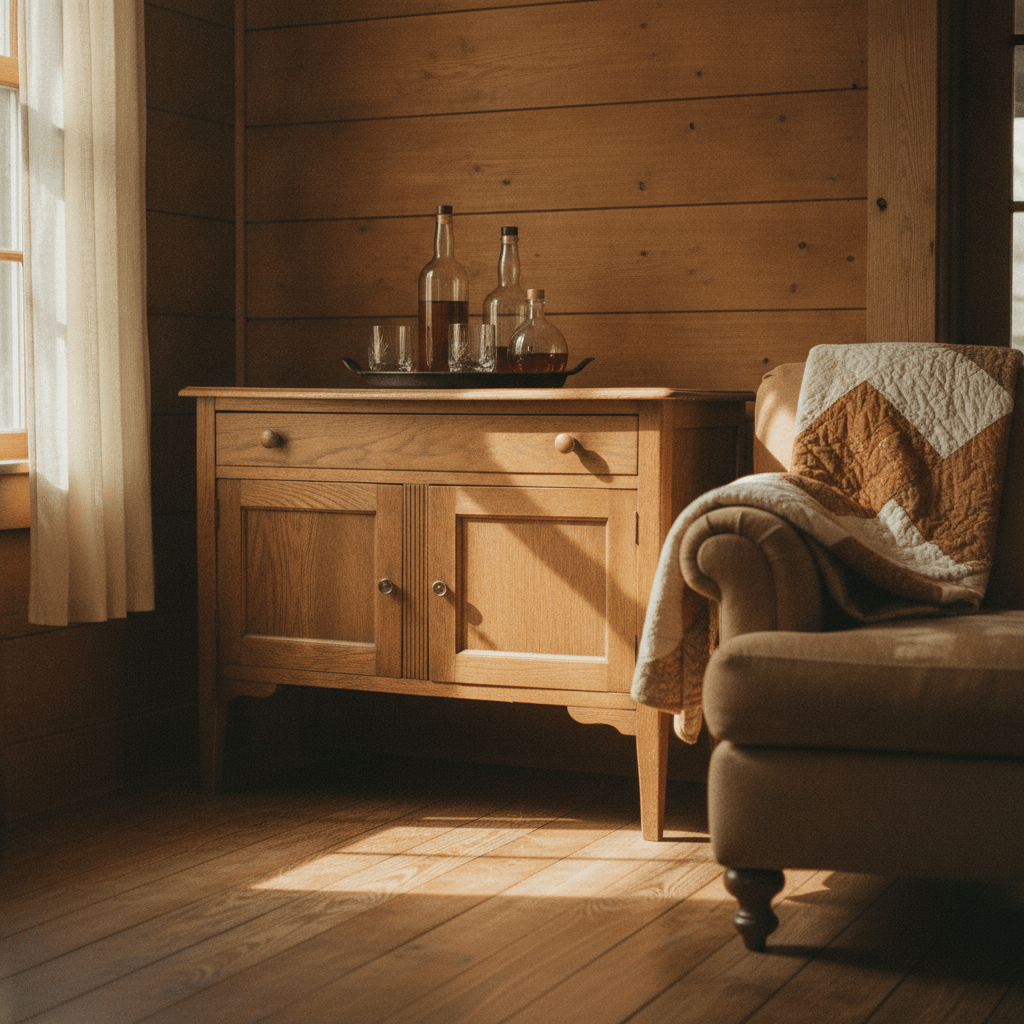
Your Bar Living Room Corner Is Older Than You Think
Somewhere in your house right now, there is probably a shelf, a cart, or a cabinet holding a few bottles of something good. Maybe it sits in a corner of the den. Maybe it occupies a whole wall. Either way, that bar living room setup you've assembled — even if it's just a bourbon bottle and two mismatched glasses on a sideboard — is part of a tradition that runs back further than most people realize. The mini bar in living room form we know today didn't appear out of nowhere. It evolved slowly, over centuries, shaped by Southern hospitality, frontier pragmatism, and one spectacularly failed attempt by the federal government to make Americans stop drinking.
This is that story.

The Sideboard: Where Southern Hospitality Got Its Start
Before there were bars, there were sideboards. In the great plantation houses of Virginia, the Carolinas, and Kentucky, the sideboard was a piece of furniture that stood against the dining room wall and held the household's spirits, decanters, and good silver. It was the first bar living room ancestors ever knew, and it carried a specific social function: a guest was never supposed to want for a drink.
This wasn't casual. Offering a visitor something to drink was a statement about your household's standing. The quality of your bourbon or rye, the cut of your crystal decanters, the way the whole thing was arranged — these things communicated something. Southern hospitality has always been a performance in the best sense of the word. It says, without saying it: you matter enough that I prepared for your arrival.
The sideboard also served a practical purpose. Spirits kept better in a cool dining room than in a separate outbuilding. Keeping them visible and accessible meant the host controlled the pour — and in households where the host was also the one who distilled the whiskey, that mattered.
By the mid-1800s, the sideboard had become a fixture in middle-class homes across the South, not just the grand estates. Furniture makers competed to produce elaborate pieces with carved details, mirrored backs, and marble tops. The bar had moved from the plantation to the parlor, and it brought its social meaning with it.
◆ From the Workshop: Speaking of furniture makers and their tricks — when you joint two boards edge-to-edge for a glue-up, the old hand-tool method is to clamp them face-to-face and plane both edges at once. Any angle error in the plane cancels out perfectly because the two boards mirror each other, so it doesn't matter if your plane is a degree off square. Furniture makers called it 'shooting in pairs,' and it's one of those shop tricks where understanding the geometry feels like a small magic trick the first time you work it out.
Frequently Asked Questions
What's the difference between a wet bar and a dry bar, and does it matter for a living room setup?
A wet bar has a sink with running water plumbed directly into the unit, which makes rinsing glasses and dumping ice easy without leaving the room. A dry bar has no plumbing — it's essentially a cabinet or cart with storage for bottles, glassware, and tools. For most living rooms, a dry bar is the practical choice: no contractor, no permits, no drywall work. A wet bar makes more sense if you're finishing a basement or building out a dedicated room where running a water line is already part of the renovation.
How do you stock a home bar from scratch without spending a fortune?
Start with five base spirits — bourbon, gin, vodka, rum, and tequila — and you can make the vast majority of classic cocktails. Add one bottle of sweet vermouth, one of dry vermouth, a good bitters like Angostura, and simple syrup you made yourself on the stove in ten minutes. That's your foundation. Resist buying every liqueur you see; most collect dust. Fill gaps as specific recipes call for them, and you'll build a genuinely useful bar over a few months without a single impulse purchase you regret.
Are there any building codes or permits required to add a wet bar to a living room or den?
In most jurisdictions, adding a wet bar with plumbing does require a permit because you're tapping into supply and drain lines. Requirements vary significantly by county and city, so the right first call is your local building department, not a contractor. A dry bar — no plumbing, just furniture — generally requires no permit at all, which is one reason the cabinet-style bar cart became so popular. If you're in a condo or HOA community, check your CC&Rs as well; some have restrictions on modifications that affect shared plumbing walls.
The Saloon Era and What It Actually Taught Us About Bar Living Room Design
The American saloon gets a bad reputation, mostly from temperance literature that was never interested in accuracy. The reality was more interesting. The historical record shows that saloons in the post-Civil War South and West served as community centers, post offices, polling places, and the closest thing many frontier towns had to a hotel lobby. The bar itself — the long wooden counter, the back bar with its shelves of bottles, the mirror that let the bartender watch the room — was a piece of considered design.
That back bar layout is exactly what most people recreate when they build a mini bar in living room spaces today. Floating shelves. Bottles arranged by height. A mirror behind them to double the visual weight of the collection. We absorbed the saloon's design language so thoroughly that we no longer recognize it as borrowed.
What the saloon era also gave us was the idea that the bar should have a personality. Saloons were decorated. They had names painted on the windows, mounted game on the walls, and signs behind the counter that told you something about the place and the people who ran it. That instinct — that a bar should say something — never went away. We wrote about how a funny bar sign changes the whole energy of a gathering, and the short version is that it works for the same reason it worked in 1878: it sets the tone before anyone opens their mouth.

Prohibition Made the Home Bar Permanent
Here is the great irony of American drinking history: Prohibition, which ran from 1920 to 1933, did more to establish the home bar as a cultural institution than any other single event. When legal saloons closed, drinking moved indoors. Into parlors. Into basements. Into the kind of quiet, domestic spaces where people had always gathered anyway.
Wealthy households built elaborate concealed bars — cabinets that looked like bookcases, sideboards with false backs, rolling carts that could be whisked into a closet when needed. The speakeasy aesthetic, with its low light and close quarters and sense of conspiracy, filtered into home design and never entirely left. By the time Repeal came, Americans had spent thirteen years treating the home bar as a natural feature of domestic life. They weren't about to give that up.
The postwar era of the 1950s and 1960s took the home bar to its cultural peak. The mid-century home bar became a symbol of arrival — a built-in unit in the rec room or den, knotty pine paneling, a brass rail, a set of monogrammed highball glasses. Every suburban house with any pretension had one. The bar living room concept had fully matured into an American institution.
What the Modern Mini Bar in Living Room Gets Right
The current revival of the home bar is quieter than the 1950s version, but it's more considered. People are less interested in the full built-in production and more interested in something that fits the room they actually have — a bar cart, a console table styled as a drinks station, a section of open shelving dedicated to the good stuff.
What makes a bar living room setup work in a modern home is the same thing that made the plantation sideboard work: intention. The bottles are arranged, not just stacked. There's glassware that suits what you actually drink. There's something on the wall that acknowledges what the space is for. That last part matters more than people give it credit for. A bare shelf of bottles reads as clutter. A shelf of bottles with a carved solid-wood sign above it reads as a room with a point of view.
If you're putting together that kind of space, our bar sign collection has the kind of pieces that feel like they belong in a room with history behind it — not decorations, but statements. And if you want one specific sign that earns its place on the wall, this carved funny drinking quote sign hits the right note: dry, confident, and built to last longer than whatever's in the bottle beneath it.
The details that make a bar living room feel complete are mostly small ones.
- One good ice tray beats a bag of freezer cubes every time.
- Glassware grouped by type looks intentional; glassware scattered looks like a yard sale.
- A small tray corrals the bottles and keeps the surface readable.
- One piece of wall art anchors the whole setup and tells people what kind of bar this is.
The sideboard, the saloon, the speakeasy cabinet, the postwar rec room bar — they all understood this. The space should feel like it was put together by someone who thought about it. That's what Southern hospitality always meant. Not extravagance. Just the quiet message that you were expected, and that someone cared enough to make it right.
New from the workshop: we now engrave bourbon barware — whiskey glasses with original Kentucky sayings, hidden bottom messages, and personalized groomsmen sets. A home bar deserves glassware with an opinion.
Share:
Handmade Wooden Ornaments and the Quiet Truth About Wood Getting Better With Age | Bluegrass Gifts
What Your Coworker's Desk Actually Says About Them: Humor Quotes About Work Decoded | Bluegrass Gifts