

Why Does Laundry Never End? The Math and Psychology Behind Small Laundry Room Decor That Keeps You Sane
You finished the laundry on Sunday. Every basket empty, every drawer full, a minor household miracle. By Tuesday there was a pile on the floor again. Not a big pile. Just enough of one to remind you that you are losing. If you have ever stood in your laundry room and felt a specific, low-grade existential dread, you are not disorganized. You are experiencing a math problem that has no clean solution, and understanding it — really understanding it — is oddly comforting.

The Threshold Problem: Why the Laundry Room Pile Is Basically Immortal
Here is the core issue. Laundry does not accumulate in discrete events. It accumulates continuously, the way sand moves into a corner. Every person in your household generates roughly one to two pounds of laundry per day — towels, socks, the shirt someone wore for forty-five minutes before deciding it was the wrong shirt. A family of four is producing somewhere between four and eight pounds of laundry every single day, whether or not anyone is paying attention.
The math problem is this: most people do laundry in batches, not continuously. You wait until there is enough to justify a full load, or until you run out of something specific, or until the pile reaches a height that starts to feel embarrassing. That gap between generation and action is where the pile lives. It is not a failure of discipline. It is a structural mismatch between a continuous input and an intermittent response.
Researchers who study household labor — and yes, that is a real field — call this the threshold effect. Tasks that accumulate invisibly below a threshold of discomfort tend to get deferred until they cross that threshold, at which point they feel overwhelming, which makes deferral even more tempting. The pile grows. You do laundry. The pile grows again. This is not a cycle you can break with more willpower. It is a cycle you can only manage.
The Psychology of Why You Hate It More Than Other Chores
Laundry has a specific psychological profile that makes it more draining than, say, washing dishes. Dishes have a clear end state. The sink is either empty or it is not. Laundry has at least four distinct sub-tasks — sorting, washing, drying, folding, and putting away, which is technically five — and each one can be completed while leaving the others undone. This is what behavioral economists call task fragmentation, and it is brutal for motivation.
Your brain registers the completion of each sub-task as a small reward. You moved the wet clothes to the dryer. Done. Reward. The brain does not automatically connect that action to the remaining steps. So you get the dopamine hit of finishing the dryer cycle and then wander off, and three days later there is a cold, wrinkled pile waiting for you that feels like a brand new problem even though it is the same laundry you started on Monday.
There is also what psychologists call the Zeigarnik effect — the tendency for incomplete tasks to occupy more mental bandwidth than completed ones. That basket of unfolded clothes sitting in the corner is not just laundry. It is a low-level mental notification that never clears. Studies on household task completion suggest that visible, unfinished domestic work contributes measurably to background stress, particularly for the person who notices it most. Which, in most households, is one specific person. They know who they are.
What Small Laundry Room Decor Actually Does for Your Brain
Here is where it gets interesting. Environmental psychology has spent decades studying how the appearance of a space affects the behavior of the people in it. A room that looks intentional — designed, considered, cared for — tends to produce more careful behavior from the people who use it. A room that looks like an afterthought tends to get treated like one.
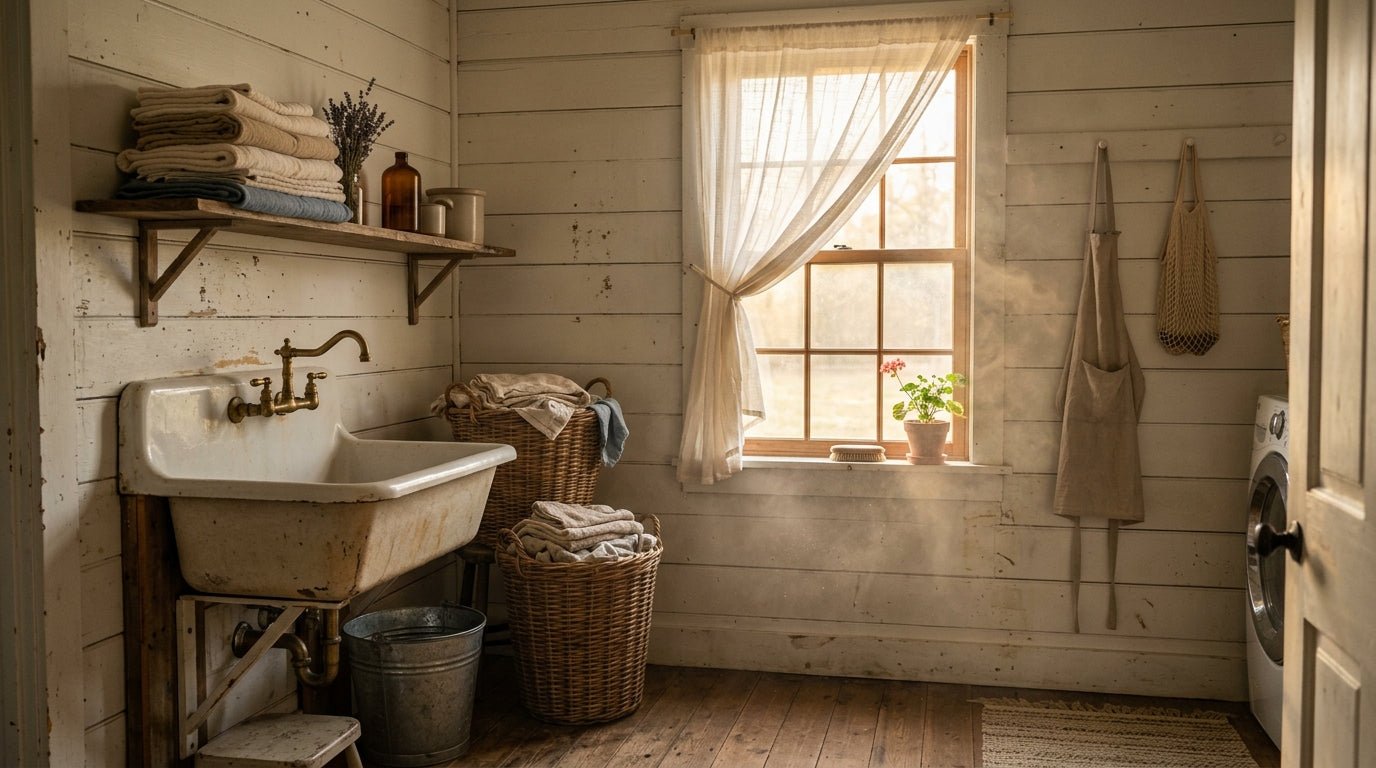
Most laundry rooms are afterthoughts. They are the rooms that got whatever was left over: the paint color nobody wanted in the kitchen, the shelving unit from a previous decade, the bare bulb. And so people treat them accordingly. They dump things in there. They let the pile grow. The visual environment is communicating that this space does not matter, and the brain is taking that message seriously.
Small laundry room decor is not about making the space pretty for its own sake. It is about changing what the room communicates. A shelf with a plant on it, a rug that was chosen rather than inherited, something on the wall that makes you smile — these things signal intention. And intention, it turns out, is contagious. You are slightly more likely to fold the clothes in a room that someone clearly thought about than in a room that feels like a utility closet with a drain.
This is why humor works particularly well in laundry spaces. A sign that names the absurdity of the situation — that acknowledges out loud that this room is where you come to do an endless, thankless task — does something useful. It reframes the chore as something you are in on, rather than something being done to you. If you want to see what that looks like in practice, our laundry room decor ideas post has a full room-by-room breakdown worth keeping open while you plan.
◆ From the Workshop: When you are fitting a hand-cut wooden plug to cover a screw hole, do not just grab any scrap off the bench — cut the plug from the same board, right next to the hole, with the grain running the same direction. The figure and color will be a near-perfect match, and once the glue sets and you pare it flush with a sharp chisel, the repair practically disappears. Cut a plug from a different board and you have traded one flaw for another.
Frequently Asked Questions
Is there a proven system for doing laundry that actually prevents the pile from coming back?
The closest thing researchers and professional organizers agree on is a 'one load per day' rhythm rather than a weekly marathon. The weekly approach creates a psychological event — something you have to gear up for — which makes avoidance easier. A single daily load stays below the threshold where the task feels overwhelming, and the folding never stacks up into a mountain. The catch is that it only works if you fold and put away the same day, not the same week.
What is the actual best order to sort laundry if you want clothes to last longer?
Most people sort by color, which protects against dye transfer, but fabric weight matters just as much for longevity. Heavy items like jeans and towels create mechanical abrasion against lighter fabrics in the drum. A better system sorts first by temperature requirement — hot, warm, cold — and then by weight within those groups. That way your cotton tees are not tumbling against denim for forty minutes, and you are not accidentally shrinking a wool sweater because it ended up in the warm load.
How do you make a tiny laundry room feel less claustrophobic without a full renovation?
Light and vertical space do most of the work. A single floating shelf above the machines immediately pulls the eye upward and creates storage without eating floor space. Replacing a bare bulb with a warmer-toned LED (around 2700K) makes the room feel less like a utility closet and more like a room someone thought about. Beyond that, keeping one visual anchor on the wall — something with personality, whether a print, a sign, or even a framed piece of vintage laundry ephemera — tricks the brain into reading the space as intentional rather than incidental.

The One-In-One-Out Rule (and Why It Is Harder Than It Sounds)
Most organization advice for laundry boils down to some version of the one-in-one-out rule: when something clean comes out of the dryer, something worn goes into the hamper, and the net count stays flat. Simple in theory. Genuinely difficult in practice, because it requires every member of the household to participate, and households are not democracies so much as they are loose coalitions with competing priorities.
What actually works, according to people who study household systems rather than just write about them, is reducing friction at every step. That means:
- A hamper in every room where clothes are taken off, not just in the laundry room itself
- A folding surface at a comfortable height — back pain from hunching over a dryer lid is a real deterrent
- Dedicated bins for each family member so that putting away becomes sorting, not a full archaeological dig
- A timer habit: start a load before a meal, move it after
None of this eliminates the math problem. The clothes will still accumulate. But friction reduction means the response time shortens, and a shorter gap between generation and action means the pile never gets tall enough to feel impossible.
Why the Laundry Room Deserves to Be a Real Room
There is a longer history here worth knowing. For most of the twentieth century, laundry was done in a dedicated space that households took seriously — a proper wash house, a utility room with its own character, sometimes even its own window and natural light. The postwar era of tract housing squeezed laundry into closets and hallways and whatever square footage was left over after the kitchen and bathrooms got their due. The room stopped being a room and became a function.
The current revival of thoughtful laundry spaces — the mudroom-adjacent setups with open shelving and tile floors and actual lighting — is not just an Instagram trend. It is a correction. People are remembering that a room you use every single day of your life probably deserves five minutes of consideration. That is a low bar, and it is still more than most laundry rooms have gotten in fifty years.
If you are working with a tight space, the principles are the same as any small room: light, vertical storage, one strong visual anchor. For the anchor, something with a little personality tends to outlast the purely decorative. A carved hardwood sign that says something true about the experience — we make those in Kentucky, for what it is worth — tends to age better than a subway tile decal. Something like a funny carved laundry sign on the wall above the machines is the kind of thing that makes the room feel like someone lives there, rather than just survives there.
The pile will come back. It always comes back. But a room that makes you smile when you walk into it is a room you are more likely to actually use, and that turns out to matter more than any sorting system or timer trick. The laundry signs collection has a range of options if you want to see what other people have put on their walls — some funny, some straightforward, all of them carved from real hardwood and meant to last longer than the next load.
The math will never fully work in your favor. But the room can still be on your side.
Share:
Can't Sleep Why You're Exhausted but Wide Awake: What Scientists Found | Bluegrass Gifts
What Mothers Actually Know: The Science Behind Funny Moms Day Quotes | Bluegrass Gifts