

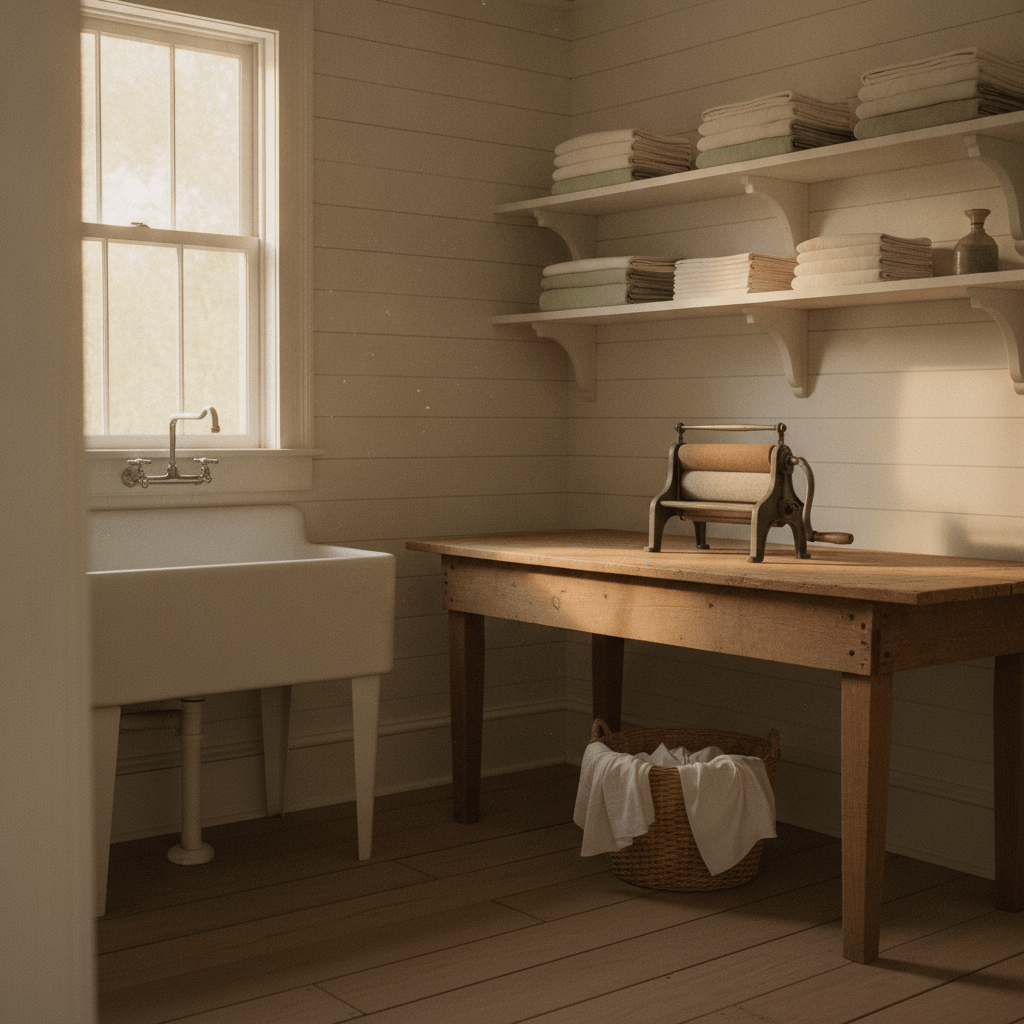
The Vintage Laundry Room Was the Heart of the House — Here's What Happened to It
Your laundry room is probably a closet. Or a narrow slot between the garage and the kitchen. Maybe it's in the basement, behind a door that sticks, next to the water heater and a box of things you haven't unpacked since 2019. The vintage laundry room — the real one, the one your great-grandmother ran like a small factory — looked nothing like that. It was a dedicated space, often the largest working room in the house, and the woman who ran it was doing one of the most physically demanding jobs on the property.
That room didn't disappear by accident. It got engineered out, room by room, decade by decade, until what was once a point of household pride got reduced to wherever the builder had leftover square footage. Here's how it happened, and why so many people are quietly reversing the trend.
What the Laundry Room Actually Was Before Appliances Changed Everything
Before the electric washing machine went mainstream in the 1920s, laundry was a full-day ordeal — sometimes a full two days. Monday was wash day in most American households, and it wasn't a suggestion. The laundry room, or washhouse as it was often called in the South, had a wood-fired or coal-fired wash boiler, a scrub board, a hand-cranked wringer, and rinse tubs. Heavy linen and wool didn't move itself.
The work started before sunrise. Water had to be hauled or pumped and heated. Whites went first, in the hottest water, then colors, then work clothes — always in that order, because the water got dirtier with each load and you didn't want your Sunday shirt going in after your husband's overalls. The whole sequence had a logic to it that took years to learn well.
In wealthier households, the washhouse was a separate outbuilding entirely, positioned downwind and away from the main house because of the steam, the smell of lye soap, and the fire risk. In farmhouses and modest homes, it occupied a dedicated back room — always on the ground floor, always near a water source, always with a door to the outside for hanging lines. It was infrastructure. You planned the house around it.

How the Laundry Room Lost Its Status (and Its Square Footage)
The automatic washing machine hit the mass market in earnest after World War II, and it changed the math entirely. What had required a dedicated room, a full day, and real physical strength now took about forty-five minutes of intermittent attention. The labor shrank. And when the labor shrank, the logic for giving the space square footage shrank with it.
Postwar suburban housing was built fast and built cheap. Developers were squeezing maximum bedroom count onto minimum lots, and a big dedicated laundry room looked like wasted space when a stackable unit could fit in a hallway closet. By the 1960s and 70s, the laundry room had migrated to the basement in most new construction — out of sight, out of mind, definitely not something you showed guests.
The cultural shift mattered too. Laundry had been skilled domestic labor. When appliances automated most of the skill, the work got reclassified — in the cultural imagination, anyway — as something that just sort of happened. The room that housed it followed suit. Nobody was writing magazine features about basement utility closets.
There's a parallel here worth noting. We did the same thing to the kitchen for a while, tucking it away as a purely functional space, until someone figured out that the room where people actually gather deserves to look like it. We wrote about that shift in why the Kentucky kitchen deserves more than just function — the laundry room is having the same reckoning, just about twenty years later.
◆ From the Workshop: Osage orange — that gnarly yellow-green hedge tree most people walk right past — is so rot-resistant that fence posts made from it routinely last 50 years in the ground without any treatment at all. The wood is hard enough to turn the edge of a mediocre chisel on the first pass, and when you cut it fresh, the sawdust stains your hands a bright, almost neon yellow from the natural pigment inside. Native Americans prized it for bows long before European settlers arrived, and serious bowyers still seek it out today.
Frequently Asked Questions
What laundry products from the early 1900s are still worth using today?
Washing soda (sodium carbonate) and bar soap like Fels-Naptha have been around since the 1800s and still outperform plenty of modern options on grease stains and heavily soiled work clothes. They're cheap, they store indefinitely, and they don't require a chemistry degree to use safely. Old-timers knew what they were doing.
What's the best way to add natural light to a laundry room that has none?
A solar tube (also called a sun tunnel) is often the most practical fix — it routes daylight through a reflective tube from the roof without the structural work of cutting a full window. They run $200–$500 installed and can transform a windowless interior room. If the roof isn't an option, a full-spectrum LED panel that mimics daylight color temperature (around 5000K) does more for the mood in there than you'd expect.
Are there any building code requirements for laundry room ventilation?
Most U.S. building codes require dryer exhaust to vent directly to the exterior — not into an attic, crawl space, or wall cavity — and the duct run is typically limited to around 25 feet with reductions for each elbow. Gas dryers also require makeup air provisions in tighter homes. If you're finishing a basement laundry space or converting a closet, it's worth pulling a permit; the inspector will catch ventilation problems before they become a mold or fire issue.
The Laundry Room Revival — What's Actually Driving It
Something shifted around 2015, and it wasn't subtle. Pinterest boards started filling up with shiplap walls, farmhouse sinks, open shelving with folded towels arranged by color, and pendant lights hung over folding counters. The laundry room was getting the kitchen treatment. Real estate listings started calling it out by name as a feature rather than a footnote.
Some of it is practical. People who work from home noticed they were spending more time in every room of the house, including the utilitarian ones, and a grim basement space starts to wear on you when you're down there four times a week. Some of it is the broader farmhouse aesthetic that's been running through home design for a decade now — the appetite for rooms that feel deliberate and warm rather than purely functional.
But some of it is something older. There's a quiet satisfaction in a room that's organized around a real task, that has a place for everything, that tells you exactly what it's for. The vintage laundry room had that. It wasn't pretty, but it had integrity. People are chasing that feeling again, and they're willing to spend on it.

How to Actually Bring That Vintage Feel Back Without a Renovation Budget
You don't need to gut the room. Most of what made the vintage laundry room feel purposeful was about organization and intention, not square footage. A few things that genuinely move the needle:
- Add a folding surface. A butcher-block countertop over the machines, even a simple one from a home center, changes how the room functions and how it feels. The vintage washhouse always had a work surface. Yours should too.
- Put the supplies in real containers. Decant your detergent into a glass jar with a metal lid. Move the dryer sheets into a small basket. The room looks intentional immediately, and you'll stop losing things behind the machines.
- Hang something on the wall. A bare utility room signals that nobody cares about the space. A single piece of wall art — even something dry and funny about the nature of laundry — tells the room it matters. That's the kind of thing our laundry signs say out loud, carved in solid wood, made right here in Kentucky.
- Fix the lighting first. Most laundry rooms have one overhead bulb from 1987. Swap it for something with decent color temperature and the whole room reads differently. This costs thirty dollars and twenty minutes.
- Add a rod for hang-dry items. The vintage washroom always had somewhere to hang things. A tension rod between two walls or a simple ceiling-mounted bar brings back that functionality and keeps clothes off the floor.
If you want to go deeper on the decorating side, our laundry room decor ideas post covers the full room — walls, floors, storage, and the details that make a utility space feel like it belongs in the rest of your house.
The Room That Tells You Something About the House
There's an old idea in architecture that you can tell how a family lives by looking at the rooms they don't show guests. The laundry room is one of those. Not because it has to be hidden, but because it's one of the few rooms in the house that's purely about the work of living — not entertaining, not resting, not impressing anyone. Just the daily maintenance of a household.
The vintage laundry room took that work seriously. It gave it space, tools, and a logical order. When we squeezed it into a closet, we weren't just saving square footage. We were saying something about how much we valued the work itself.
Getting that room back — even a version of it, even in a rented apartment with a stackable unit and twelve inches of wall space — is a small act of taking the work seriously again. That's not a bad thing to say about a room.
And if you'd rather hold one than read about it, the Funny Laundry Room Sign — I'm Feeling a Little Dirty is the one folks pick first.
Share:
How to Work From Home Without Losing Your Mind (Or Your Sense of Humor) | Bluegrass Gifts
Funny Sarcasm Quotes About Life and What They Reveal About the People Who Give Funny Gifts | Bluegrass Gifts