

Can't Sleep Why Your Exhausted Brain Stays Wide Awake: What Sleep Scientists Actually Found
You're so tired you could fall asleep standing in the kitchen, but the second your head hits the pillow, your brain lights up like a pinball machine. You cant sleep. Not for lack of trying. You've done everything right — turned off the TV, put the phone across the room, counted something boring — and still you're staring at the ceiling doing mental accounting at midnight. There's a reason this happens, and it's not weakness or bad habits. Sleep scientists have spent the last two decades figuring out exactly why the exhausted brain refuses to quit, and the answer involves biology, architecture, and a stress system that was never designed for modern life.

Why You Cant Sleep When You're Tired: The Hyperarousal Problem
The short answer is that exhaustion and sleepiness are not the same thing. Your body can be running on fumes while your nervous system is still idling at high RPM. Researchers call this state hyperarousal — a condition where the brain's alerting systems are chronically overactive, even when every other signal says it's time to rest.
Think of it like a car engine that won't return to idle. The accelerator isn't stuck, exactly, but the idle speed is set too high. You can take your foot off the gas all you want — dim the lights, cool the room, lie very still — and the engine just keeps running.
The physiological fingerprint of hyperarousal includes liftd cortisol in the evening hours, higher core body temperature at bedtime, and increased high-frequency brain wave activity (beta waves) when you should be winding down into the slower theta and delta rhythms of early sleep. We've written before about what full-night fatigue actually does to the body — the short version is that the damage compounds faster than most people expect.
The cruel irony is that sleep deprivation itself worsens hyperarousal. The more nights you cant sleep properly, the more reactive your stress system becomes, which makes the next night harder, which makes the system more reactive. It's a loop, and recognizing it as a loop is the first step toward breaking it.
Your Brain Has a Wake-Promotion System — and It Doesn't Have an Off Switch
Here's the part sleep scientists find genuinely fascinating. The human brain doesn't have one sleep system. It has two opposing systems locked in constant negotiation: a sleep-promotion system driven largely by a chemical called adenosine (which builds up the longer you're awake) and a wake-promotion system driven by a cluster of neurons in the hypothalamus that release orexin, also called hypocretin.
Adenosine is why you feel drowsy after a long day. It's a byproduct of neural activity — the brain's version of exhaust — and it accumulates in the spaces between neurons, gradually pressing down on wakefulness. Caffeine works by blocking adenosine receptors, which is why a late afternoon coffee doesn't make you less tired, it just makes you unable to feel how tired you are. The adenosine is still there. You just can't read the gauge.
The orexin system, on the other side of the equation, is what keeps you awake and alert during the day. It's sensitive to light, stress, novelty, and anxiety. And here's the problem: it responds to emotional threat the same way it responds to physical danger. A worry about a work deadline registers in the orexin system almost identically to a predator on the savanna. The system doesn't distinguish. It just keeps you up.
People who cant sleep chronically often have an orexin system that's slightly overtuned — more reactive to stress cues, slower to stand down when the threat passes. Mindfulness practices that slow the breath work partly because slow, controlled breathing is one of the few things that directly signals the orexin system to ease off.

◆ From the Workshop: Spalted wood — those dramatic black lines running through maple and beech — are actually the borders between competing fungal colonies that colonized a dying tree. Each zone line marks where two different fungi met, couldn't cross each other's territory, and built a chemical wall. The wood is essentially a map of a microscopic turf war, and you have to catch it at exactly the right moment: too early and the lines are faint, too late and the fungus has eaten the wood too soft to work.
Frequently Asked Questions
Does the temperature of your bedroom actually affect how fast you fall asleep?
Yes, and more than most people realize. Your core body temperature needs to drop about two to three degrees Fahrenheit to trigger the onset of sleep. A room that's too warm — anything above roughly 68°F — slows that drop. Most sleep researchers point to 65–67°F as the sweet spot for most adults, though people who run naturally warm often do better closer to 62°F. A cool room isn't just comfortable; it's doing biological work.
Is it true that lying in bed awake for too long actually trains your brain to associate the bed with wakefulness?
That's the core idea behind stimulus control therapy, one of the most evidence-backed techniques in cognitive behavioral therapy for insomnia (CBT-I). Every minute you spend awake and frustrated in bed teaches your nervous system that the bed is a place for alertness, not sleep. The standard recommendation is to get up after about 20 minutes of wakefulness, do something quiet in dim light, and return only when you feel genuinely sleepy — not just tired.
Can a single bad night of sleep create a cycle that's hard to break?
It can, especially if anxiety about sleep becomes part of the picture. One rough night raises cortisol slightly the next evening, which makes it harder to fall asleep, which creates more worry, which raises cortisol further. Sleep researchers call this the hyperarousal loop. The good news is that it's usually broken by reducing the performance pressure around sleep — treating it less like a task you have to execute correctly and more like something you allow to happen.
The 3 A.M. Wake-Up: Why Cant Sleep Problems Peak in the Middle of the Night
Waking at three in the morning and lying there for an hour is so common it has its own research literature. It's not random. It tracks almost perfectly with a natural dip in core body temperature and a shift in sleep architecture — the brain moves from deep, slow-wave sleep in the first half of the night toward lighter REM sleep in the second half. That transition is a vulnerability window.
Add to that the fact that cortisol begins rising naturally around 3–4 a.m. to prepare the body for waking. In people with healthy sleep, that rise is gradual and doesn't disturb sleep. In people running a chronically liftd stress response, the rise is steeper and earlier — enough to pull them out of light sleep entirely.
What makes it worse is what happens next. The mind, now awake in the dark and quiet, does what minds do: it finds things to worry about. And worrying in the middle of the night is particularly vicious because the prefrontal cortex — the part of the brain responsible for rational perspective — is still partially offline. You're anxious without the full toolkit to talk yourself down.
A few things that actually help during a 3 a.m. wakeup:
- Keep the room dark and cool — don't check the clock, which spikes cortisol further
- Try the 4-7-8 breath: inhale for 4 counts, hold for 7, exhale for 8 — it activates the parasympathetic nervous system
- If you're still awake after 20 minutes, get up and do something quiet in dim light rather than lying there building frustration
- Write down whatever you're ruminating on — externalizing the thought onto paper reduces its grip on working memory
What Actually Works When You Cant Sleep: The Science Worth Keeping
Cognitive Behavioral Therapy for Insomnia — CBT-I — consistently outperforms sleep medication in long-term studies, including a landmark NIH-reviewed analysis that found CBT-I produced more durable improvements than sedative-hypnotics with none of the dependency risk. The core techniques aren't complicated, but they require patience.
Sleep restriction therapy sounds counterintuitive: you temporarily limit your time in bed to consolidate sleep drive, then gradually extend it as efficiency improves. Most people see results within two weeks. It's uncomfortable at first. It works.
Stimulus control means using the bed only for sleep and intimacy — no reading, no scrolling, no lying awake worrying. The goal is to rebuild the mental association between bed and sleep that hyperarousal has eroded.
Sleep hygiene is the stuff you've heard before, but the details matter more than people think:
- Consistent wake time every day, including weekends — this anchors your circadian rhythm more than any other single behavior
- No caffeine after noon if you're a slow metabolizer (a genetic trait that affects roughly half the population)
- Dim lights in the two hours before bed — blue light suppresses melatonin, but any bright light keeps the orexin system alert
- Exercise helps, but vigorous workouts within three hours of bedtime raise core temperature and delay sleep onset for many people
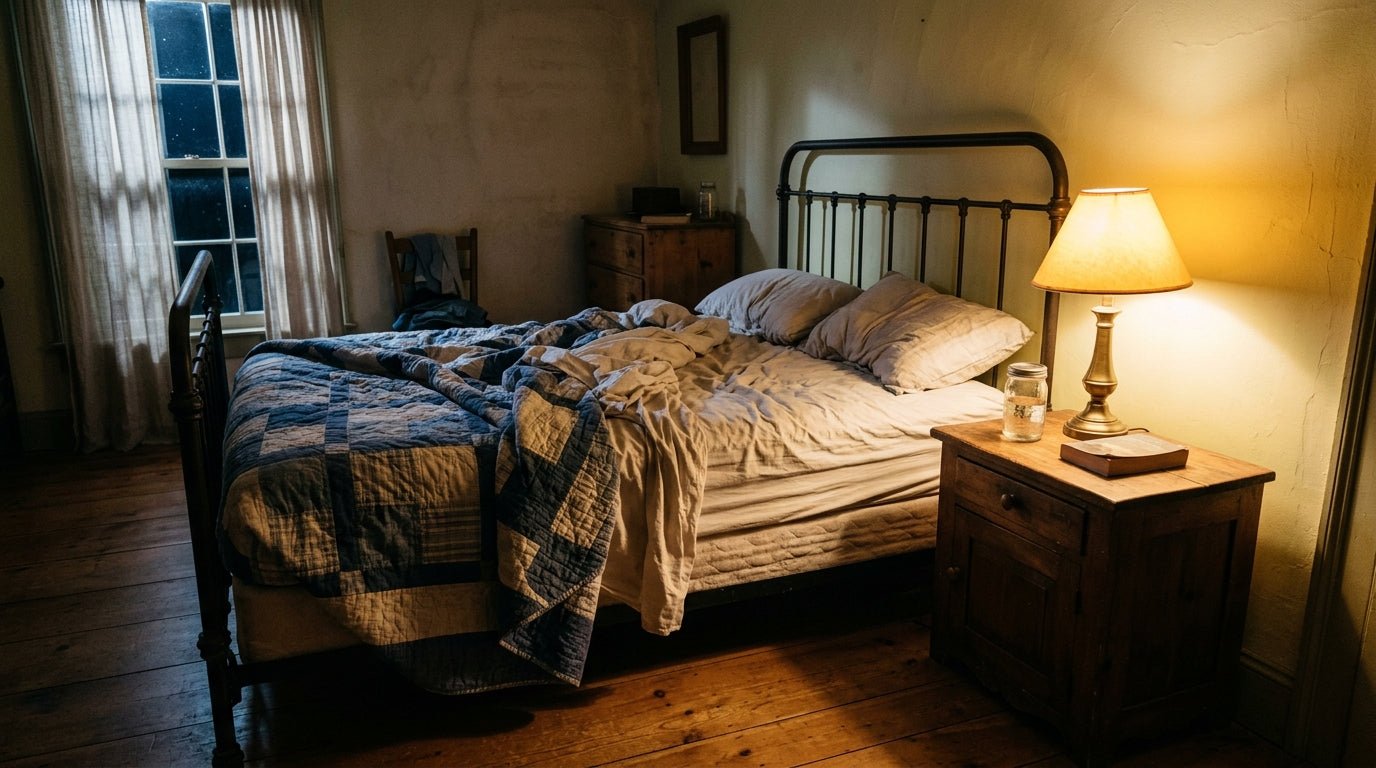
The bedroom environment matters more than most sleep guides admit. A room that feels calm and intentional — not a second office, not a doom-scrolling den — does real psychological work. That's the whole idea behind farmhouse bedroom wall decor that actually settles a room: the visual cues you surround yourself with at night send signals, and those signals accumulate. Something as simple as a carved hardwood nap sign on the bedroom wall is a small, dry joke that says: this room is for rest, not productivity. Sometimes the reminder helps.
The broader collection of bedroom signs carved from real hardwood is the kind of thing people hang not because it's decorative but because it changes how the room feels — and how the room feels is exactly what sleep science keeps circling back to.
The bottom line, after all the research: you cant sleep not because something is broken in you, but because your brain is doing exactly what a stressed, overstimulated, chronically under-rested brain does. The system isn't malfunctioning. It's responding. Understanding that distinction — that this is biology, not failure — is usually where the actual recovery begins.
Share:
The Unwritten Rules of Office Etiquette That Nobody Teaches You | Bluegrass Gifts
Why Does Laundry Never End? The Math and Psychology Behind Small Laundry Room Decor That Keeps You Sane | Bluegrass Gifts