
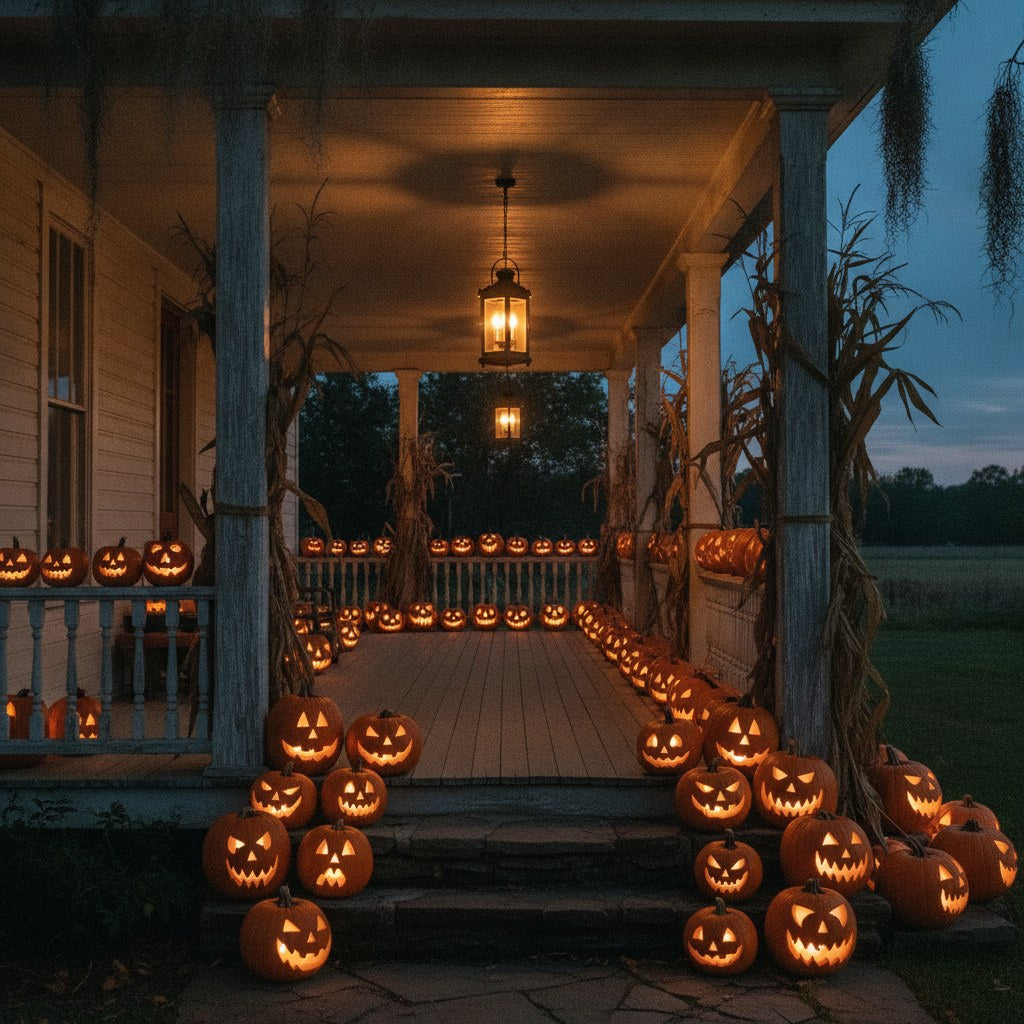
How Halloween America Became the Second Biggest Decorating Holiday (And Why Your Front Porch Is Ground Zero)
The history of Halloween in America is not a straight line. Halloween america as we know it — the carved signs, the lit porches, the inflatable skeletons taller than your truck — is the result of roughly 150 years of immigrant traditions colliding with retail ambition and a very old human instinct to mark the dark half of the year. It's worth understanding how that happened, because it explains why your front porch feels like the most important real estate in the neighborhood every October.

Where Halloween America Actually Started: The Celtic and Irish Foundation
The holiday traces back to Samhain, a Celtic festival observed on November 1st that marked the end of the harvest and the beginning of winter. The Celts believed the boundary between the living and the dead thinned on the night before — October 31st — and they lit bonfires, wore costumes made of animal heads and skins, and left food offerings at their doors to appease wandering spirits. When the Roman Empire absorbed Celtic territories, Samhain blended with two Roman autumn festivals: Feralia, which honored the dead, and a celebration of Pomona, goddess of fruit and trees. The apple — still showing up in your bobbing barrel — is Pomona's contribution.
The holiday came to America in force with the Irish immigration wave of the 1840s. Fleeing the famine, Irish immigrants brought Samhain customs with them, including the practice of carving lanterns — originally from turnips in Ireland, switched to pumpkins once they arrived and found a far superior canvas. By the late 1800s, the holiday had spread beyond Irish communities and was being written about in American newspapers as a neighborhood event. It was already becoming something new: less about spirits, more about community.
How Halloween America Became a Decorating Event (Not Just a Children's Holiday)
For most of the early twentieth century, Halloween in America was primarily a children's affair. Trick-or-treating as a structured neighborhood ritual solidified in the 1930s and 1940s, partly as a way to redirect the property vandalism that had become a genuine problem in some cities on October 31st. Give the kids candy, the thinking went, and they'll leave your fence alone. It worked, mostly.
The decorating dimension — the part that turns your porch into a production — came later and faster than most people realize. A few forces drove it:
- Post-war suburbanization created neighborhoods with visible front porches and lawns, giving people a stage they hadn't had before.
- The plastics industry, maturing in the 1950s and 60s, made mass-produced Halloween decorations cheap enough to be disposable.
- The 1978 release of Halloween and the horror film boom of the early 1980s reframed the holiday as something adults could participate in — and spend money on.
- Home improvement retail chains in the 1990s started dedicating entire seasonal sections to Halloween, normalizing the idea of decorating your exterior the same way you'd decorate for Christmas.
By the early 2000s, Halloween had crossed a threshold. It was no longer just the holiday before the real holidays. It was a decorating event in its own right, with its own aesthetic vocabulary and its own social expectations about participation.
◆ From the Workshop: When you're peeling the paper backing off a sheet of veneer that's been taped for a glue-up, dampen the tape with a wet sponge and wait sixty seconds before you pull — dry tape tears the veneer face with it, especially across the short grain at the ends. The moisture softens the adhesive just enough that the tape releases cleanly, and you save the surface you spent an hour preparing. Old veneer workers kept a small sponge in a dish on the bench the same way a painter keeps a rag on the shoulder: it was always the next move.
Frequently Asked Questions
When did Americans start decorating the outside of their homes for Halloween, not just the inside?
Exterior decorating — jack-o'-lanterns on the porch steps, hay bales at the door, hanging ghosts from porch ceilings — became mainstream in the 1980s and accelerated sharply through the 1990s as big-box retailers started stocking outdoor Halloween décor in dedicated seasonal aisles. Before that, most Halloween decoration was table centerpieces and paper cutouts inside the house. The shift outward tracked directly with the rise of organized trick-or-treat routes in suburban neighborhoods, where curb appeal suddenly had social stakes.
Is there a regional difference in how heavily Americans decorate for Halloween?
Yes, and it's more pronounced than most people expect. The Upper Midwest and New England tend to go heaviest on outdoor décor, partly because the leaf color peaks at the same time and the visual payoff is high. The South decorates enthusiastically but historically leaned more toward harvest and fall themes alongside spooky ones — a blend that's been narrowing as national retail trends homogenize the aesthetic. Warmer-climate states in the Southwest have seen some of the fastest growth in Halloween decorating over the last decade, likely because the holiday doesn't compete with weather the way it does in Minnesota.
What's the practical difference between decorating for Halloween versus decorating for fall — and do I have to choose?
You don't have to choose, and most people don't. The smartest approach is a layered one: start with a neutral fall foundation in early October — pumpkins in natural tones, dried corn, mums, a wood sign with a harvest sentiment — then add the spooky layer on top as the 31st approaches. That way your porch isn't aggressively Halloween for six weeks, but you're not scrambling to decorate on October 29th either. The fall layer stays up through Thanksgiving; the cobwebs and skull candles come down November 1st.

Why the Front Porch Is the Actual Battlefield
There's a reason Halloween decorating concentrates on the exterior of the house more than any other holiday except Christmas. The front porch is the negotiation point between your private space and the public street. On October 31st, that negotiation becomes explicit: a lit porch with a jack-o'-lantern and a bowl of candy is a social contract. An unlit porch is an opt-out. The decoration isn't just aesthetic — it's communication.
This is also why front porch decorating has its own logic and its own escalation dynamic. One neighbor puts out a hay bale and two mums. The next one adds a skeleton. By mid-October on a competitive street, you've got fog machines and motion-sensor ravens. Nobody planned this. It's emergent behavior driven by visibility and the very old human instinct to signal participation in a communal ritual.
We wrote a whole piece about front porch decorating and what makes an entryway actually feel welcoming — it's worth reading alongside this one, because the principles don't change much whether you're decorating for October or April. The porch is always doing social work.
The witch-themed front porch in particular has become a dominant aesthetic in halloween america over the last decade — pointed hats, cauldrons, the color palette of black and deep purple against orange. If you want to see how that translates into a specific decorating approach, this post on witch-themed Halloween party and front décor gets into the practical details.
The Psychology Underneath All of It
Here's what I think is actually going on, stripped of the retail layer. Humans have always needed to mark the transition from light to dark, from harvest to dormancy. Every culture on earth has a version of this. Halloween america is our version — chaotic, commercialized, loud, and genuinely fun — but it's doing the same psychological work that Samhain did for the Celts. It externalizes the anxiety about darkness and death by making them theatrical. You put a skeleton on your porch and it becomes funny. You carve a face into a pumpkin and the dark gets a little less dark.
That's not nothing. That's actually the whole point.
The decorating impulse is part of this. When you put a carved welcome sign on your door that says something wicked and wonderful, you're participating in a tradition that is genuinely ancient, even if the sign itself was made with a CNC router in Kentucky. The form changes. The function doesn't. If you want something for your door that leans into the season without taking itself too seriously, this carved hardwood Halloween welcome sign is the kind of thing that earns a double-take from the trick-or-treaters.
And if you want to browse the broader seasonal range — mugs, signs, the whole October spread — our holidays and seasons collection is where that lives.
The history of halloween america is really a story about belonging. About showing up for the neighborhood, marking the season, and refusing to let October 31st pass without some acknowledgment that the dark is here and we're not afraid of it. Your front porch is ground zero because that's where the community can see you. Make it count.
Share:
The Mai Tai Recipe Original vs. the Old Fashioned: How One Simple Bourbon Drink Conquered America | Bluegrass Gifts
What Makes Something Actually Funny? The Science Behind Why We Laugh | Bluegrass Gifts