

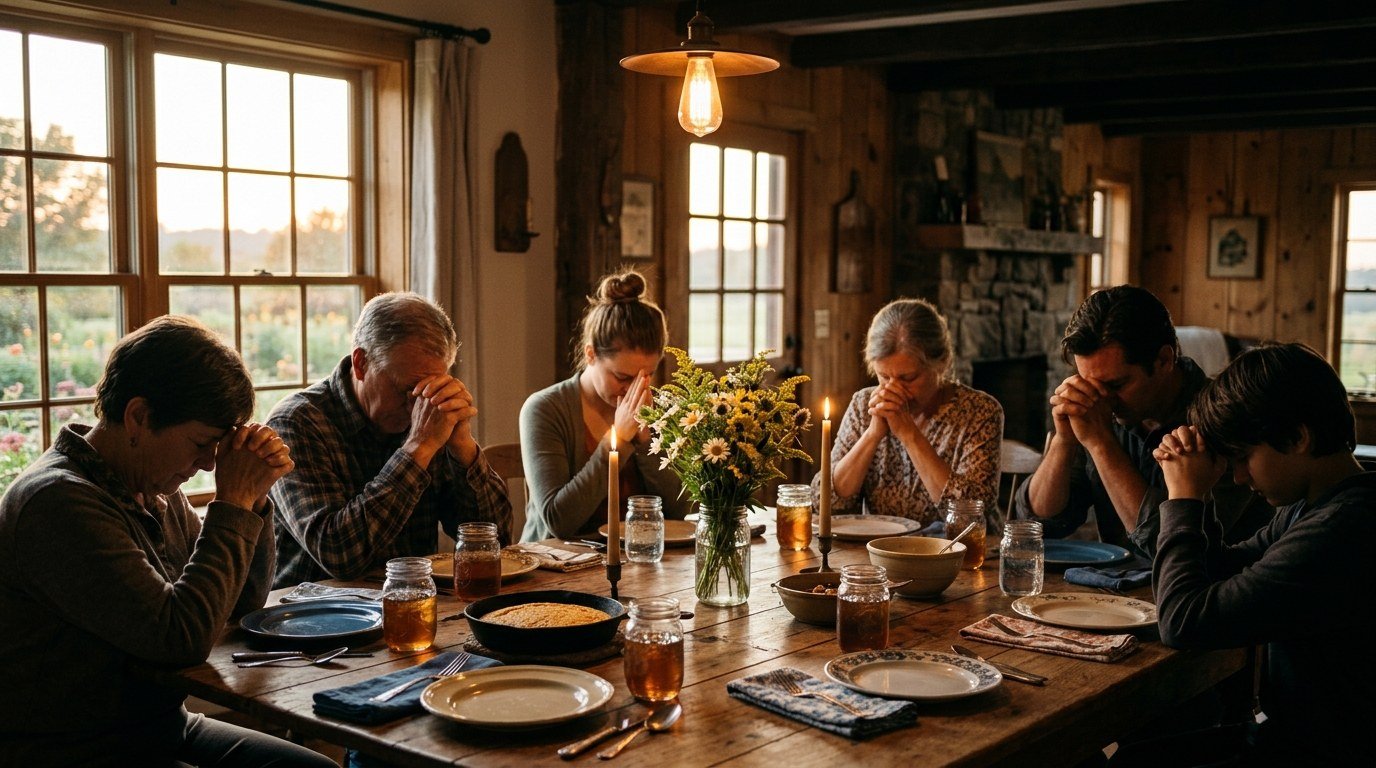
The Family Dinner Prayer: Where the Tradition Came From and Why So Many Families Are Bringing It Back
Somebody at your table bows their head before the fork hits the plate, and for a second everyone else follows along without thinking about it. That's the family dinner prayer doing exactly what it was designed to do — pulling people out of their own heads and into the same moment. It's one of the oldest rituals in human civilization, it nearly disappeared in the twentieth century, and right now, quietly, it's coming back.

The Dinner Prayer Is Older Than the Fork
People have been blessing food before eating it for roughly as long as there has been food worth blessing. Ancient Greeks poured libations to the gods before meals. Jewish table prayers — the birkat hamazon — date back at least two thousand years and are still recited today. Early Christians adapted the practice so thoroughly that by the medieval period, saying grace before a meal was simply what you did. No debate. No opting out.
The specific phrase "saying grace" comes from the Latin gratiarum actio, which means an act of thanksgiving. It wasn't a request so much as an acknowledgment — someone made this food possible, and it wasn't entirely you. That humility was baked into the ritual from the start.
In colonial America, the dinner prayer was a fixed point in the day. Puritan households treated it as seriously as Sunday worship. Even households that weren't particularly devout kept the form, because the form itself did something useful: it marked the beginning of the meal as a shared event, not just a feeding. That distinction mattered more than people realized until they stopped making it.
How the Blessing Got Dropped — and What Actually Replaced It
The twentieth century didn't kill the dinner prayer on purpose. It just got crowded out. Television moved into the dining room in the 1950s. Work schedules got longer and less predictable. By the 1980s, the family meal itself was under pressure — the average American household had already started eating in shifts rather than together. When the meal fragments, the blessing that opened it doesn't have anywhere to land.
Surveys from the Pew Research Center show that the share of Americans who pray daily has held relatively steady, but the location of that prayer shifted. It moved from the table to the bedroom, the car, the quiet moment before a hard conversation. The dinner prayer specifically — the communal, out-loud, everyone-stops version — became less common even in households that considered themselves religious.
What replaced it wasn't nothing. It was just smaller. A quick mental thanks. A habit of noticing. But the communal pause, the moment where everyone at the table is doing the same thing at the same time — that part largely went away. And a lot of families, looking back, can name the moment they realized they missed it.
If you're curious about the research on what shared meals actually do for families, we put together a piece on dinner table conversation and what the studies say — it connects directly to why rituals like this one carry more weight than they seem to.

Why Families Are Bringing the Dinner Prayer Back Right Now
The revival isn't happening in churches, exactly. It's happening in kitchens. Families who drifted away from the practice for a generation are picking it back up, and the reasons they give are less theological than practical. They want a seam in the day. A place where the phone goes face-down and nobody is mid-sentence about something that happened at school.
The dinner prayer provides that seam without requiring much. Thirty seconds. Everyone present. A few words that have been said so many times they feel like coming home.
There's also something happening with younger parents specifically. A generation that grew up in households where the blessing was inconsistent — sometimes said, sometimes skipped, sometimes rushed — is making a deliberate choice to be more consistent. Not necessarily more religious, just more intentional. The dinner prayer becomes a container for whatever the family wants to put in it: gratitude, acknowledgment, a moment of stillness before the chaos of passing dishes and spilled milk.
The Sunday dinner tradition has always carried this kind of weight in Southern households, and we've written about that specifically over at the history of the Southern Sunday supper — because the blessing and the meal were never really separate things.
◆ From the Workshop: When you're turning a bowl and the blank suddenly goes quiet — that soft, muffled sound instead of the clean hiss of tool on wood — you've hit a pocket of punky, partially rotted wood inside the log. You can't see it from the outside, and it won't show up until the gouge breaks through the surface layer. Old turners called it 'finding the rotten heart,' and the rule is simple: slow the lathe down immediately, because punky wood doesn't fail gradually — it fails all at once. There's a version of that lesson in family traditions too: the rot doesn't announce itself. You only notice it when something breaks.
Frequently Asked Questions
Are there dinner prayers that work for mixed-faith or secular families?
Absolutely. Many families use gratitude-based blessings that don't invoke a specific deity at all — something as simple as naming one thing each person is thankful for before eating counts. The Quaker tradition of silent grace is another option: thirty seconds of quiet before the meal, no words required. The ritual structure matters as much as the theology.
How do you start a dinner prayer tradition when your kids are teenagers and already resistant?
Don't announce it as a new rule. Try framing it as a rotating responsibility — each person picks the blessing that week, including something funny or personal. Teenagers respond better to ownership than obligation. Give them the wheel and most of them will actually drive it.
What's the difference between a blessing and a grace, technically?
Historically, 'saying grace' referred specifically to giving thanks to God before eating — from the Latin 'gratiarum actio,' an act of thanks. A 'blessing' is broader and can refer to asking God to bless the food, the hands that prepared it, or the people gathered. In everyday use the words are interchangeable, but in liturgical traditions they carry distinct meanings.
How to Start — or Restart — a Dinner Prayer Tradition That Actually Sticks
The families who make it work tend to share a few habits. None of them are complicated.
- Keep it short at first. A two-sentence blessing said consistently beats a beautiful paragraph said once a month. Start with something everyone can memorize.
- Let it rotate. When one person always leads, it becomes their thing. When it rotates, it becomes everyone's. Kids especially rise to the responsibility when it's genuinely theirs.
- Allow for silence. Some of the most powerful dinner prayers are thirty seconds of quiet before the meal. No words required. The pause itself does the work.
- Don't correct in the moment. If a child says something unexpected or funny during their turn, let it land. The goal is participation, not performance.
- Tie it to something physical. Holding hands, bowing heads, or even just setting down phones — a physical cue trains the brain faster than words alone.
The families who struggle are usually the ones who treat it as an all-or-nothing proposition. Miss one night and the whole practice collapses. It doesn't have to work that way. A tradition interrupted and resumed is still a tradition. The blessing doesn't require a perfect record to mean something.
What the Words Actually Do — and Why It Matters Where You Say Them
Language that gets repeated in the same place, at the same time, does something to a space. It layers meaning onto it. The kitchen table where your grandmother always said grace before Sunday dinner isn't just a table anymore. It's a place where certain words have been said so many times the air holds them.
That's not mysticism. It's how memory and place work together. Researchers who study family rituals consistently find that the location of a repeated practice matters almost as much as the practice itself. The table, the chairs, the habit of gathering — these become the container that holds the words.
Some families mark that container with something visible. A carved hardwood sign hung near the dining room, carrying a blessing or a family verse, does the same work the words do: it says, this is a place where we mean something to each other. The rustic family gathering sign we make for dining rooms is exactly that kind of anchor — not decoration for decoration's sake, but a daily reminder of what the table is for.
If you're thinking about what else belongs in a space like that, our family signs collection is where those pieces live — the kind of words that say out loud what most families only think.
The dinner prayer never really went away. It just waited. It waited in the muscle memory of people who grew up saying it, in the quiet before meals where something felt missing, in the instinct that gathering around food should mean more than just eating. Families are finding their way back to it now, one table at a time, and they're not doing it because someone told them to. They're doing it because it works.
Share:
What Duck Hunting Dogs Actually Know That Their Owners Don't: The Science Behind the Retrieve | Bluegrass Gifts
How to Remove Coffee Stains and Everything Else: The Laundry Rules Every Grandmother Knew by Heart | Bluegrass Gifts