

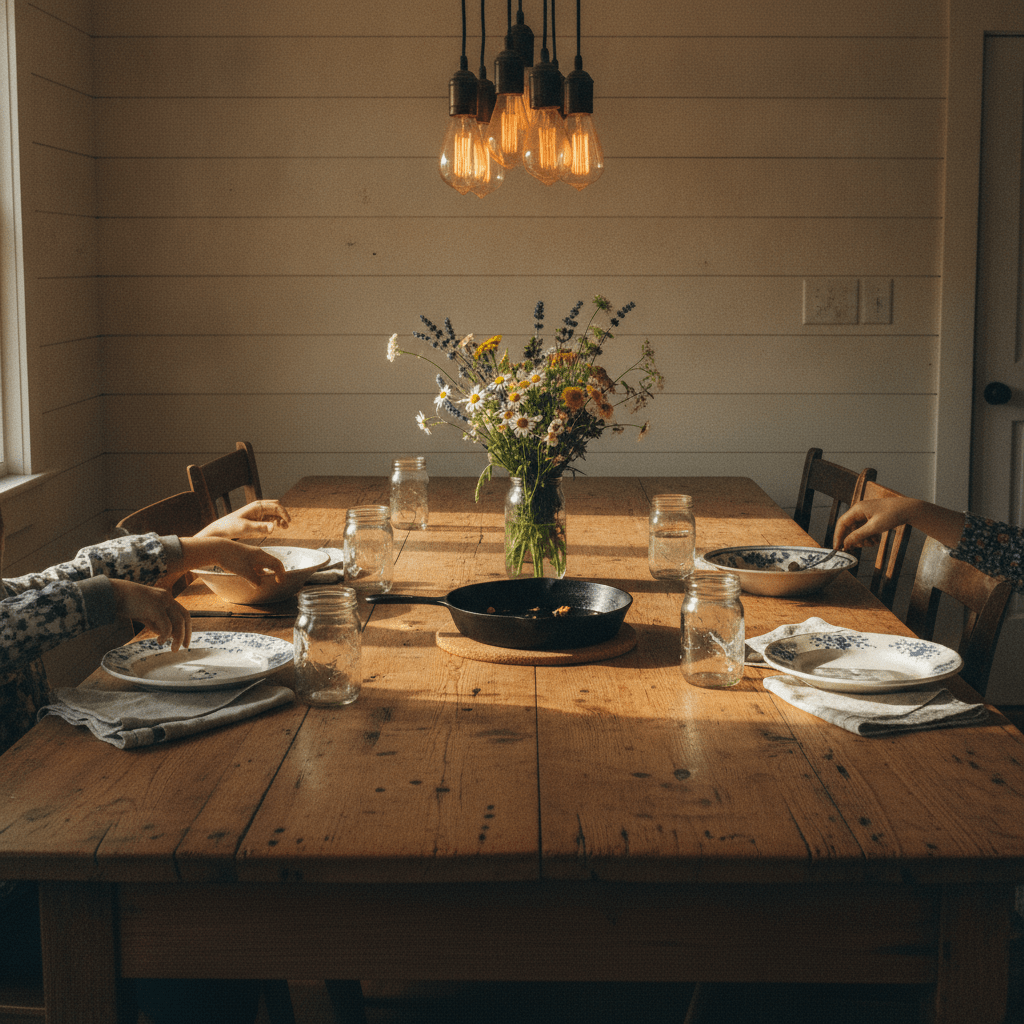
The Dinner Table Has Been Quietly Studied for Thirty Years
You sit down most nights, somebody complains about what's on the plate, someone else checks a phone under the table, and you wonder if any of this actually matters. It turns out researchers have been wondering the same thing — and they went looking for an answer with longitudinal studies, behavioral surveys, and enough academic funding to make you think somebody important believed the dinner table was worth understanding.
The short version: they were right. The longer version is more interesting than the headline.
Starting in the 1990s, researchers at Columbia University's National Center on Addiction and Substance Abuse began tracking the relationship between family meals and adolescent behavior. What they found wasn't subtle. Teens who ate dinner with their families five or more nights a week were significantly less likely to use drugs, alcohol, or tobacco than those who rarely shared meals. That finding held up across income levels, family structures, and regions. It wasn't about the food. It was about the table.
The dinner table, it turns out, is one of the most consistent predictors of family cohesion that researchers have been able to measure — not because anything magical happens there, but because of what the habit signals: we show up for each other, regularly, on purpose.

What Actually Happens at the Dinner Table — According to the Data
The Columbia studies got enough attention that other researchers started looking closer. What they found when they actually observed family meals — not just surveyed about them — was more specific than anyone expected.
Families who ate together regularly used more complex vocabulary during conversation, which correlated with stronger language development in children. They interrupted each other less over time. They were more likely to share opinions and disagree productively. And children in those households were better at identifying and naming their own emotions — a skill that turns out to matter enormously in adolescence and adulthood.
A 2012 study out of Harvard's School of Public Health added another layer: family meals were associated with healthier eating patterns, yes, but the mental health outcomes were stronger than the nutritional ones. Kids who ate with their families reported lower rates of depression and anxiety. The effect was consistent enough that the researchers called it one of the most cost-effective interventions available to families — which is a clinical way of saying it's free and it works.
What none of this tells you is what to actually say. And that's where most families get stuck.
Why Dinner Table Questions Matter More Than the Meal Itself
The research on family meals keeps circling back to one variable: conversation quality. Not length. Not formality. Quality. Families who asked genuine questions — not just "how was school" — showed stronger outcomes across almost every measure studied.
The problem is that most of us default to the same five questions every night. School. Practice. Homework. What did you eat for lunch. Did you finish that thing. These aren't bad questions, but they're logistical. They don't open anything up. They're the conversational equivalent of checking boxes.
Good dinner table questions do something different. They invite opinion. They reveal something about the person asking. They're slightly unexpected. A few that researchers and family therapists have noted tend to generate real conversation:
- What's something you changed your mind about this week?
- If you could trade places with anyone for one day, who would it be and what would you want to know?
- What's the hardest part of your day that you didn't tell anyone about?
- What's something you're looking forward to that's more than a month away?
- If our family had a motto, what should it be?
That last one tends to produce either genuine insight or complete chaos, and honestly both are fine. The point is to get people talking about something that matters to them, not something they're obligated to report on.
We've written about how the kitchen itself shapes the feeling of a meal — what makes a kitchen feel like the heart of the home gets into that in a way that's worth sitting with.
◆ From the Workshop: Hickory is so tough it was the wood of choice for wagon wheel spokes and axe handles for centuries — but most people don't know it's also the most calorie-dense firewood in North America, burning hotter and longer than oak. When you run a hickory board through the planer, the shavings carry a faint smokiness, like the wood already knows what it was destined to become. There's something fitting about that — the hardest materials tend to hold the most.
Frequently Asked Questions
How long does a family meal actually need to be to get the benefits researchers found?
Most of the studies that showed positive outcomes — lower rates of depression, better academic performance, stronger communication — were based on meals lasting 20 minutes or more. A rushed 10-minute dinner while someone's half-watching a phone doesn't register the same way. The conversation itself seems to be the active ingredient, not the food, so the meal needs to be long enough for a real exchange to happen.
Do the benefits of family dinners still apply to teenagers, or does it stop working once kids hit middle school?
This is where the research gets interesting: the benefits actually become more pronounced during adolescence, not less. Teens who ate regularly with their families showed lower rates of substance use and higher rates of reporting they'd go to a parent if they had a serious problem. The catch is that the dynamic has to shift — teens respond to being asked genuine questions, not interrogated about grades or schedules. The meal has to feel like a conversation, not a debrief.
What if our family dinners are consistently chaotic — little kids, spills, someone crying — does that undo the benefit?
Not according to the research. The chaos itself isn't the variable. What matters is that the family is physically present together and talking, even imperfectly. Studies that followed families over time found that the ritual of showing up — even when dinner is loud and messy and someone knocks over their milk — still builds the sense of stability and belonging that produces the long-term outcomes. Perfection at the table was never part of the equation.
The Ritual Matters as Much as the Content
Here's the part the data keeps returning to, and it's worth saying plainly: consistency beats perfection. Families who ate together regularly but imperfectly — chaotic evenings, short meals, interrupted conversations — still showed better outcomes than families who occasionally had long, intentional dinners but no real routine.
Researchers call this the "ritual effect." When something happens regularly enough, it stops being an event and becomes a container. The family dinner becomes a place where things get said that wouldn't get said otherwise, not because anyone planned it that way, but because the container exists and people know it's safe to fill it.
This is also why disruptions to the routine — a stretch of travel, a season of sports schedules, a teenager who suddenly won't come to the table — tend to feel like more than just missed meals. They feel like something structural is loosening. Because something structural is loosening.
The fix isn't complicated. It's just consistent. Show up. Ask something real. Let the conversation be imperfect. Do it again tomorrow.

What Families Who Do This Well Actually Look Like
There's a temptation to picture the research-backed family dinner as something out of a magazine — linen napkins, no devices, everyone taking turns sharing their feelings. That's not what the studies were measuring, and it's not what most families can sustain.
What the families who showed the strongest outcomes actually had in common was simpler: they treated the meal as non-negotiable. Not sacred. Not formal. Just non-negotiable. It happened. Everyone came. The rest was variable.
Some of those families were loud. Some were quiet. Some had a TV on in the background. Some had a standing joke that started every meal. Some had a family member who barely talked but showed up anyway. The ritual held because the expectation held — not because the execution was flawless.
One pattern that showed up in qualitative research: families who had some kind of physical anchor to the space — a specific table, a chair that was always someone's chair, something on the wall that marked the room as theirs — reported stronger feelings of belonging tied to mealtimes. It sounds small. It apparently isn't. There's a reason people keep their grandmother's table long after they need the furniture.
That instinct to mark a space as meaningful is something our family signs collection was built around — the idea that what hangs in a room quietly shapes how people feel in it.
If you want to go deeper on what actually holds families together over the long haul, we wrote about why family-themed decor hits differently than regular decoration — it gets at the psychology in a way that surprised even us when we were putting it together.
None of this requires a perfect family or a perfect kitchen. It requires a table, some people who matter to you, and a question worth asking. The researchers did thirty years of work to arrive at something your grandmother probably already knew. Show up. Eat together. Talk about something real. It turns out that's most of it.
If this post put you in the mood to browse, the Grandparents Sign — First 50 Years Are the Hardest is the one folks pick first.
Frequently Asked Questions
Does eating dinner together as a family actually make a difference?
Yes, and the research backs it up further than most people expect. Columbia's longitudinal studies found teens eating dinner with family five or more nights a week were significantly less likely to use drugs, alcohol, or tobacco, regardless of income or family structure. It was not about the food on the plate. It was about the regular, repeated act of showing up together.
What did the Harvard study find about family dinners and mental health?
The 2012 Harvard School of Public Health study found family meals were linked to lower rates of depression and anxiety in kids, and that effect was actually stronger than the nutritional benefits. Researchers called it one of the most cost-effective interventions available to families, since it costs nothing and consistently works across households.
How many nights a week should a family eat dinner together for it to matter?
Researchers found five or more nights a week produced the clearest results in teen behavior and family cohesion. That said, the studies point to consistency mattering more than hitting a magic number. A family that manages three steady nights a week is likely to see more benefit than one that aims for seven but rarely follows through.
Share:
What to Write in a 25th Anniversary Card When You've Already Said Everything | Bluegrass Gifts
Anniversary Meanings: The Strange, Sweet History of How Each Year Got Its Symbol | Bluegrass Gifts