

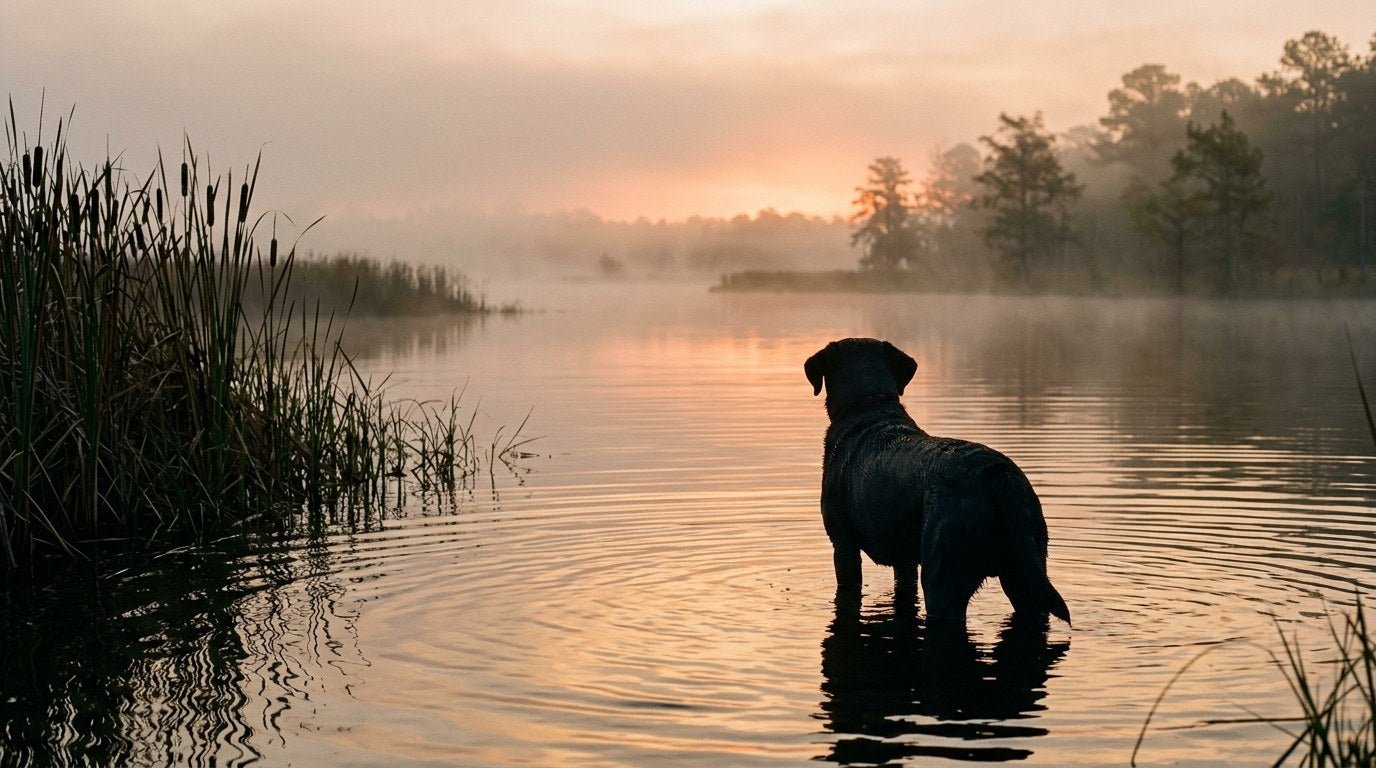
Duck Hunting Dogs Already Knew Where That Bird Was Going to Land
Your Labrador was off the blind step and into the water before you finished saying the word. You were still tracking the bird with your eyes, doing the mental geometry of wind and drop angle. She had already run the calculation and committed. That gap — between what you perceived and what she acted on — is not a coincidence, and it is not just enthusiasm. Duck hunting dogs are operating on a sensory and cognitive system that makes the human hunter look like he's working with a rotary phone.
The retrieve looks simple from the bank. Dog goes out, dog comes back with bird. What actually happens in between is one of the more quietly extraordinary things in the natural world, and most hunters spend years watching it without ever understanding the machinery underneath.

The Nose Knows More Than You Can Imagine — Literally
A dog's nose contains roughly 300 million olfactory receptors. Humans have about 6 million. That's not a minor upgrade — that's a different instrument entirely. But the raw receptor count undersells the real advantage, which is in the brain. The portion of a dog's brain devoted to analyzing smell is, proportionally, about 40 times larger than the equivalent region in a human brain.
What that means in the marsh is this: a duck hunting dog is not just smelling a downed bird. She is reading a scent cone — a three-dimensional, constantly shifting plume of odor molecules that spreads downwind from the bird. She can detect the difference between where the scent is strongest and where it's fading, and she moves through that gradient the way you'd follow a trail of breadcrumbs, except the breadcrumbs are invisible and moving and she's tracking them at a dead run through chest-deep water.
There's also the matter of what she's smelling. Dogs can detect the scent of a bird that has been dead for hours, buried under water, or hidden in grass so thick you'd need to part it with both hands. The whole tradition of dogs and ducks in the Kentucky marsh is built on this partnership — but the dog's half of the deal is doing work most hunters never fully appreciate.
How Duck Hunting Dogs Mark, Remember, and Run Multiple Retrieves
Marking is the skill that separates a good retriever from a great one. When a bird falls, the dog is doing several things simultaneously: tracking the arc of the bird visually, noting landmarks relative to the fall, registering the sound of the splash or impact, and storing all of it in a short-term spatial memory that researchers have compared to the way humans remember directions.
On a double or triple retrieve, the dog holds multiple fall locations in working memory while completing each retrieve in sequence. Studies in canine cognition — including work from the American Kennel Club's retriever training research — suggest dogs use a combination of visual landmarks, egocentric spatial memory (position relative to their own body), and allocentric memory (position relative to fixed objects in the environment). They are, in other words, building a mental map of the marsh in real time.
The handler calling a line and the dog running it are not always doing the same thing. The handler is pointing. The dog is navigating.
◆ From the Workshop: When you need to mark an exact depth on a chisel for a through-mortise, skip the tape measure and wrap a piece of masking tape around the blade at the right spot — the tape edge becomes your stop line, sits perfectly perpendicular, and reads clearly in dim shop light. Old timber framers called any improvised depth gauge a story stick, and the masking tape version is the one that never gets lost. It sounds like a shortcut until you've used it once and then used it every time after that.
Frequently Asked Questions
At what age should a duck hunting dog start formal water retrieve training?
Most trainers begin introducing water retrieves around 10 to 14 weeks, using shallow, warm water and keeping sessions short. Formal marked retrieves with decoys and gunfire are typically introduced between 6 and 9 months, once the dog has solid obedience on land. Starting too early with cold water or long swims can create a negative association that's hard to undo later.
Do duck hunting dogs ever lose their marking ability as they age?
Yes, but it's usually vision and hearing loss driving the decline, not a failure of memory or drive. Many older dogs compensate remarkably well by leaning harder on scent once their eyesight dims. Hunters with aging dogs often report that the dog's nose actually seems sharper in the back half of its career — likely because it's relying on it more consciously.
Why do some retrievers refuse to give up the bird once they've retrieved it?
Hard mouth and possessiveness are two different problems that get lumped together. Possessiveness is usually a training gap — the dog was never taught that delivering the bird leads to something better than keeping it. Hard mouth, where the dog grips too firmly and damages the bird, can be genetic or a response to pain in the jaw or teeth. A vet check before assuming it's a training issue is always worth doing.
What Duck Hunting Dogs Feel in Cold Water That Changes Their Retrieve
Water temperature is not just a comfort issue. It is a physiological one that directly affects performance, and most hunters underestimate how fast it compounds.
A dog entering 40-degree water begins vasoconstriction — blood pulling away from the extremities toward the core — within minutes. Her muscles in the legs and tail cool faster than her core, which affects swimming mechanics and, eventually, the precision of her final approach to the bird. A dog that looks like she's hunting sloppily in late-season water may simply be fighting cold-induced muscle fatigue that her owner is attributing to distraction or poor training.
- Dogs lose body heat in water roughly 25 times faster than in air at the same temperature.
- A healthy adult Labrador can typically handle 30 to 45 minutes of cold-water work before performance begins to degrade noticeably.
- Dark-coated dogs absorb more solar radiation between retrieves, which is a genuine physiological advantage on sunny days — not just aesthetics.
- The double coat of a retriever is not simply insulation; the dense undercoat traps a layer of warmer water against the skin, functioning more like a wetsuit than a blanket.
The dog is managing all of this silently, in real time, while also tracking scent and running marks. The hunter is standing on dry land in waders complaining about the cold.

The Retrieve Is a Conversation, Not a Command
Here is the thing that most duck hunting dogs would probably like their owners to understand: the retrieve is not a simple stimulus-response loop. It is a negotiation between instinct, training, environment, and trust. The dog is reading the handler's body language, tone, and positioning as much as she's reading the field. A handler who is tense, over-directing, or giving conflicting signals is genuinely making the dog's job harder.
Researchers studying handler-dog communication in working breeds have found that dogs are remarkably sensitive to involuntary human cues — the direction a handler's shoulders are angled, the tension in a leash, even the handler's own gaze direction. A dog that appears to be ignoring a command may actually be responding to the handler's body saying something different than the handler's mouth.
The best retriever trainers describe their relationship with a finished dog less like operating a piece of equipment and more like hunting with a partner who happens to have better senses and worse opinions about staying in the blind. That framing matters. The dogs who perform best in difficult conditions — long blinds, heavy cover, cold water, multiple falls — are almost always dogs who trust their handler completely and whose handlers have learned to trust them back.
If you want a reminder of that partnership on the wall of your mudroom or gear room, a marsh-themed duck hunting dog design says it better than most trophies do. And if the whole category of nature and wildlife speaks to your household, our nature and wildlife magic mugs are the kind of thing that makes a cold morning in the blind feel like it started right.
The dog already knew all of this, of course. She was just waiting for you to catch up.
Share:
Be a Sunflower, Not a Rose: The Deep History Behind Resilience Quotes | Bluegrass Gifts
The Family Dinner Prayer: Where the Tradition Came From and Why So Many Families Are Bringing It Back