

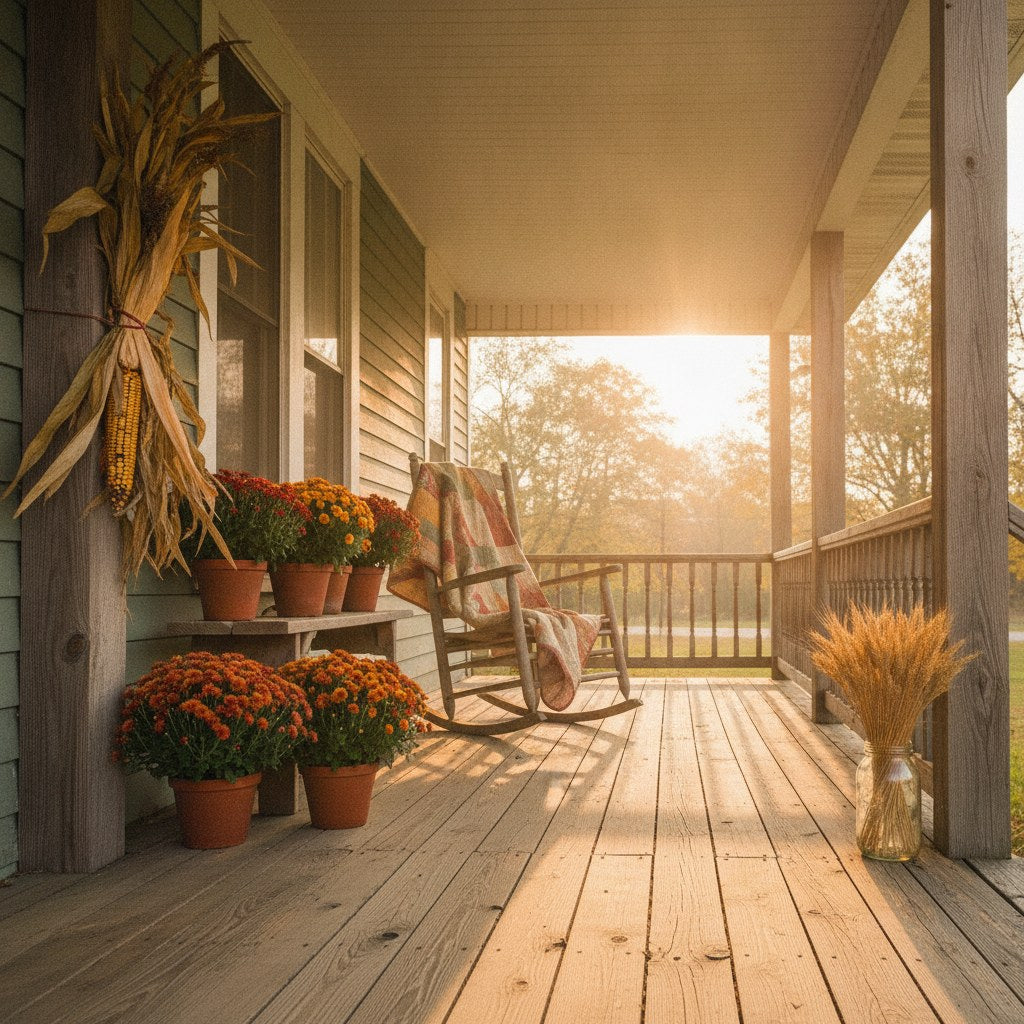
Seasonal Decor Is Older Than You Think — And Stranger Than You'd Expect
You pulled the fall bin out of the attic last weekend. You know you did. And somewhere between unwrapping a ceramic pumpkin and untangling a garland, you probably didn't stop to ask why you were doing it. Holiday and seasonal decor is so baked into domestic life that the habit feels like gravity. You just do it. But the impulse goes back a long way — further than Hobby Lobby, further than department stores, further than printed catalogs. It goes back to the actual seasons themselves, and what they meant to people who had no choice but to pay attention to them.
Anthropologists who study domestic ritual point out that humans have been marking seasonal transitions with changes to their living spaces for as long as there have been living spaces. Ancient Romans hung laurel branches in January to honor Janus, the god of doorways and new beginnings. Medieval European households brought in evergreens in December not for aesthetics but because green living things in the dead of winter were genuinely remarkable. The decoration was the announcement: something is happening here, and we are part of it.

The Psychology Behind Seasonal Decor Changes — Your Brain Needs the Reset
Here is what the research actually says. Environmental psychologists have found that people report higher feelings of well-being and sense of control when their surroundings change in sync with the natural world. The technical term is temporal landmarks — moments that mark the passage of time and give us a sense of forward movement. Seasonal decor functions as a physical temporal landmark inside your own home. You're not just putting up a wreath. You're telling your nervous system that time is moving, that you are moving with it, and that this particular stretch of the year has its own texture and meaning.
There's also something simpler at work. Novelty. The human brain habituates fast — neuroscientists call it sensory adaptation — which means the things you see every single day essentially become invisible to you. Your brain stops processing them as information. A seasonal swap breaks that adaptation. The same room suddenly reads again. You notice it. You feel it. That's not a small thing when you spend most of your waking hours inside it.
- Temporal landmarks reduce what psychologists call the "tunnel effect" — the feeling that time is blurring together.
- Novelty in a familiar environment activates the brain's reward circuitry without the stress of actual change.
- Shared seasonal rituals (decorating together, putting things away together) strengthen family cohesion in ways that are well-documented in family systems research.
- The anticipation of a seasonal change — knowing it's coming — provides a low-grade positive affect that researchers associate with hope and forward orientation.
So the person who starts putting up fall decorations in late August isn't just impatient. She's chasing that anticipatory lift, which is its own legitimate form of joy. Hard to argue with that.
◆ From the Workshop: Wood and seasons have a relationship that most people never think about until a drawer starts giving them trouble. When a wooden drawer binds in summer but rattles loose in winter, the culprit is almost always the top edge — that's where the widest face-grain surface sits exposed, and it swells and shrinks the most as humidity rises and falls. A few strokes of a hand plane along that top edge in August will buy you a smooth-running drawer all year long, and you barely touch the sides at all. Old cabinetmakers in humid climates kept a block plane hanging right next to the bench for exactly this one seasonal chore.
Frequently Asked Questions
How do I store seasonal decor so it doesn't get ruined between years?
The two enemies of stored decor are moisture and pressure. Natural materials — dried florals, fabric wreaths, paper goods — do best in breathable containers, not sealed plastic bins, because trapped humidity breeds mildew. Hard ornaments and resin pieces handle plastic bins fine, but wrap them in unbleached tissue rather than newspaper, which can transfer ink over time. Label the outside of every bin with the season AND the room it goes in. Future-you will be grateful in a way that is hard to overstate.
Is there a point where rotating seasonal decor becomes too much — cluttered rather than cozy?
The rule most interior stylists use is subtraction before addition: before anything new goes up, something existing comes down. Seasonal decor works best as an edit, not a layer cake. Pick two or three anchor spots in a room — the mantel, the entry table, one wall — and let those do the seasonal work while the rest of the room stays consistent. That way the change reads as intentional rather than accumulated.
What's the difference between seasonal decor and holiday decor, and does it matter?
It matters more than people think when you're shopping or styling. Holiday decor is tied to a specific occasion — Christmas trees, Easter baskets, Halloween jack-o-lanterns — and has a hard expiration date. Seasonal decor tracks the broader arc of the year: warm tones and harvest textures for fall, bare branches and wool throws for winter, botanicals for spring. Seasonal pieces have a longer useful window and tend to layer better with what you already own, which makes them a smarter investment if you're building a collection over time.
How Seasonal Decor Became a Retail Industry (And Why That's Not the Whole Story)
The commercialization of seasonal decorating accelerated in the late nineteenth century, when mass manufacturing made decorative goods cheap enough for middle-class households to buy and discard on a seasonal cycle. Before that, most families reused the same items year after year — a few dried herbs, a piece of ribbon, whatever was growing outside. The shift toward disposable seasonal goods happened gradually, then all at once, and by the mid-twentieth century the holiday decorating industry was a multi-billion dollar machine.
But here's the thing: the commercial layer sits on top of something that was never commercial to begin with. People decorated for the seasons long before anyone was selling them anything. The industry didn't create the impulse. It just found a way to sell to it. Which means that when you choose to invest in something that lasts — a carved hardwood sign, a piece of furniture, a hand-thrown pot — rather than something disposable, you're actually closer to the original spirit of the thing than the person filling a cart with plastic gourds every October.
That distinction matters more now than it used to. There's a real and growing countermovement toward front-door fall decorating that lasts more than one season — pieces chosen for durability and meaning rather than novelty alone. The goal isn't to stop celebrating the seasons. It's to do it in a way that doesn't end up in a landfill by November 1st.

What Seasonal Decor Actually Does for a Home — Room by Room
The most effective seasonal decorating isn't about covering every surface. It's about choosing a few high-visibility spots and letting them carry the whole room's feeling. Entry points do the most work per square foot. The front door, the entry table, the first wall a guest sees — those are the places where a seasonal change lands hardest, because they set expectation before anyone has even sat down.
Kitchens are the second-highest-impact zone, and not just because people spend time there. The kitchen is where the smells of a season live — cinnamon in fall, citrus in winter, fresh herbs in summer — and visual cues that match those smells create a coherent sensory experience that feels intentional rather than accidental. Our piece on the kitchen as the heart of the home gets into the science of why that room carries so much emotional weight, and it's worth sitting with if you've ever wondered why kitchen decor feels different from decorating any other room.
Living spaces and mantels are the traditional canvas, and they remain effective because they're where families gather. The mantel especially functions almost like an altar in the secular sense — a raised surface that holds the objects a household considers worth displaying. Changing what's on it with the seasons is a way of saying what matters right now, in this particular stretch of the year.
- Entry and porch: high-visibility, sets the seasonal tone before guests enter.
- Kitchen: pairs visual cues with sensory memory — smell, warmth, texture.
- Mantel or bookshelf: the traditional focal point, works as a rotating seasonal display.
- Bedroom: often overlooked, but a seasonal textile swap — throw blanket, pillow covers — changes how the room feels to wake up in.
The Signs That Say What the Season Feels Like Out Loud
There's a reason certain phrases feel right at certain times of year. "Gather here." "Grateful." "Let it snow." They're not complicated sentiments, but they do something specific: they name the emotional register of the season, and naming a thing makes it more real. That's what the best holiday and seasonal decor does. It doesn't just look like the season. It speaks it.
A carved wood sign does this particularly well because wood itself is a seasonal material — it responds to the air, it ages with the house, it has a warmth that reads differently in October firelight than it does in May sunshine. The spooky carved Halloween welcome sign is a good example of a piece that earns its place on the porch because it commits fully to the season's personality — dry humor, a little theatrical, exactly right for the one month of the year when your front door is supposed to make people stop and grin.
We carve our signs in Kentucky from Amish-sourced hardwood, and one thing that work has taught us is that the pieces people keep for decades are almost never the most elaborate ones. They're the ones that said something true about who the family was in a particular season of life. That's the version of seasonal decor that earns its place on the wall year after year — not because it matches the throw pillows, but because it still means something when you look at it.
If you're building out a seasonal rotation and want pieces that hold up past one calendar year, the holidays and seasons collection is a good place to see what that looks like when the goal is meaning over novelty. And if the season you're decorating for is the one that involves a lot of coffee and early mornings and trying to feel festive before you're fully awake, well — that's a whole other category of seasonal survival gear.
The deeper truth underneath all of it is simple enough to say out loud on a porch: we decorate for the seasons because we are seasonal creatures. We need the year to have texture. We need October to feel different from April. We need our homes to reflect the fact that time is passing and we are here for it, paying attention, marking it with objects we chose on purpose. That is not a retail impulse. That is a human one.
Share:
The Boss Who Changed Everything: Great Manager Qualities, According to the People Who Had One | Bluegrass Gifts
Bathroom Etiquette Rules Every Household Needs — Plus the Bathroom Joke Nobody Tells You | Bluegrass Gifts