

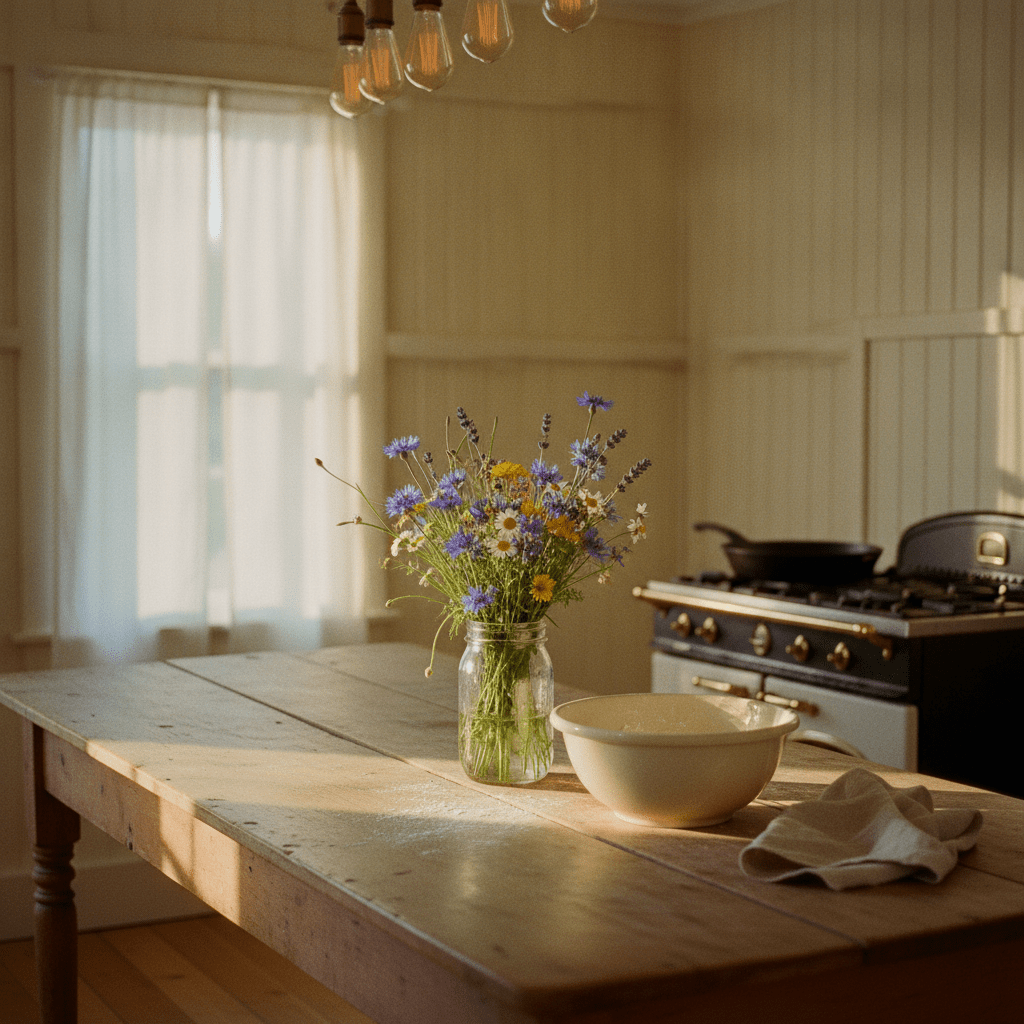
The Heart of the Home Kitchen Didn't Start With Open Floor Plans
You didn't decide the kitchen was the center of your house. It just became that. Somebody was always already in there when you walked through the door, and somehow the important conversations — the ones about school and money and what's really going on with your sister — happened over a cutting board rather than in the living room where the nice furniture is. That's not an accident. That's about ten thousand years of human wiring playing out in your ranch house.
The kitchen's role as the beating heart of the home is older than kitchens as we know them. Before there were rooms, there was fire. Anthropologists who study early human settlements note that hearth placement was essentially the floor plan — everything else radiated out from the point of heat and light. The hearth was where food was made safe to eat, where the cold was kept back, and where the group gathered after dark. Calling the kitchen the center of the home isn't sentiment. It's archaeology.
The ancient Romans had a dedicated kitchen goddess, Vesta, whose temple fire was never allowed to go out. Medieval great halls were organized around the hearth. Even the word 'focus' is Latin for fireplace. The center of the home has always been the place where something burns.

What Neuroscience Says About Why We Gather of the Home's Warmest Room
Here's where it gets interesting. Researchers at Cornell University's Food and Brand Lab have spent years studying how people actually behave in kitchens, and the findings line up with what your grandmother already knew. The smell of food cooking triggers the release of oxytocin — the same bonding hormone associated with physical touch and social trust. You are, literally, chemically drawn toward a kitchen where something good is happening on the stove.
There's also a concept called 'ambient belonging' — the sense that a space is safe and you are welcome in it — and kitchens score higher on this measure than any other room in the house. Warm light, familiar smells, the low-grade noise of water and pots: these are sensory signals that register as safety in the oldest parts of the brain. The living room might be more comfortable. The bedroom is more private. But the kitchen is where the nervous system relaxes.
This is also why the kitchen tends to be where people have the conversations they didn't plan to have. Psychologists who study communication patterns note that side-by-side activity — both people doing something with their hands, neither one looking directly at the other — lowers social defensiveness. You say things chopping onions that you'd never say sitting across a table. The kitchen creates that condition naturally, every single day.
◆ From the Workshop: There's a woodworking tool called a marking gauge — a small thing with a pin that scores a line parallel to an edge before you cut. That pin doesn't crush the wood fibers the way a pencil does; it severs them cleanly, leaving a tiny groove. When you come back with a chisel or a shoulder plane, the edge registers right in that groove like it was always meant to sit there. It's the difference between chasing a fuzzy line and following a track that's already been cut. A kitchen works something like that — it scores a groove in the life of a household, and everything else tends to find its way back to it.
Frequently Asked Questions
Does kitchen layout actually affect how much time families spend together in it?
Yes, and the research is pretty specific about it. Open-plan kitchens that face a living or dining area — what designers call a 'social kitchen' layout — increase spontaneous family interaction by removing the wall that used to isolate the cook. Studies from the Environmental Design Research Association found that sightlines matter most: when a parent at the stove can see a child doing homework at the table, both people linger longer. Galley kitchens, by contrast, tend to funnel people in and out rather than gathering them.
What's the best way to make a small kitchen feel more like a gathering space?
The trick is removing barriers to casual presence — meaning you want people to be able to stand or sit nearby without being in the way. A counter-height stool tucked against an island or peninsula gives someone a place to perch and talk without crowding the cook. Warm lighting (around 2700K, not the cool white that makes kitchens feel clinical) also signals 'stay a while' rather than 'this is a work zone.' Scent matters too — a pot of something simmering draws people in faster than any design choice you can make.
Why do people tend to have their most honest conversations in the kitchen rather than, say, the living room?
Psychologists call it 'side-by-side conversation,' and it turns out humans open up more easily when they're not facing each other directly. The kitchen naturally produces this: two people chopping vegetables, one washing and one drying, a kid sitting at the counter while a parent cooks. The shared task gives both parties something to look at besides each other, which lowers the social stakes enough that harder things get said. Therapists actually use this principle deliberately — some conduct sessions while doing a simple activity together rather than sitting face to face.
The Social Architecture of the Home's Most Functional Room
There's a reason kitchen renovations consistently rank as the home improvement project people say improved their quality of life the most — above bathrooms, above master bedrooms, above anything else. It's not about the appliances. It's about what happens when the layout changes who can be in the room together.
The shift from the closed, servant-era kitchen to the open-plan kitchen of the last forty years wasn't just an aesthetic trend. It was a social reorganization. When the wall came down between the kitchen and the living space, the cook stopped being isolated from the rest of the family. Suddenly the person making dinner was part of the conversation, and the people who used to drift to the couch started drifting to the counter instead. The island became the new hearth.
Research from the University of Illinois found that families who eat together at least five times a week show measurably better outcomes across almost every metric studied — academic performance, emotional resilience, lower rates of anxiety and substance use in adolescents. The kitchen is where that ritual is built, one ordinary Tuesday at a time. Not on holidays. Not at restaurants. At home, with the same slightly-too-soft pasta and the same argument about whose turn it is to clear the table.
If you want to go deeper on what makes a kitchen feel like a real gathering space rather than just a room with appliances, our farmhouse kitchen decor ideas break down the specific choices — materials, scale, placement — that make a kitchen feel like somewhere people want to stay.

How the Kitchen Became the Place Where Families Actually Talk
Ask most adults where they remember their best conversations with a parent happening. Not the planned ones — the ones that just happened. Almost universally, the answer involves a kitchen. Standing at the counter after school. Sitting on the counter as a kid while someone cooked. The late-night refrigerator-open-staring-into-the-light conversation that somehow became the most honest thing said all year.
This isn't nostalgia. It's the side-by-side effect at work. Families who are bad at talking face to face are often fine in the kitchen, because the kitchen gives everyone something to do with their hands and their eyes. The task absorbs the awkward silence. The shared purpose — we are making food, we will eat it together — creates enough common ground that harder things can get said.
There's a reason the phrase 'kitchen table conversation' became shorthand for real, unguarded talk in American political culture. It means the opposite of a press conference. It means two people who aren't performing for anyone, saying what they actually think. The kitchen earned that meaning honestly.
That spirit — the warmth, the wit, the slightly chaotic love of a room where everyone ends up — is exactly what joyful cooking kitchen style is really about. The food is almost beside the point.
Why Marking the Space Matters as Much as Using It
There's an old instinct to name the things that matter to us. We put signs above doors, carve initials into trees, hang things on walls that say out loud what we believe about a place. Kitchens have always attracted this impulse more than any other room. Think about how many kitchens you've walked into and noticed something on the wall — a cross-stitch from someone's grandmother, a chalkboard with a grocery list that's been there so long it became decoration, a wooden sign with something funny or true or both.
That instinct is doing real work. Marking a space signals to everyone who enters it: this room means something. This is not just a place where meals get made. This is where we are who we are.
A carved solid-wood sign that says kitchens bring families together isn't decoration in the way a throw pillow is decoration. It's a statement of purpose. It says what the room is for, every single time someone walks past it. That's not a small thing.
If you're thinking about what belongs on the walls of your own kitchen, the kitchen signs collection is full of the kind of pieces that say something real — some funny, some warm, most of them both at once, all of them carved from solid wood here in Kentucky.
The kitchen has always been the heart of the home because fire, food, and the people we love are the oldest combination there is. The science just gave us the vocabulary to explain what we already felt every time we walked through that door and found someone already there, waiting for the coffee to finish.
Share:
Do Bears Mate for Life? Bear Facts That Will Change How You See Them | Bluegrass Gifts
What Does 'Bless Your Heart' Actually Mean? A Complete Translation Guide for Outsiders | Bluegrass Gifts