

Bathroom Etiquette Rules Every Household Needs — Plus the Bathroom Joke Nobody Tells You
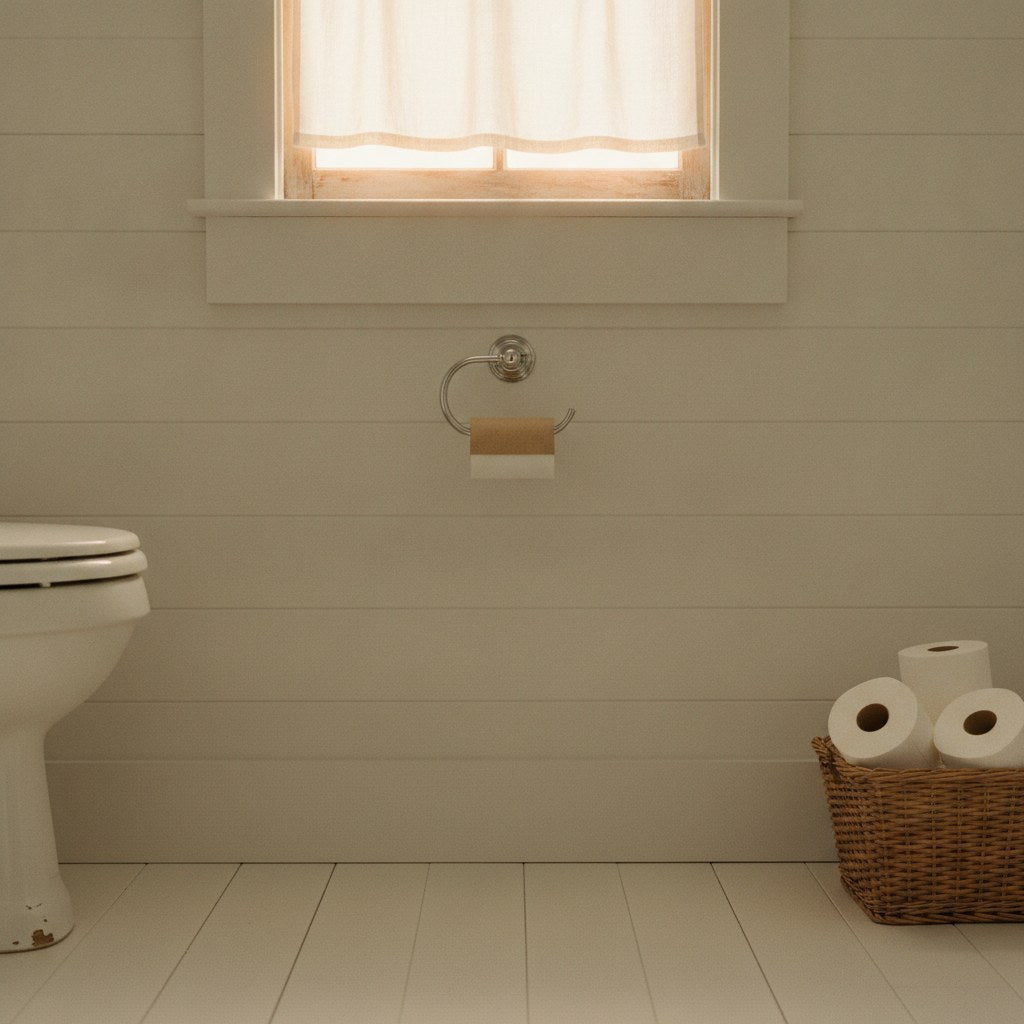
Somewhere in your house right now, someone left an empty toilet paper roll on the holder and replaced it with nothing. Not a new roll. Not even the new roll set on top of the old roll as a gesture of good faith. Just the cardboard tube, standing there like a monument to optimism. That right there is the real bathroom joke — not the one on the wall, but the one your household has been living for years without ever officially addressing it. These rules exist in every home. Nobody set them. Nobody agreed to them. And yet somehow, everyone is expected to know them.
So let's write them down. All of them. The obvious ones, the ones you've been silently furious about for a decade, and a few you probably hadn't thought to name.

The Toilet Paper Rule Is a Bathroom Joke Waiting to Happen
Every household has a toilet paper philosophy, and almost none of them have ever been spoken aloud. There's the over-versus-under debate, which has actual research behind it — the original 1891 patent by Seth Wheeler shows the paper going over the top, if you want to settle that one at the dinner table. But the more pressing issue is the replacement rule.
Here's the standard that every reasonable person can agree on: if you use the last sheet, you replace the roll. Not tomorrow. Not when you think about it. Right then. The new roll lives in the cabinet under the sink, or in the basket on the floor, or in the closet down the hall — wherever your household keeps it, the location should be known to every person old enough to use the bathroom without supervision.
- If you open a new package of rolls, put more than one in the cabinet. Future you will be grateful.
- The cardboard tube goes in the trash, not balanced on the back of the toilet as a hint.
- Guest bathrooms get checked before anyone arrives. Every time. No exceptions.
If your household has been treating this as a bathroom joke for years — laughing it off, leaving passive-aggressive notes — a sign on the wall actually works better than either of those. Something that says it plainly, with enough wit that nobody feels personally attacked. We wrote a whole piece on the psychology of bathroom TP humor if you want to go deeper on why that works.
The Fan Is Not Optional — and Other Courtesy Rules Nobody Announced
The exhaust fan exists for one reason, and that reason is courtesy. Turn it on when you walk in. Leave it running for a few minutes after you walk out. This is not complicated. It is, however, routinely ignored, which makes it the second-most-common source of quiet household resentment after the toilet paper situation.
Beyond the fan, there are a handful of other unwritten rules that most households operate on without realizing it:
- If you use the last of the hand soap, you replace it before you leave the room.
- The counter gets wiped down after shaving, hair-doing, or anything else that leaves evidence.
- Wet towels go on the bar or hook — not the floor, not balled up on the vanity.
- If you clog it, you deal with it. The plunger is right there.
- Long hair in the drain gets removed by the person whose hair it is. This is non-negotiable.
None of these rules were ever formally adopted. They emerged the way most household standards do — through trial, friction, and someone eventually reaching a breaking point at 7 a.m. on a Tuesday. The difference between a household that runs smoothly and one that doesn't is usually whether these things got named out loud at some point.
◆ From the Workshop: Here's something that sounds unrelated but isn't — when you're cutting with a card scraper on resinous woods like rosewood or cocobolo, the heat from friction builds up fast enough that the scraper becomes genuinely too hot to hold. Old turners and luthiers kept a cup of water on the bench and dipped the scraper between passes, not to cool the steel, but because a scraper that's too hot to touch is also too hot to hold at a consistent angle, and your surface starts to go wavy before you realize why. The lesson is the same in the shop as it is in the bathroom: small things ignored long enough create bigger problems than anyone expected.
Frequently Asked Questions
What's the most effective way to actually get kids to flush consistently?
Behavioral research on habit formation suggests tying a new habit to an existing one — called habit stacking. If your kid already washes their hands every time (which is its own battle), pairing the flush with the handwash routine gives the brain a built-in trigger. A visual cue on the wall, like a short rhyming reminder, outperforms verbal nagging by a wide margin because it removes the parent from the equation entirely. Kids comply more readily when the instruction comes from the room rather than from a person they're already tuning out.
Is there a polite way to tell a houseguest about bathroom rules without making it awkward?
The most effective method is environmental rather than conversational — meaning you let the room do the talking before the guest even unpacks. A sign with a light touch of humor handles the TP situation, the fan courtesy, and the 'please don't use the last towel' problem without a single uncomfortable sentence from you. If you need to address something specific, the window before they arrive is your best moment: a quick 'heads up, the hot water takes a minute to come in' feels helpful rather than instructional.
How do shared bathrooms in rentals or older homes change the etiquette calculus?
Shared bathrooms between separate households or renters introduce a layer that family bathrooms don't have: there's no shared affection to smooth over friction. Etiquette researchers who study communal living note that the single biggest source of conflict in shared bathrooms isn't cleanliness — it's time. Posting a loose schedule for peak morning hours, even an informal one on a whiteboard, reduces tension more than any cleaning rota. The secondary issue is storage encroachment, which is best handled by giving each person a clearly designated shelf or caddy rather than relying on spatial intuition.

The Shared Bathroom Bathroom Joke — Kids, Guests, and the Chaos In Between
If you have children sharing a bathroom, you already know that the rules above are aspirational at best. Kids' bathrooms operate on their own logic, which is to say almost no logic at all. Toothpaste on the mirror. Soap somehow on the ceiling. A towel that hasn't moved in four days but is somehow both wet and stiff at the same time.
The approach that actually works is shorter rules, stated simply, posted visibly. Not a lecture. Not a chore chart with seventeen line items. Three or four rules, written plainly, at eye level for a child. The bathroom joke version of this — a sign that's funny enough that the kid reads it every time — outperforms the serious version because it doesn't trigger the defensive shutdown that parental authority sometimes does.
If you want a concrete example of what that looks like on a wall, this carved etiquette sign covers the tinkle rule with enough rhyme and humor that kids actually remember it. That's the whole point — make the rule stick without making it a fight.
For guest bathrooms, the calculus shifts. Your guests don't know where anything is. They don't know if the hot water takes a minute. They don't know whether the fan is the switch on the left or the right. A small sign that answers the two or three most common questions removes the awkwardness of having to ask. Our piece on rustic bathroom decor ideas gets into how to make a guest bath feel both welcoming and functional at the same time.
The Unspoken Time Rules That Every Multi-Person Household Needs
Nobody talks about bathroom time management until it becomes a problem. Then it becomes a significant problem. In a household with more than two people sharing one bathroom, the morning window is a finite resource, and treating it like an unlimited one is how you end up with someone late for school three days a week.
The rules here are simple but they have to be said:
- Know approximately how long you take. If you don't know, you're probably the one causing the backup.
- Showers longer than fifteen minutes in a shared-bathroom household are a luxury, not a right, on weekday mornings.
- If someone knocks, you answer. Silence is not an acceptable response when there are four people and one shower.
- Getting ready at the mirror can happen in a bedroom. The bathroom is not the only place a person can apply mascara.
These feel obvious when you write them down. They are apparently not obvious in practice, given how many households have never said them out loud. The act of naming a rule — even a funny one, even on a sign — changes behavior more reliably than repeated verbal reminders, because it removes the emotional charge. The rule is just there. It's part of the room now.
Why Putting the Rules on the Wall Actually Works
There's a reason the bathroom joke has been a fixture of home decor for generations. It's not just that bathrooms are funny — it's that humor is disarming. A rule delivered with a straight face from a parent or a spouse carries authority and resistance in equal measure. The same rule, delivered with a dry line and a little wit from a piece of wood on the wall, just lands differently.
Behavioral researchers who study household compliance — which is a real field, and a useful one — have found that environmental cues outperform interpersonal reminders for routine behaviors. The sign doesn't get tired of repeating itself. It doesn't sound annoyed. It just says the thing, every time, without escalation.
That's why the bathroom signs collection here tends to lean into humor rather than instruction — because the goal isn't to post a policy memo in your powder room. It's to say the thing that needed saying, in a way that people will actually read and remember. Our post on the psychology of bathroom sign humor gets into why the smallest room in the house has always punched above its weight when it comes to making people laugh.
The rules your household needs have probably existed for years. They just haven't been official yet. Write them down. Put them on the wall. Let the room handle it from here — that's the one bathroom joke that actually improves your daily life.
Share:
Why Do We Decorate for Every Season? The Deep Human Need Behind Holiday & Seasonal Decor
Trusting God in Hard Times: What 'Let Go and Let God' Really Means | Bluegrass Gifts