

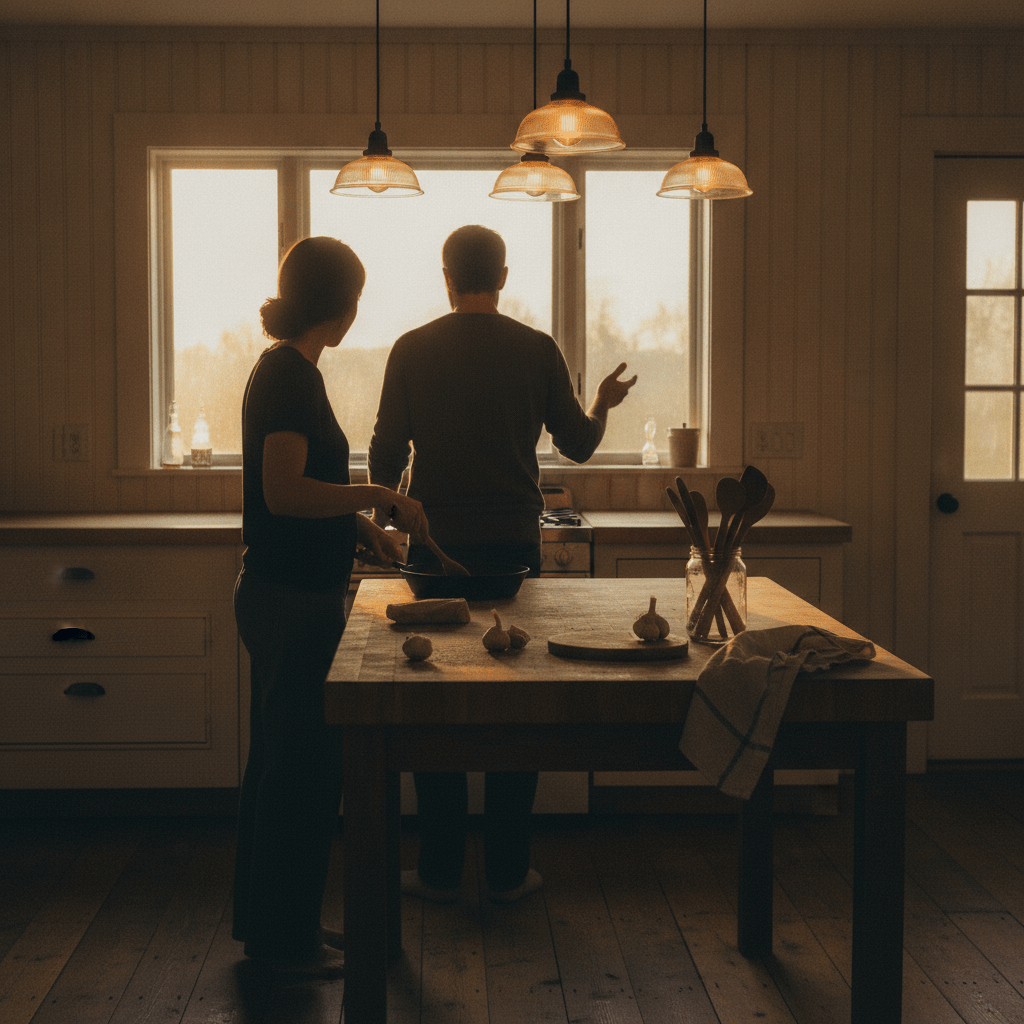
Cooking Together as a Couple Is the Relationship Advice Nobody Thinks to Give
You've sat through the marriage retreats. You've read the books with the soft-focus covers. You've been told to schedule date nights, practice active listening, and put your phones away at dinner. All fine advice. But the thing that actually moves the needle — according to researchers who study this for a living — might be standing next to your spouse at the stove on a Tuesday, arguing mildly about whether the garlic is done yet.
Cooking together as a couple turns out to be one of the more quietly powerful things two people can do for their relationship. Not because it's romantic in the movie sense. Because it's real in the way that matters: shared effort, low stakes, and a built-in reason to be in the same room at the same time with no agenda except feeding yourselves.
The science behind it is more interesting than you'd expect. And the practical application is easier than most marriage advice will ever be.

What the Research Actually Says About Cooking Together
A Cornell University food psychology study found that people who prepare food collaboratively — even strangers — rate the food as tasting better and report higher satisfaction with the experience than people who just receive the finished meal. Apply that to a marriage and you start to see the compounding effect. You're not just eating dinner. You're building a small shared history, one meal at a time.
Beyond taste perception, the research on collaborative tasks more broadly shows that working toward a common goal releases oxytocin — the same bonding hormone associated with physical affection. Chopping vegetables side by side isn't the same as a long embrace, but neurologically, it's in the same neighborhood. Your brain doesn't require candlelight to register connection. It requires cooperation.
There's also the communication angle. Cooking has a built-in structure: someone has to say what needs to happen next, someone has to listen, someone has to adjust when the plan changes because the chicken is taking longer than expected. Couples who struggle to talk about hard things often find it easier to talk about everything else when their hands are busy and the conversation has a natural container around it. The kitchen lowers the temperature on difficult topics in a way that sitting across a table in silence rarely does.
We wrote a piece on what research says about family meals and connection that goes deeper on the conversation side of things — it's worth a read alongside this one, because the two ideas work together.
The Specific Ways Cooking Together Builds Intimacy
It's not magic. It's mechanics. Here's what's actually happening when couples cook together that makes it different from other shared activities:
- Negotiated territory. Every kitchen has unspoken rules about who owns what. Working through those — who seasons, who tastes, who decides when something is done — is low-stakes practice for the higher-stakes negotiations that come up in every marriage.
- Physical proximity without pressure. You're close to each other. You're brushing elbows reaching for the same thing. There's no performance required. That kind of casual physical nearness, repeated over time, maintains a baseline of comfort that distance quietly erodes.
- Shared failure. The meal that didn't work — the soup that was somehow both bland and too salty, the pasta that welded itself to the pot — becomes a story you both own. Shared failures are underrated glue.
- A finished thing. Most relationship-building activities are abstract. Cooking produces something real that you made together and then sit down to eat. That completion loop matters more than it sounds.
There's a reason the couples who've been married forty years tend to have a story about a kitchen disaster. It's not coincidence. It's evidence.
◆ From the Workshop: When you're driving a nail by hand, the last few taps should be made with the hammer face held nearly flat — but the real trick is the nail set, a small punch you use for those final strokes to drive the head just below the surface without denting the wood. Try to skip it and finish with the hammer alone, and you'll leave a crescent-shaped mark called a hammer shadow in the wood around the nail. Old finish carpenters kept a nail set in their apron pocket the way a surgeon keeps a scalpel — it's the last tool that touches the surface, and the surface remembers it.
Frequently Asked Questions
What if one partner is a much better cook — won't that just create tension?
Skill gaps are actually where most of the benefit lives. The research on collaborative tasks shows that teaching a partner something — patiently, without taking over — builds a specific kind of trust that's different from everyday closeness. The trick is giving the less experienced cook a real job with real stakes: not 'stir occasionally' but 'you're in charge of the sauce, and I won't touch it.' Ownership matters. Being handed a spoon to babysit does not.
Are there specific types of meals that work better for couples cooking together?
Recipes with natural division of labor tend to work best — think tacos, homemade pizza, stir-fry, or anything with a build-your-own component. These give each person a distinct domain rather than two people crowding the same cutting board. Long braises and slow-cooker meals, paradoxically, work well too: the prep is short, the payoff is shared hours later, and there's no frantic timing pressure that turns the kitchen into an air traffic control tower.
How often do couples actually need to cook together to see a relationship benefit?
The Cornell study that's most cited on this didn't prescribe a frequency — it measured the quality of the shared experience, not the quantity. Most relationship researchers suggest that even one intentional shared cooking session per week is enough to shift the dynamic, as long as both people are genuinely present. The phone-on-the-counter, half-distracted version doesn't count the same way. Consistency over time matters more than cooking together every single night.

How to Actually Make Cooking Together a Habit (Without It Becoming a Chore)
The theory is easy. The execution is where most couples quietly give up after one too many evenings where one person did everything while the other stood nearby asking if they could help and being told no, it's fine, I've got it.
A few things that actually work:
- Pick one night and protect it. Not every night. One. The bar is low enough that it doesn't feel like a commitment and high enough that it actually happens.
- Choose recipes with clear division of labor. Tacos, homemade pizza, stir-fry — anything with distinct components so each person has a real job, not just a ceremonial one.
- Ban the phone from the counter. This is the one that changes everything. The kitchen becomes a different room when there's no screen pulling half your attention sideways.
- Let the less confident cook own something completely. Not 'you can stir this.' Actual ownership. 'The sauce is yours and I won't touch it.' That's the version that builds confidence and trust simultaneously.
- Eat at the table. Not on the couch. Not standing over the counter. The meal is the payoff, and it deserves the full treatment.
If you want a little help with the tone in your kitchen — the kind of reminder that sets the mood before you even turn on the stove — a carved solid-wood kitchen sign that says something true and a little playful goes a long way toward making the room feel like a place you want to be together rather than a place you're just passing through.
The Couples Who Cook Together Longest Have One Thing in Common
It's not that they're both good cooks. Some of the happiest long-married couples we've ever heard from couldn't produce a decent meal between them. What they have is the habit of showing up in the same space with the same intention.
Cooking together over years becomes a kind of shorthand. You stop asking where the colander is. You know how your spouse likes their eggs without asking. You've developed a rhythm that took time to build and that, quietly, neither of you wants to lose. That rhythm is the relationship, expressed in something as ordinary as knowing to start the rice before the chicken because your partner always eats slower than you expect.
We wrote about the joyful and occasionally contentious art of cooking with a strong opinion in the room — which, if you've ever cooked alongside someone who has Feelings about the correct way to dice an onion, you'll recognize immediately.
The kitchen is where a lot of marriages actually live — not in the big moments, but in the ordinary ones that stack up into something you didn't notice building until you look back and realize how much of your life together happened right there at that stove. Our kitchen signs collection is full of things that say what that room means, in solid wood carved right here in Kentucky — the kind of words that fit a place where real life happens.
Start with one meal. One Tuesday. See what happens when you put two people, one kitchen, and no particular agenda in the same room together. The research says it matters. Forty years of happy couples say it matters. And if the soup doesn't turn out right, that's just the beginning of a story you'll both be telling for a long time.
Share:
Bar Basics: How to Set Up a Home Bar (And the One Thing That Makes It Feel Like Yours) | Bluegrass Gifts
Why Sibling Fighting as a Kid Made You Better at Everything as an Adult | Bluegrass Gifts