

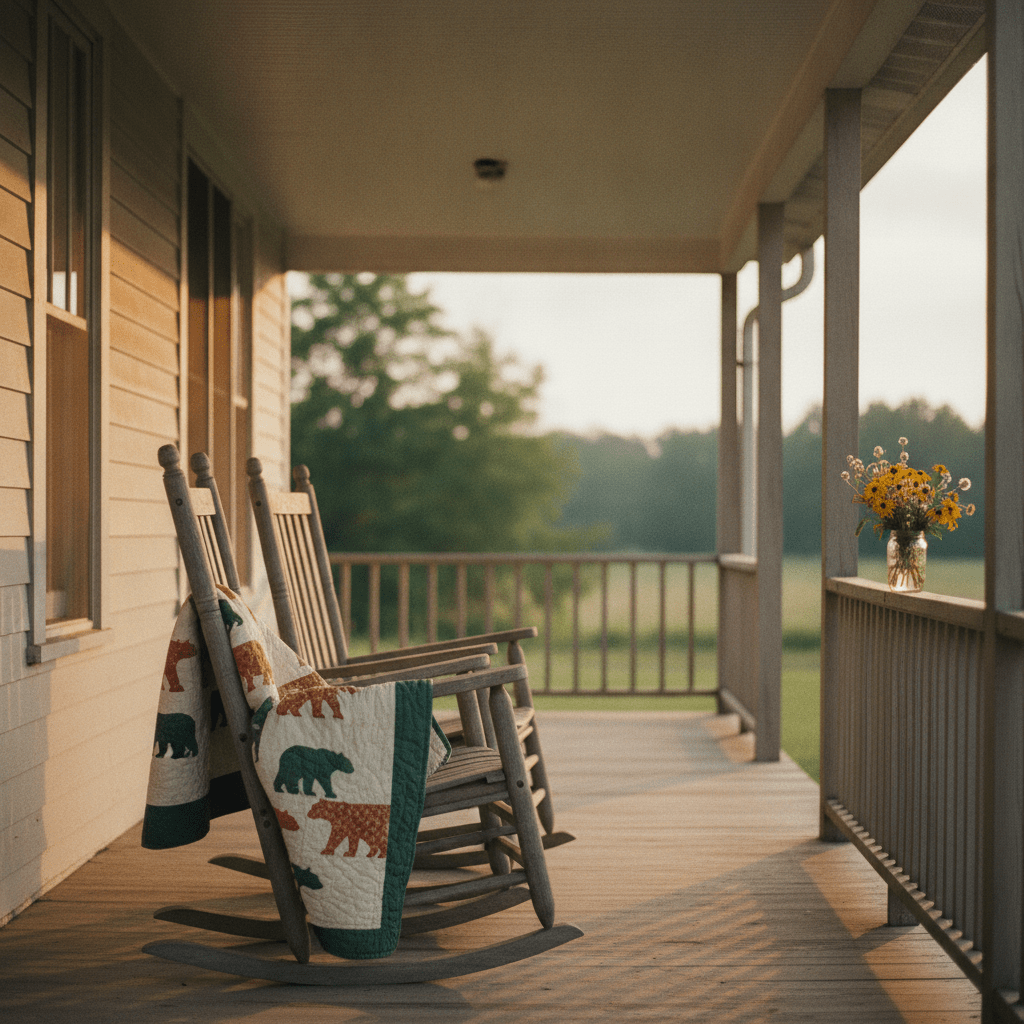
Do Bears Mate for Life — or Is That Just a Good Cabin Sign?
You have almost certainly seen the sign. Maybe it's on a friend's lake house, maybe it's on your own wall: An Old Bear Lives Here With His Honey. It's warm. It's funny. It implies something sweet about bears and their domestic arrangements. But if you've ever actually wondered whether do bears mate for life is a yes or a no, the answer is going to rearrange some furniture in your brain. The short version: no, bears do not mate for life. Not even close. The long version is so much better.
Bears are what biologists call promiscuous breeders. A female black bear in heat will mate with multiple males over the course of a few weeks. A male will travel extraordinary distances — sometimes over a hundred miles in a single season — following scent trails left by females, competing with other males, and then moving on. There is no pair bond. No shared den. No coming home to the same bear twice.
And yet. The story of how bears actually live is, in its own strange way, more interesting than any romantic fable we could invent for them.

Why Bears Don't Need to Mate for Life — They Have a Better System
The reason bears never needed to mate for life comes down to one of the most remarkable reproductive tricks in the mammal world: delayed implantation. A female bear can mate in early summer, but the fertilized egg won't actually implant in her uterus until fall — and only if she's put on enough fat to survive winter and nurse cubs. If she hasn't eaten enough, the pregnancy simply doesn't proceed. Her body makes the call.
This means a sow is never stuck carrying a pregnancy she can't support. It also means she has no particular incentive to stay bonded to one male. She's already handled the quality-control problem internally. The male's job, biologically speaking, ends at mating. Everything after that is hers.
Cubs are born in January or February, while the mother is still denning. They arrive tiny — a 400-pound black bear sow gives birth to cubs that weigh less than a pound. They nurse through the rest of winter, emerge in spring, and spend the next year and a half learning everything their mother knows about finding food, reading terrain, and staying out of trouble. Then she sends them off. The whole operation runs without a father present at any stage.
◆ From the Workshop: Reading the grain in wood is its own kind of animal instinct. When shaping a curved chair leg or bow with a spokeshave, the tool only cuts cleanly in one direction — with the grain curving upward toward you. Flip it around on a concave curve and the blade catches the rising grain and chatters or digs in. Chair makers learn to read the hill: always cutting downhill into the curve, changing direction mid-stroke if the grain shifts mid-piece. The wood tells you which way to go, same as a trail tells a bear.
Frequently Asked Questions
Do bears recognize their cubs after being separated for a long time?
Mother bears and their cubs rely heavily on scent for recognition. If a cub is separated for more than a few weeks, especially after the first year, there's a real risk the sow may not recognize it — and could treat it as a stranger. Wildlife rehabilitators who raise orphaned cubs go to significant lengths to avoid imprinting them on humans precisely because reintroduction to a natural social structure depends on the bear behaving like a bear, not a pet.
Are there any bear species that show more long-term pair bonding than others?
Giant pandas are sometimes cited as an exception worth watching. In the wild, males and females do overlap territories more consistently than most bear species, and there is some evidence of repeated pairings between the same individuals across seasons. That said, researchers are careful not to call it monogamy — it's more that pandas, due to their limited range and low population density, end up with fewer viable partners. Familiarity, not devotion, may be doing most of the work.
How do bears actually find mates if they're solitary most of the year?
Bears use scent marking heavily during breeding season — rubbing against trees, leaving claw marks, and depositing scent at trail intersections. Males will travel enormous distances following these chemical signals. A male black bear has been tracked covering over 100 miles in a single breeding season searching for receptive females. The females, meanwhile, are far more stationary. They essentially set out a welcome mat and let the males sort themselves out.
The Social Life of Bears Is Stranger Than You Think
Bears have a reputation for being solitary, and mostly that's accurate. But it's not the whole picture. Black bears in areas with abundant food — a productive berry patch, a salmon stream, a field of ripening corn — will tolerate each other's company in ways that look almost social. They're not friends. They're just tolerating proximity because the food is worth it.
What's more interesting is the hierarchy that emerges when they do gather. Older, larger males get first access. Younger males hang back. Females with cubs are given a wide berth — not out of chivalry, but because a sow defending cubs is genuinely dangerous and everyone seems to know it. There's a whole unspoken protocol operating at a salmon stream, and bears navigate it without any obvious communication.
Mother bears, for their part, are some of the most attentive parents in the animal kingdom. The eighteen months a sow spends raising cubs is dense with teaching. She shows them which plants are edible, how to flip rocks for insects, where the good fishing spots are, and how to read the landscape for danger. Cubs who lose their mother early have dramatically lower survival rates. The knowledge she passes down is irreplaceable.

Bear Intelligence: The Part That Actually Earns Respect
Bears have the largest brain-to-body ratio of any carnivore. They remember. A black bear has been documented returning to the exact same patch of berry bushes three years in a row, timing the visit to peak ripeness. They solve problems — wildlife managers have an entire catalog of increasingly elaborate bear-proof food storage designs that bears have, one by one, figured out how to defeat.
There's a documented case of a bear in Yosemite that learned to recognize minivans as likely food sources because families with small children tend to pack a lot of snacks. It wasn't breaking into every car. Just the minivans. That's pattern recognition operating at a level that should give you pause.
- Bears can smell food from over a mile away — their sense of smell is roughly seven times stronger than a bloodhound's.
- They can run 35 miles per hour for short bursts, which is faster than any human who has ever lived.
- Black bears are excellent tree climbers well into adulthood. Grizzlies generally stop climbing once they get too heavy, but black bears don't have that excuse.
- Bears have been observed using tools — propping rocks to hold open trap doors, using sticks to test ground stability near water.
None of this makes them safe to approach. It makes them more interesting to respect from a reasonable distance.
Why the Cabin Sign Still Gets It Right (Just Not Biologically)
Here's the thing about An Old Bear Lives Here With His Honey — it was never really about bear biology. It's about a certain kind of person. The one who's a little gruff, moves at their own pace, fiercely protective of their people, and deeply attached to their territory. That's the bear archetype we've always been drawing on, and it holds up just fine even if the actual animal doesn't mate for life.
Bears are not romantic in the way the sign implies. But they are loyal to place, loyal to their young, and loyal to the rhythms of their own nature in a way that most of us find quietly admirable. That's worth something. If you've got that kind of person in your life — the grumpy, steady, show-up-when-it-matters type — a carved rustic bear couple sign is a pretty honest description of what they've built together.
The tailgate tradition post we did on dogs, ducks, and the Kentucky marsh covers a similar kind of loyalty — the kind you see in working animals and the people who keep them. Worth a read if you liked this one.
And if you want the bear theme to follow you into your morning coffee, our nature and wildlife magic mugs are exactly the kind of thing that makes a Tuesday feel a little more like the woods. For anyone who takes their wildlife appreciation seriously — and their coffee the same way.
Bears don't mate for life. But they live deliberately, they remember everything, and they raise their young with a ferocity that most parents would recognize. That's not a bad reputation for a creature that spends half its life asleep.
If your interest runs more folklore than biology, here's what it means when a bear crosses your path — the superstition has deeper roots than the science.
Share:
The Lost Art of Porch Sitting: Why Doing Nothing Is Good for You | Bluegrass Gifts
Why the Kitchen Has Always Been the Heart of the Home — and the Science That Proves It | Bluegrass Gifts