

How to Work From Home Without Letting It Work You Over
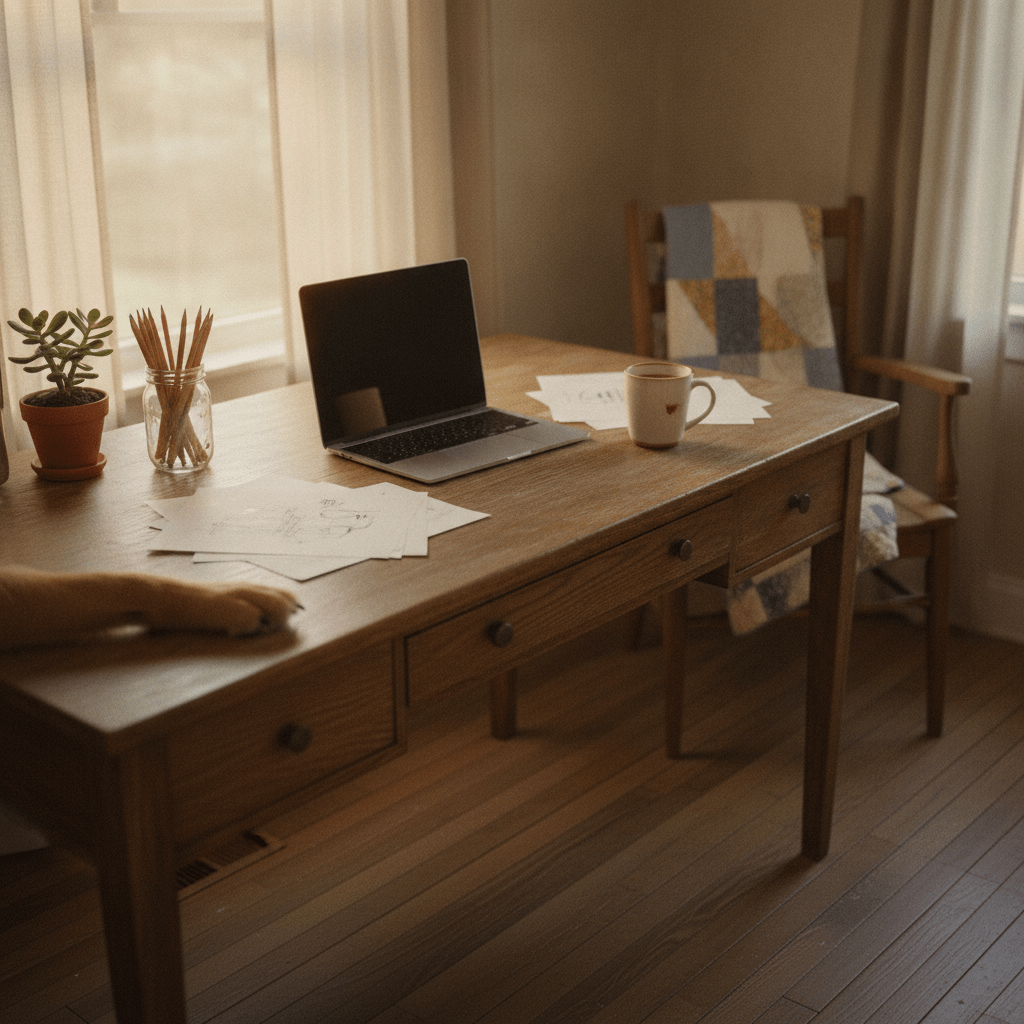
Your coffee is cold, your dog is sitting on your laptop charger, and the person on your Zoom call just said 'you're on mute' for the third time this week. If you are trying to figure out how to work from home without slowly becoming a person who talks to their houseplants about quarterly projections, you are in the right place. The good news is that it is genuinely workable. The bad news is that almost everything the internet tells you about it is either obvious or wrong.
Remote work has been around longer than the pandemic made it fashionable. Writers, farmers, and tradespeople have always worked where they lived. What changed is that millions of people who built their entire professional identity around a commute and a conference room suddenly had to reinvent their day from scratch — in the same square footage where they also sleep and eat cereal at midnight. That is a real adjustment. It deserves real advice.

Your Space Shapes Your Brain Whether You Want It To or Not
Here is the thing nobody tells you plainly: the kitchen table is not a desk. It is a kitchen table. Your brain knows this, even when you are pretending otherwise. Every time someone walks through to get a glass of water, every time you smell dinner starting, every time a dish clinks — your focus takes a small hit. Stack enough small hits and you have lost an hour without noticing.
You do not need a dedicated room, though a door that closes is worth more than any productivity app ever written. What you need is a consistent place that your brain learns to associate with work. Same chair. Same corner. Same lamp, if possible. Consistency is the whole trick. The brain is a pattern-recognition machine, and it will eventually accept 'this spot means focus' as a rule — but only if you hold the line.
- Face a wall or window, not a hallway where foot traffic pulls your eyes.
- Keep the work surface clear of anything that belongs to a different part of your life — no mail, no kid's homework, no stray coffee mugs from three days ago.
- If you share the space, a simple visual signal — headphones on, door cracked to a specific angle, a sign on the wall — communicates 'I am working' without a conversation every single time.
That last point matters more than people admit. Households where the work-from-home boundaries are unspoken tend to be households where someone is quietly resentful by Thursday. Say the thing out loud once, clearly, and then let the signal do the talking.
◆ From the Workshop: There is a lesson in woodworking that applies to almost everything requiring sustained attention. When you are pulling a drawknife across a piece of green wood, the grain direction is everything — go with it and the tool glides, peeling clean shavings like you are unwrapping the wood itself. Go against the grain and the blade dives and tries to split off a chunk you never asked for. Old chairmakers called it 'running downhill,' and learning to read which way the fibers slope before the first stroke is the whole skill. Setting up your workspace is the same kind of reading — get the conditions right before you start, and the work moves with you instead of against you.
Frequently Asked Questions
What is the best room in the house to set up a home office?
The honest answer is: the one with a door that closes. Natural light and a dedicated surface matter, but acoustic separation from the rest of the house does more for focus and professionalism on calls than any desk upgrade. A spare bedroom edges out a basement corner not because of light, but because the ceiling height keeps you from feeling like you are filing taxes in a bunker.
How do you handle work-from-home burnout when your office is also your living space?
The core problem is that your nervous system never gets a commute — that transitional dead time that used to signal 'work is over.' A deliberate shutdown ritual fills that gap: close every browser tab, write tomorrow's first three tasks on paper, and physically leave the room. Some people change clothes. Sounds small. Works surprisingly well, because your brain is pattern-hungry and it will accept a five-minute ritual as a substitute for a forty-minute drive.
Are there IRS home office deductions for remote workers, and what actually qualifies?
The IRS requires that the space be used regularly and exclusively for business — a corner of the bedroom where you also fold laundry does not qualify under the strict reading. W-2 employees lost the home office deduction after the 2017 Tax Cuts and Jobs Act, so this primarily benefits self-employed workers and freelancers. The simplified method lets you deduct five dollars per square foot up to 300 square feet, which is easier than calculating actual expenses. A tax professional is worth the conversation if your situation is anything other than straightforward.
The Work From Home Schedule Problem (And Why Willpower Is Not the Answer)
Most people who struggle to work from home are not lazy. They are operating without structure, which is a different problem entirely, and it requires a different fix. Willpower is a finite resource. Structure is not. A good schedule does not ask you to resist temptation — it just removes most of the decisions that drain you before noon.
Start times matter more than end times, counterintuitively. If you begin at the same hour every day, the rest of the day tends to organize itself around that anchor. Sleep in until nine on Tuesday and you have already lost the thread before you opened your laptop. This is not a moral position. It is just how circadian rhythms interact with task-switching.
- Build your hardest work into the first two to three hours, before the day accumulates its own demands.
- Schedule breaks on the calendar the same way you schedule meetings — otherwise they do not happen, and you end up eating lunch at 3:47 pm again.
- A hard stop time is not laziness. It is what keeps you from the slow drift into working every waking hour because the office never actually closes.
The connection between your physical environment and how you carry yourself professionally is something we have written about before — the short version is that the space signals something to you before it signals anything to anyone else. Dress the part, set the space, and your brain follows.

Boundaries With Other Humans Are a Skill, Not a Personality Trait
If you have ever had a family member walk into your home office mid-sentence on a client call, you already understand that work from home boundaries are not theoretical. They are survival infrastructure. And the people in your house are not the only ones who need them — so does everyone at the office who now assumes that 'working from home' means 'available at all hours because where else would you be.'
The answer to both problems is the same: communicate expectations once, clearly, and then hold them consistently. With family, that means specific hours that are genuinely off-limits for non-emergencies. With colleagues, it means not answering Slack at 9 pm, because the moment you do it once, you have taught everyone that 9 pm is a reasonable time to reach you.
There is also the quieter boundary problem — the one you have with yourself. The refrigerator is fifteen feet away. The couch is right there. The laundry pile has been staring at you since Monday and now it feels like a personal accusation. The trick is not to fight those pulls with grit but to make the path of least resistance point toward work. Phone in another room during focus blocks. Browser extensions that lock social media during work hours. A to-do list short enough to actually finish. Small friction, applied in the right places, does more than motivation ever will.
We wrote a piece on finding your happy place at home that gets into the emotional side of this — because a house that feels like a trap and a house that feels like a refuge are the same square footage arranged differently.
Keep Some Humor in the Room — Literally
Here is something the productivity literature mostly ignores: morale is real, and it erodes quietly when you work from home long enough. You lose the ambient social texture of an office — the hallway joke, the shared complaint about the printer, the colleague who always has good coffee. None of that sounds important until it is gone and you realize you have not laughed at work in three weeks.
One underrated fix is simply making your workspace a place you actually want to be. Not expensive. Not elaborate. Just intentional. A plant that is still alive. A mug you like. Something on the wall that makes you smirk when you glance up from a frustrating email. The relationship between dry humor and workplace sanity is well-documented by anyone who has ever survived a long project — a little levity is not unprofessional, it is protective.
If you want something that earns its wall space, this carved solid-wood office sign says exactly what most of us are thinking by Wednesday afternoon — and it is the kind of thing that makes a video call background worth a second look. We make ours in Kentucky from Amish-sourced lumber, which means it will outlast whatever phase of remote work comes next.
If you want to browse further, the full office and work signs collection runs from the quietly motivational to the openly sarcastic — the kind of range that covers every personality type from 'inspiring morning person' to 'functional only after the second cup.'
What Nobody Tells You About the Long Game
Most advice on how to work from home is written for the first month. The harder conversation is about month fourteen, when the novelty is gone, the routines have calcified into ruts, and you genuinely cannot remember the last time you had an unscheduled conversation with another adult during business hours.
The people who do this well long-term tend to share a few habits. They leave the house once a day, even briefly — a walk to the end of the street counts. They maintain at least one standing commitment that has nothing to do with work. They treat their home office like a professional space, not a purgatory they are passing through until real life resumes.
Remote work is not a lesser version of work. It is just a different set of conditions, with different failure modes and different rewards. Read the grain before the first stroke. Set up the space, hold the schedule, keep the humor close — and you will find that work from home, done right, has a lot going for it.
Share:
Bible Verses About Fear: What the Scripture Actually Says (And Why 'Faith Over Fear' Is Harder Than It Sounds)
The Vintage Laundry Room Was the Heart of the House — Here's What Happened to It | Bluegrass Gifts