

Toilet Paper Invented When? The Surprisingly Long History of the Outhouse — And How We Got From There to Here
You are sitting in the most private room in your house, probably on your phone, and it has almost certainly never occurred to you to wonder when toilet paper was invented. Fair enough. But pull on that thread a little and you end up somewhere genuinely interesting — a few thousand years of human ingenuity, desperation, and occasional brilliance, all aimed at solving the same basic problem.
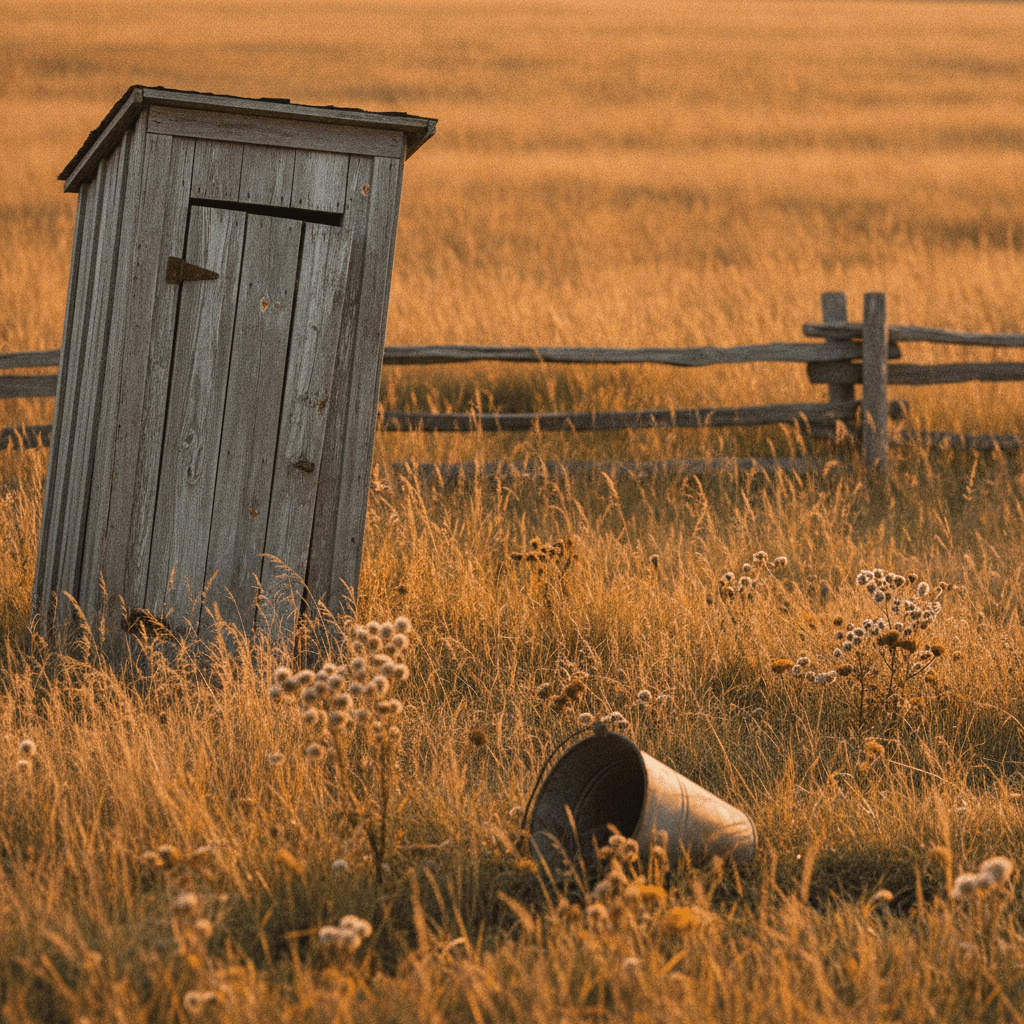
The outhouse is where that story starts. Not the cute, weathered one you see on farmhouse signs. The real thing: a small wooden structure over a hole in the ground, used by the majority of Americans well into the twentieth century. Understanding how we got from there to here says more about civilization than most history books bother to mention.

Before Toilet Paper Was Invented, There Was the Outhouse — and Before That, There Was Just the Field
The outhouse as a dedicated structure is older than most people realize. Archaeological evidence from ancient Rome shows multi-seat communal latrines with running water beneath — surprisingly sophisticated. The Romans used a shared sponge on a stick, rinsed in a channel of flowing water. You read that right. Shared. The Latin word for it was xylospongium, and knowing that word exists does not make it better.
Medieval Europe largely abandoned Roman plumbing infrastructure, and sanitation took a long step backward. Castle garderobes — narrow stone closets built into the wall with a shaft dropping to the moat or a pit below — were the luxury option. Everyone else made do with chamber pots, fields, and rivers. Cities smelled accordingly.
The American outhouse came into its own with westward settlement. A simple structure, easy to build, easy to relocate when the pit filled. Two-seaters were common in family homes — not for company, but because a second hole of smaller diameter was cut for children, so they wouldn't fall in. That detail alone tells you something about the practical engineering mindset of the era.
When Was Toilet Paper Invented — and Why Did It Take So Long?
The Chinese were first, as they were with so many things. Records from the 6th century AD describe paper being used for personal hygiene, and by the 14th century, the Zhejiang province was producing millions of sheets annually for the imperial court. The rest of the world did not get the memo for another five hundred years.
In the West, toilet paper invented its commercial form in 1857, when a New York entrepreneur named Joseph Gayetty began selling flat, aloe-infused sheets he called "Medicated Paper." His name was printed on every sheet. He sold it as a health product, not a convenience item, and marketed it specifically as a remedy for hemorrhoids. It was sold in pharmacies. People were not immediately convinced.
The perforated roll — the format we recognize today — came from Seth Wheeler, who patented it in 1891. His original patent drawings even specified that the paper should roll over the top, which means the over-versus-under debate has a correct answer, and it is over, and it has been over since 1891, and yet here we are.
Still, even after toilet paper invented its way into American stores, adoption was slow. Rural families relied on Sears catalogs, corn cobs, and whatever else was handy long after the product existed. The shift to widespread use didn't happen until the early twentieth century, when indoor plumbing made the whole system work as a unit.
◆ From the Workshop: Hand saws are a good reminder that the same job can be done two completely different ways depending on where the tool was made. Western saws cut on the push stroke; Japanese saws cut on the pull. Because a pull stroke puts the blade in tension rather than compression, Japanese blades can be ground much thinner — which means a narrower kerf, less wasted wood, and a noticeably cleaner cut. Pick up both back to back and the difference is immediate, like comparing a butter knife to a scalpel.
Frequently Asked Questions
What did people use before toilet paper was widely available in the United States?
Corn cobs were genuinely common in rural America — they were plentiful, cheap, and apparently more effective than you'd imagine. Catalogs (Sears Roebuck being the most famous) also served double duty once people were done reading them. Wealthy households in earlier centuries used wool, hemp, or lace. The short answer is: whatever was nearby and not too precious to sacrifice.
When did indoor plumbing become standard in American homes, and what drove the shift from outhouses?
Indoor plumbing spread gradually through American cities in the late 1800s, but rural homes lagged significantly. The U.S. Census Bureau estimated that as late as 1940, nearly half of American homes still lacked complete indoor plumbing. The shift was driven by a combination of public health campaigns, the Rural Electrification Administration's broader infrastructure push, and rising postwar prosperity that made renovation affordable for working families.
Are there any building codes or rules about outhouses today — can you still legally build one?
Yes, in many rural areas you can still legally construct a privy or pit toilet, though the rules vary widely by county and state. Most jurisdictions require a minimum distance from water sources, property lines, and structures. Some states permit them only as secondary facilities on properties that already have indoor plumbing. If you're seriously considering one — for a hunting cabin, a remote property, or a homestead — your county health department is the right first call, not the internet.

The Outhouse in American Culture: More Than Just a Hole in the Ground
The outhouse occupied a specific place in American domestic life that went beyond its obvious function. It was a place of genuine solitude in crowded farmhouses. It held the Sears catalog — first for reading, then for other purposes. It was the subject of more jokes than any other structure in American folk humor, and those jokes were told because the outhouse was universal. Everybody had one. Everybody understood.
Tipping outhouses on Halloween was a rural tradition so common it barely registered as vandalism. Some families built elaborate two-story versions. Others painted them, decorated them, gave them names. The outhouse was the one structure on the property where you could be alone, and people treated that accordingly.
By the 1930s and 40s, the New Deal's public works programs were actively campaigning to replace outhouses with sanitary indoor facilities, distributing pamphlets and offering construction assistance. The outhouse didn't disappear overnight. In parts of Appalachia and the rural South, they remained in use through the 1960s. Some are still in use today on hunting properties and remote land where running water isn't practical.
How the Bathroom Became the Room We Actually Decorate
Indoor plumbing changed not just sanitation but the entire psychology of the room. Once the toilet moved inside, it needed to fit into a house — to look like it belonged. Early indoor bathrooms were purely functional: white tile, white fixtures, nothing on the walls. The idea of decorating a bathroom was almost an afterthought.
That changed gradually through the mid-twentieth century as bathrooms got larger and more permanent. By the 1970s and 80s, wallpaper, art, and personality had fully arrived in the American bathroom. The room became a place people actually thought about.
Today it's one of the most decorated rooms in the house, which is funny when you trace the line back to a wooden shack over a pit. The rustic bathroom decor ideas that resonate most tend to lean into that history — a little humor, a little warmth, an acknowledgment that this room has always been a place people spend more time than they admit.
The humor, specifically, has never gone away. It just moved indoors. A sign that says something dry and self-aware on the bathroom wall is doing exactly what the outhouse joke did around a farmhouse table — acknowledging a shared human reality with a grin. If you want to see what that looks like carved into solid wood, our bathroom signs collection is where that tradition lives now.
One sign in particular lands well in this context: this rustic TP humor sign is the kind of thing that makes a guest laugh out loud and then stand there a second longer, thinking about it. Which is exactly what a good sign should do.
For more on how a well-placed sign can set the tone for a whole room, styling a funny wooden bathroom sign walks through the practical side — placement, framing, what works next to what. It's more thought than you'd expect goes into it, and more fun too.
The outhouse is gone from most American properties. The catalog is gone. The corn cobs are gone. What remains is the humor, the privacy, and the very human need to make even the most functional room in the house feel like it belongs to someone. We've been doing that, in one form or another, for a long time.
Share:
What Do You Want to Be Called? The Complete Guide to Good Grandparent Names | Bluegrass Gifts
Bar Basics: How to Set Up a Home Bar (And the One Thing That Makes It Feel Like Yours) | Bluegrass Gifts