

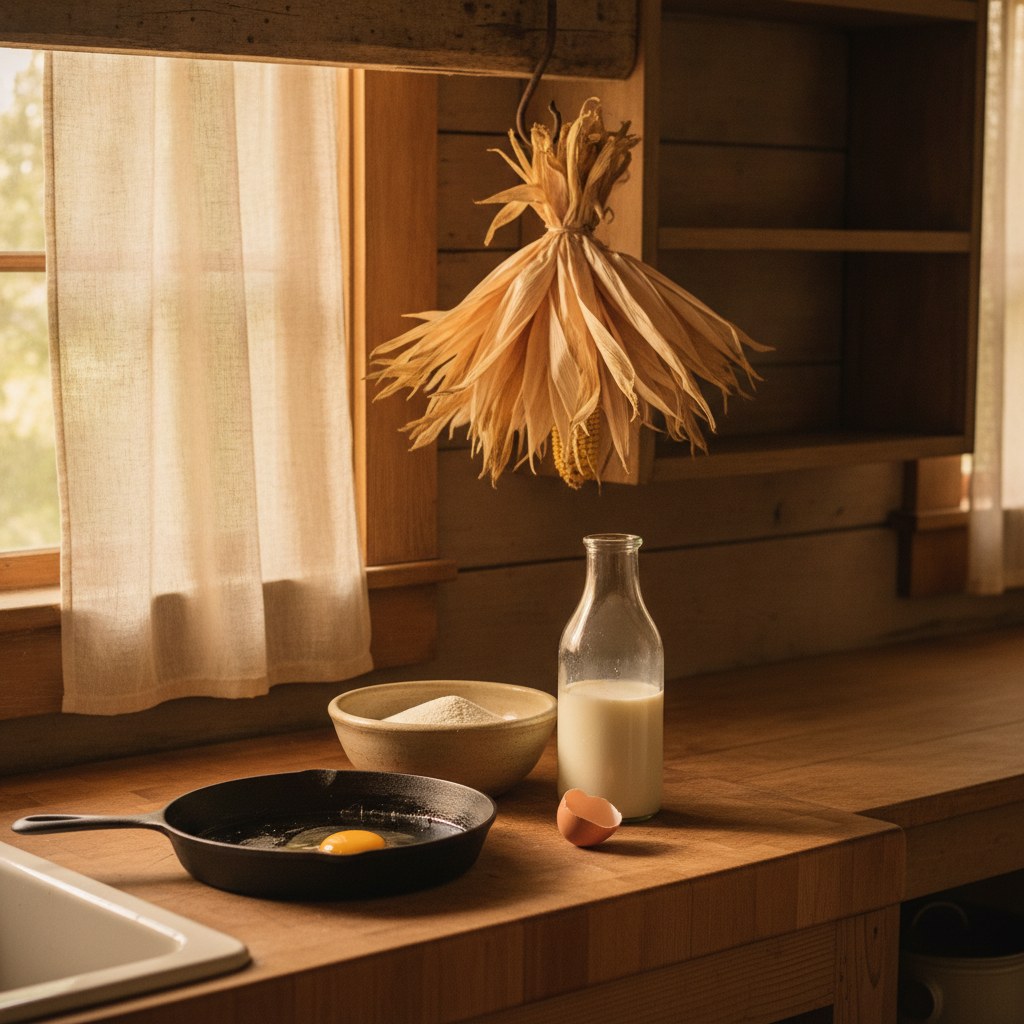
Grandma's Buttermilk Cornbread Had No Recipe Card
She poured the meal straight from the bag, held her palm flat over the bowl, and stopped when it looked right. That was the whole instruction. If you were standing at the counter beside her, you were supposed to be watching — not asking questions, not measuring, just watching. Grandma's buttermilk cornbread was not a recipe. It was a performance, and the audience was expected to memorize it.
Most of us didn't. We were eight years old and more interested in licking the spoon than studying the pour. And now we're standing in our own kitchens, holding a bag of stone-ground cornmeal, trying to reverse-engineer something that lived entirely inside another woman's hands.
This is the story of what those women knew — and what it cost us not to pay closer attention.

The Cast Iron Was Not Optional, and Grandma's Buttermilk Cornbread Proved It
The skillet went into the oven before the batter was mixed. That's rule one, and it's the rule most people skip first. A cold pan gives you pale, steamed cornbread with a crust that peels away sad and soft. A screaming-hot cast iron skillet — greased with a spoonful of bacon drippings, not butter, never cooking spray — gives you that dark, almost crackling bottom crust that made grandma's buttermilk cornbread worth driving forty-five minutes on a Sunday.
The science is simple enough: the batter hits the hot fat and immediately begins to fry from below. The crust sets before the bread has time to stick. But the grandmothers who figured this out didn't know the science. They knew that their mother did it this way, and their mother's mother before that, and the cornbread was good, so you did not change the method. This was considered sufficient reasoning.
- The skillet size matters — too large and the batter spreads thin, too small and the center never sets.
- Bacon drippings kept in a jar on the back of the stove were not a health hazard. They were infrastructure.
- You never washed cast iron with soap. You wiped it, you oiled it, you put it away. This was non-negotiable and enforced without discussion.
- If the skillet wasn't black from decades of use, it wasn't seasoned. It was just a pan.
The cast iron itself was an heirloom before anyone called things heirlooms. It came down through families the way land did — with the understanding that you were borrowing it from the people who came before you and the people who'd come after.
She Cooked by Sound and Smell, Not by Timer
There was a particular sizzle when the batter hit the hot fat — a hard, immediate hiss that meant the temperature was right. Too quiet, and she'd pull the skillet back out and let it heat another few minutes. She didn't own an oven thermometer. She owned forty years of listening.
The same held for doneness. She didn't set a timer. She smelled it. There's a moment, somewhere between twenty and twenty-five minutes depending on the oven and the humidity and the phase of the moon apparently, when cornbread shifts from smelling like raw grain to smelling like something finished — toasted and round and slightly sweet even without sugar in the batter. She caught that moment every time. We have never once caught it without checking twice and still pulling it out a minute late.
This is the rule that's hardest to teach because it requires a sensory library built over years. You can write down 400 degrees and 22 minutes, and you'll get cornbread. You won't get hers. The gap between those two things is what we lost.
◆ From the Workshop: There's a principle in hand-tool joinery that works the same way as cooking by instinct — you have to establish the boundary before you clear the field. When hand-cutting a rabbet along a board's edge, the shoulder plane will chatter and skip if you push straight through from the near end. But if you take the first few strokes as short, backward paring cuts from the far end to establish a clean shoulder line, the rest of the pass has a wall to register against and the chatter disappears entirely. Old joinery teachers called it 'establishing the ledge first.' Your grandmother did the same thing every time she preheated that skillet — she set the conditions before the work began, and everything after that had something to register against.
Frequently Asked Questions
Why does traditional Southern cornbread use buttermilk instead of regular milk?
Buttermilk is acidic, and that acid reacts with baking soda to produce carbon dioxide bubbles — which is what gives old-fashioned cornbread its tight, tender crumb without making it cakey. Regular milk doesn't carry enough acid to trigger that reaction properly, so you end up with a denser, flatter result. Before commercial baking powder was widely available, buttermilk and soda were the leavening system in most Southern kitchens. Your grandmother wasn't being fussy about the buttermilk. She was doing chemistry.
How do you season a cast iron skillet the way older Southern cooks did — without modern seasoning oils?
Traditional cooks seasoned with whatever fat they had: lard, bacon drippings, or the residue left from frying salt pork. The method was simple — coat the pan lightly, heat it in a wood stove or oven until it smoked, let it cool, wipe it, repeat. No flaxseed oil, no six-layer seasoning guides. The key they knew instinctively was thin coats and high heat. A thick coat of oil pools and goes sticky. Thin coats polymerize into the iron. The pan they handed down to you is proof the method worked.
What's the best way to actually document a family recipe that has no measurements?
Cook it with the person who knows it — or cook it yourself three times in a row, writing down every observation: what the batter looks like before it goes in the pan, how long the edges take to pull away, what color the bottom is when it's done. Measurements you can reverse-engineer later by weighing what you used. What you can't reconstruct from memory is the sensory cues: the sound the batter makes hitting a hot skillet, the smell that means it's two minutes from done. Record those first. The cup measurements are the easy part.
The Rules About Sugar Were Enforced Like Scripture
Ask a Southern grandmother whether cornbread should have sugar in it and you will get an answer that leaves no room for follow-up questions. The answer is no. The answer has always been no. The answer will be no until the sun burns out, and anyone who tells you different learned to cook from a box mix and should not be trusted near a cast iron skillet.
This is a regional conviction so deeply held that it functions less like a preference and more like a doctrinal position. Sweet cornbread — the kind that rises tall and golden and tastes vaguely like cake — is what you got at a chain restaurant. Real cornbread, the kind built around grandma's buttermilk cornbread tradition, was savory and dense and slightly tangy from the buttermilk, meant to be eaten crumbled into a glass of cold milk or broken apart alongside a pot of pinto beans that had been cooking since morning.
The sugar debate is funny until you realize what it's actually about. It's about the difference between food as comfort and food as performance. Grandma wasn't trying to impress anyone. She was feeding people. Those are not the same project.
We wrote a whole piece on how the kitchen has always been the center of the home — the history and science behind why that room pulls everyone in — and the short version is: it was never about the appliances.

What Grandma's Buttermilk Cornbread Actually Taught
The recipe, such as it was, went something like this: two cups of cornmeal, one cup of buttermilk, one egg, a spoonful of lard or bacon fat, a pinch of salt, a half-teaspoon of baking soda. Mix until just combined — overmixing was a sin almost as serious as adding sugar. Pour into the hot skillet. Don't open the oven. Trust the smell.
But what it actually taught was something else entirely. It taught you to be present. To watch instead of scroll. To understand that some knowledge doesn't transfer through text — it transfers through proximity, through repetition, through standing next to someone who knows and being quiet long enough to absorb it.
The women who cooked this way weren't withholding the recipe. They genuinely didn't think of it as a recipe. It was just what you did. The idea that it needed to be written down would have struck them as strange, the way you'd find it strange if someone asked you to document how you tie your shoes.
And that's the loss. Not the cornbread specifically — you can approximate grandma's buttermilk cornbread with enough trial and error — but the entire framework of knowledge that lived in the hands and the nose and the ears of women who never got credit for being the engineers they were.
There's a companion piece on this site about the Sunday dinner tradition and what it held together that's worth sitting with if this landed anywhere near home for you.
The kitchen walls of those houses said things, too — not in words, usually, but in the arrangement of things. The skillet on the hook. The jar of drippings. The worn spot on the linoleum in front of the stove. If your kitchen could talk, the question is what it would say. Our kitchen signs collection is full of the kind of lines that feel like they belong on a wall that's actually been cooked in. And if you want something that captures that particular flavor of Southern kitchen authority — the kind that doesn't ask for your opinion — this carved hardwood kitchen sign says exactly what your grandmother was thinking every time someone suggested she try it with less salt.
She's gone now, or going, or far enough away that you can't just call and ask. What's left is the skillet, if you're lucky, and the memory of standing beside her in a kitchen that smelled like hot iron and cornmeal and something you didn't know enough to name at the time. Write it down. Cook it badly a few times. Cook it again. The ledge gets established eventually — you just have to start.
Share:
Grow Through What You Go Through: The Science of Post-Traumatic Growth and Quotes on Growth That Actually Hold Up
Funny Grandparent Quotes and the Unwritten Rules Every Grandparent Eventually Learns | Bluegrass Gifts