

Why Cats at Halloween Take Over the Holiday (And What That Says About October)
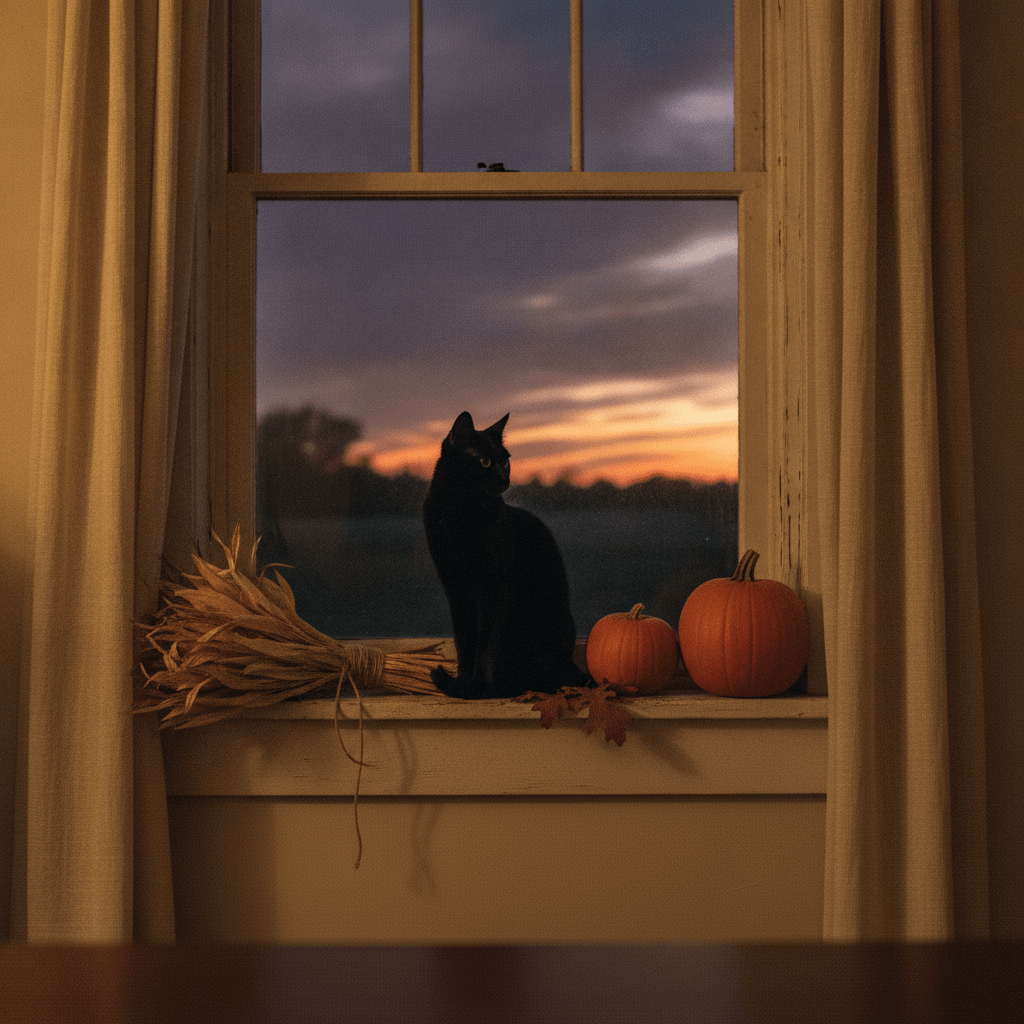
Your cat has been sitting in the window for twenty minutes, watching nothing, doing that slow tail-flick that means either deep thought or mild contempt. It is October. This is normal. Cats at Halloween are not just a decoration choice or a costume category — they are the holiday's oldest and most stubborn symbol, and the reasons go back further than most people realize. Pull up a chair. This one's worth knowing.

How Cats at Halloween Became a Thing in the First Place
The short answer is the Celts. The longer answer involves a holiday called Samhain, which the ancient Celts observed on the last night of October as the boundary between the living world and the dead one. On that night, the veil was thin. Spirits wandered. And cats — particularly black ones — were believed to be either companions of those spirits or vessels for them entirely.
When Christianity spread through Britain and Ireland, the Church folded Samhain into All Hallows' Eve. The theology changed. The cats stayed. By the medieval period, black cats had been formally associated with witchcraft across much of Europe. Pope Gregory IX issued a papal document in 1233 that specifically named black cats as diabolical. That is a level of institutional attention most animals never receive.
The witch-and-cat pairing that feels like a Halloween cliché now was, for several centuries, genuinely believed. Cats were nocturnal, independent, and impossible to fully domesticate — qualities that made nervous people uneasy in an era when unease was easily converted into accusation. The recorded history of Halloween tracks almost perfectly with the recorded history of cats as supernatural symbols.
The Witch's Familiar: Why the Cat Stuck When Other Animals Didn't
Owls were spooky. Bats were spooky. Toads got a brief run. But none of them achieved what the cat achieved, which was permanent co-branding with a major holiday. There are a few reasons for that.
First, cats were actually present in the same spaces as the women accused of witchcraft. Poor, elderly, isolated women — the demographic most often targeted during witch trials — frequently kept cats for practical reasons. Cats caught mice. They were cheap to feed. They were company. When accusers came looking for evidence of a familiar spirit, the cat sitting on the hearth was right there.
Second, cats behave in ways that read as uncanny if you're already looking for it. The slow blink. The sudden stare at empty space. The 3 a.m. sprint through the house for no reason. A 14th-century villager did not have the vocabulary of "bored indoor predator" to explain that behavior. What they had was folklore, and folklore filled the gap.
Third — and this is the part that actually matters for understanding Halloween as a holiday — cats are genuinely mysterious in a way that feels appropriate to October. They don't perform affection on demand. They keep their own counsel. There's something in that quality that fits a holiday built around the idea that not everything is visible, not everything is knowable, and the dark outside the window might contain more than you think.
If you've spent any time reading about what it actually means to live with a cat, you know that the mystery isn't an exaggeration. It's a daily reality.
◆ From the Workshop: When you're planing figured wood — curly maple, quilted cherry, anything with wild grain reversals — you'll feel the plane alternately dig and skate as the fibers change direction every few inches. The fix isn't a sharper iron; it's a steeper cutting angle. Set your plane to 50 or even 55 degrees instead of the standard 45, and that same wild grain that was tearing out becomes a surface you can plane cleanly in any direction, because the steeper iron scrapes more than it slices. Some of the most beautiful material is also the most unpredictable — which, now that we mention it, describes cats pretty well too.
Frequently Asked Questions
Do cats actually behave differently in October, or is that just something cat owners imagine?
There's something to it. Shorter days in autumn shift the light cycle, which affects melatonin production in cats just as it does in humans. Some veterinarians note increased nighttime activity and restlessness in cats during fall months. Whether that's spooky or just seasonal biology depends on how dramatic you want to be about it.
Are black cats actually adopted less often, or is that an urban legend?
It's complicated. Some shelters do report slower adoption rates for black cats year-round — often attributed to poor visibility in photos rather than superstition. A few shelters pause black cat adoptions around Halloween as a precaution, though animal welfare researchers debate whether that policy is necessary or counterproductive. The data is genuinely mixed depending on region and shelter type.
Which other animals share the same kind of deep mythological connection to Halloween that cats do?
Owls and bats come closest. Owls were associated with death and prophecy in ancient Greek and Roman traditions, and bats became linked to Halloween partly because early bonfires attracted insects, which attracted bats — so people literally saw bats circling the flames during Samhain celebrations. Neither has the staying power of the cat in modern imagery, though.

What Cats at Halloween Actually Reveal About the Holiday Itself
Halloween is the one major American holiday that has never been fully domesticated. Christmas got Hallmark. Valentine's Day got chocolate-covered predictability. But Halloween keeps its edges. It's the holiday that still asks you to sit with discomfort, to let the dark be dark for a night, to admit that some things don't resolve into warmth and light.
Cats fit that perfectly. A dog will greet you at the door with uncomplicated joy. A cat will assess you from across the room and decide later. That withholding, that self-possession — it mirrors exactly what Halloween asks of the people who love it. Not everything is cozy. Not everything is for you. Some things just watch from the window and keep their own secrets.
This is also why the cat silhouette — arched back, raised tail — became such a durable visual shorthand for the holiday. It communicates tension without violence, strangeness without gore. It's the Halloween image you can put on a front porch or a child's lunch bag without anyone flinching. The witch's broom says magic. The jack-o'-lantern says mischief. The cat says something older and quieter than either of those.
There's a whole strand of Halloween decorating that leans into that quieter, more atmospheric quality — less plastic skeletons, more candlelight and symbols that carry real weight. Our post on witch-themed Halloween party decor gets into that aesthetic if you're thinking about how to set a mood rather than just fill a porch.
Why Your Cat Probably Knows It's October
Here is where the history gets a little more grounded. Cats are exquisitely sensitive to light cycles. As the days shorten in autumn, the shift in natural light triggers real hormonal changes — melatonin production increases, activity patterns shift, and many cats become noticeably more alert and active after dark. This is not superstition. It's biology.
Add to that the fact that October brings new smells into the house — candles, dried leaves tracked in on shoes, the particular dusty-sweetness of decorations pulled from storage — and you have an animal that is genuinely processing a changed environment. Cats investigate change. That's their job. So when your cat starts doing that slow patrol of the living room at 11 p.m. in October, it's not communing with the spirit world. It's just being a cat in a house that suddenly smells different.
That said, it's hard not to find it charming. The cat doesn't know it's playing a role that humans assigned to its ancestors a thousand years ago. It's just doing what cats do. And somehow that makes the whole thing better — the holiday borrowed the cat's actual nature and turned it into mythology, and the cat never noticed or cared.
If you're the kind of household that leans fully into the season, a carved solid-wood Halloween welcome sign by the front door says exactly what the holiday is about before anyone even knocks — and it holds up a lot better than foam and plastic when November comes around. Our holidays and seasons collection has pieces built for people who treat October like it deserves its own chapter, not just a weekend.
The cat on your couch has no idea it's an icon. It's just watching the door, waiting for something interesting to happen. Which is, honestly, the most Halloween thing imaginable.
Share:
What to Cook for Sunday Supper: The Southern Tradition of Sunday Dinners | Bluegrass Gifts
The Lost Art of the Family Motto: Words to Live By That Ordinary Families Chose | Bluegrass Gifts