

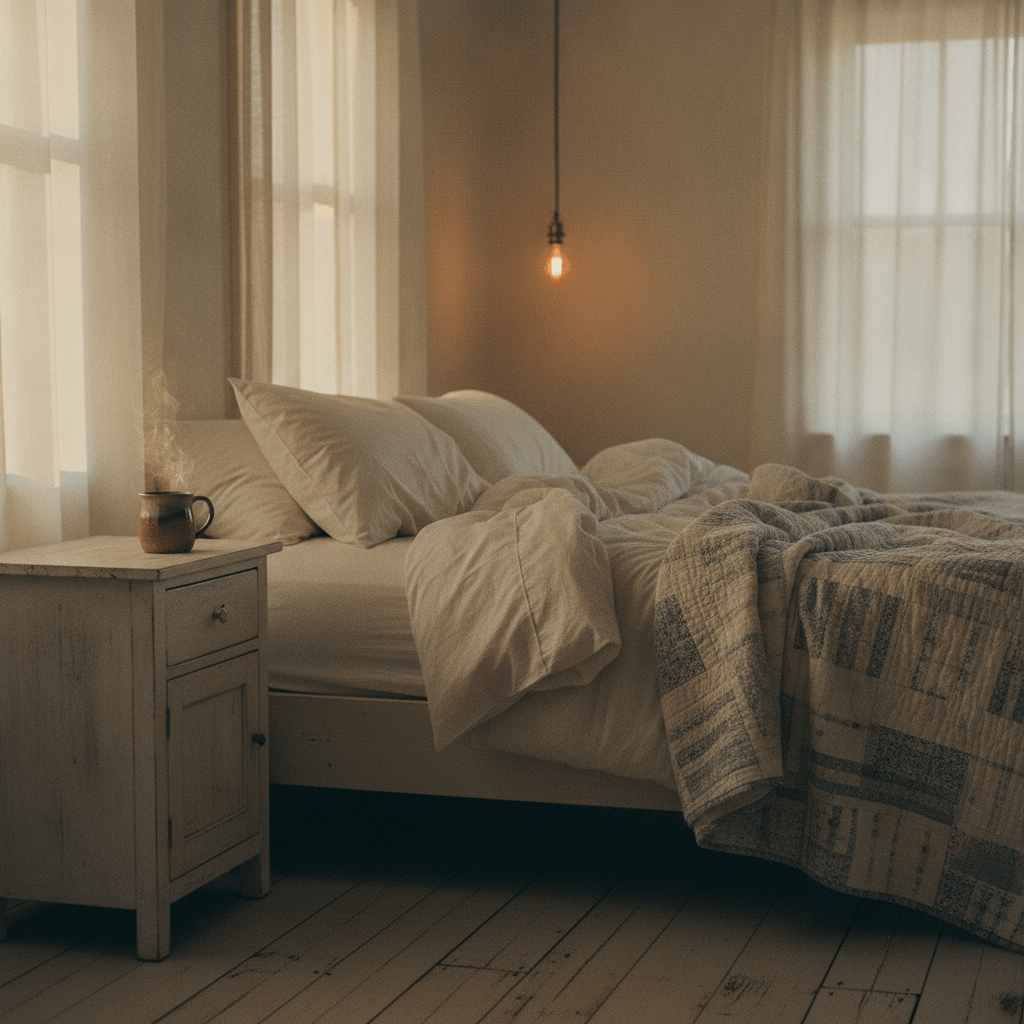
Why Am I Fatigued When I Did Everything Right Last Night
You went to bed at a decent hour. You didn't scroll until midnight. You got somewhere between seven and nine hours, which is exactly what every sleep article has ever told you to do. And yet here you are, standing in the kitchen at 7 a.m. holding a coffee mug like it's a life preserver, wondering why am i fatigued when I technically slept. That question deserves a real answer, not a listicle about chamomile tea.
The short version is this: sleep duration and sleep quality are two completely different things. You can spend eight hours in bed and get maybe five hours of actual restorative sleep, depending on what's happening in the room around you. Your bedroom environment — the temperature, the light, the noise, even the emotional weight of the space — has more influence over your morning energy than the number on the clock does.

Your Room Is Too Warm and Your Brain Knows It
The human body needs to drop its core temperature by about one to two degrees Fahrenheit to initiate deep sleep. That's not a preference — it's a biological requirement. When your bedroom is too warm, your body spends the night fighting that process instead of completing it. You stay in lighter sleep stages. You wake up more often, sometimes without remembering it. And you spend the next day asking am i fatigued or just getting old, when the real answer is that your thermostat was set to 72.
Most sleep researchers land somewhere between 65 and 68 degrees Fahrenheit as the sweet spot for a sleeping adult. That feels genuinely cold to a lot of people, especially in winter. A reasonable compromise is a cooler room with a heavier blanket — your body gets the temperature drop it needs, and you stay comfortable. Ceiling fans help more than people give them credit for, mostly because moving air feels cooler than still air at the same temperature.
- Set your thermostat between 65 and 68 degrees before bed, or use a fan to create airflow
- Avoid electric blankets that stay on all night — they trap heat against your body during the hours you need to cool down most
- If you run hot, consider moisture-wicking sheets over cotton; they move heat away from your skin instead of holding it
Am I Fatigued Because of Light, or Is That Just an Excuse
It's not an excuse. Light is the primary signal your brain uses to regulate melatonin, and melatonin is what tells your body it's time to shift into the kind of deep, slow-wave sleep that actually restores you. Even low-level light — a streetlamp through thin curtains, a charging indicator on a power strip, the glow of a cable box — can suppress melatonin production enough to shorten your deep sleep window without you ever waking up fully.
Blue-spectrum light is the worst offender, which is why screens before bed are a genuine problem and not just something parents say to teenagers. The blue wavelengths that phones and TVs emit are almost identical to the spectrum of morning sunlight. Your brain receives that signal and starts winding down its sleep chemistry before you've even put the phone on the nightstand.
Blackout curtains are the single most cost-effective sleep upgrade most people haven't made. A sleep mask works too, if you don't want to deal with curtains. The goal is simple: when you close your eyes, the inside of your eyelids should be dark, not orange.
◆ From the Workshop: Wood holds tension long after the tree is gone — and it'll remind you of that at the worst possible moment. When you're ripping a long board on a table saw without a helper, the back end of the board will slowly pivot away from the fence as you push through the cut, not because you're doing anything wrong, but because the saw is relieving internal stress that was locked into the tree while it was still growing. That tension can pinch the blade, stall the motor, or kick the board back at you. Experienced sawyers keep a wooden wedge called a kerf spreader in their back pocket for exactly this moment: slip it into the cut behind the blade and the board stops fighting you.
Frequently Asked Questions
Can eating too close to bedtime make me feel fatigued the next morning even if I slept a full eight hours?
Yes, and the mechanism is more direct than most people expect. When you eat a large meal within two to three hours of lying down, your body is still running its digestive engine during what should be deep, restorative sleep. Core body temperature stays liftd, and your heart rate doesn't drop the way it needs to for slow-wave sleep to kick in properly. The result is that you clock the hours but miss the depth. A light snack is fine; a full plate of leftovers at 10 p.m. is essentially asking your body to run a shift and sleep at the same time.
Is there a difference between feeling fatigued and feeling sleepy, and does it change what I should do about it?
There is, and it matters. Sleepiness is a drive — your body wants to sleep and will, given the chance. Fatigue is a depletion state — a sense of low energy, heaviness, or mental fog that doesn't always resolve with more sleep. If you're sleepy, sleep hygiene fixes (consistent schedule, dark room, cooler temperature) usually help. If you're fatigued but not particularly sleepy, the causes tend to be broader: low iron, thyroid function, blood sugar dysregulation, or chronic low-grade stress. Persistent fatigue that doesn't respond to better sleep habits is worth a conversation with a doctor, not just a new pillow.
Does the direction your bed faces or where it sits in the room actually affect sleep quality?
The research on compass orientation is thin and mostly folkloric. What does have real evidence behind it is position relative to light sources and air flow. A bed placed directly under a window will catch early morning light — even through curtains — which can suppress melatonin and pull you out of REM sleep earlier than your body intended. A bed positioned near a heating or cooling vent may expose you to noise and fluctuating temperature throughout the night. Neither is about feng shui; both are about physics. Moving the bed even a few feet can sometimes solve a problem that a sleep mask and earplugs never quite fixed.
The Emotional Temperature of the Room Matters Too
This one sounds soft until you think about it for a minute. Your bedroom is supposed to be the place your nervous system associates with rest. But for a lot of people, it's also where they lie awake replaying arguments, where the laundry pile lives, where the laptop comes to bed, and where the phone charges six inches from their head. The brain is an association machine. If your bedroom consistently signals stress, it will have a harder time downshifting into sleep — even when you're genuinely tired.
This is part of what sleep researchers call stimulus control, and it's one of the most evidence-backed interventions in behavioral sleep medicine. The idea is simple: the bed should be for sleep and nothing else. No working in bed. No eating in bed. No doom-scrolling in bed. The more consistently you pair the physical space with the act of sleeping, the faster your body learns to shift gears when you lie down.
The feel of a room matters in ways that aren't always measurable. Clutter creates low-grade visual noise that keeps the brain slightly activated. A bedroom that feels calm — intentionally arranged, with a few things on the wall that actually mean something to you — is easier to decompress in. Our farmhouse bedroom wall decor ideas post gets into the practical side of this if you're thinking about the space with fresh eyes.

Three Physical Culprits That Fly Under the Radar
If you've addressed the temperature, the light, and the emotional weight of the room and you're still waking up exhausted, there are a few less obvious factors worth considering before you assume something is seriously wrong.
- Mouth breathing and undiagnosed sleep apnea. If you snore, wake up with a dry mouth, or frequently wake with a headache, your airway may be partially obstructing during sleep. This interrupts the deep sleep cycle repeatedly throughout the night. A sleep study is the only way to know for certain, and it's worth asking your doctor about.
- Alcohol within three hours of bedtime. Alcohol is sedating, which is why people use it to fall asleep. But it metabolizes out of your system in the middle of the night and causes a rebound effect that fragments sleep in the second half. You fall asleep fast and wake up feeling like you barely slept at all.
- An old or unsupportive mattress. A mattress that doesn't support spinal alignment causes your muscles to stay partially engaged all night trying to compensate. You wake up stiff, sore, and more tired than when you went down. The general guidance is eight to ten years, but if you're waking up with back or neck pain consistently, that's the mattress telling you something.
The finding your happy place at home piece we put together touches on how the spaces we live in shape how we feel — which connects to this more than it might seem at first.
Making the Room Work for You Instead of Against You
Most of the fixes here are free or close to it. A cooler thermostat costs nothing. Blackout curtains run thirty to fifty dollars. Charging your phone in another room is free and probably overdue. The harder part is the habit layer — consistently treating your bedroom as a space for rest rather than a second office or a media room.
Start with one thing. Pick the variable most likely to be the problem — usually temperature or light for people who sleep hot or live near streetlights — and address that first. Give it two weeks. Sleep improvements are rarely instant because your body needs time to rebuild the sleep pressure and hormonal rhythms that bad sleep habits have disrupted.
If you're building out a bedroom that actually feels like a sanctuary rather than a staging area, the words on the wall matter more than people admit. A carved solid-wood sign that says something true and quiet — something that belongs in a bedroom rather than a conference room — can shift the emotional register of a space in a way that's hard to explain but easy to feel. Something like a carved nap-themed bedroom sign does exactly that: it's a little funny, it's a little honest, and it tells your brain this room is for rest. That's the whole point.
The question of why am i fatigued after a full night's sleep usually has an answer. It's rarely mysterious. It's almost always environmental, behavioral, or both — and almost always fixable without anything more dramatic than paying attention to the room you've been sleeping in without really seeing it. Take a look around tonight before you turn the light out. The clues are probably right there.
If you want to keep thinking about the bedroom as a space worth caring about, our full collection of bedroom signs is the kind of thing that makes a room feel like it was put together on purpose — which, it turns out, is exactly what your nervous system is looking for.
Share:
What Does 'Bless Your Heart' Actually Mean? A Complete Translation Guide for Outsiders | Bluegrass Gifts
How to Know If You're a Cats Person: A Completely Honest Field Guide | Bluegrass Gifts