

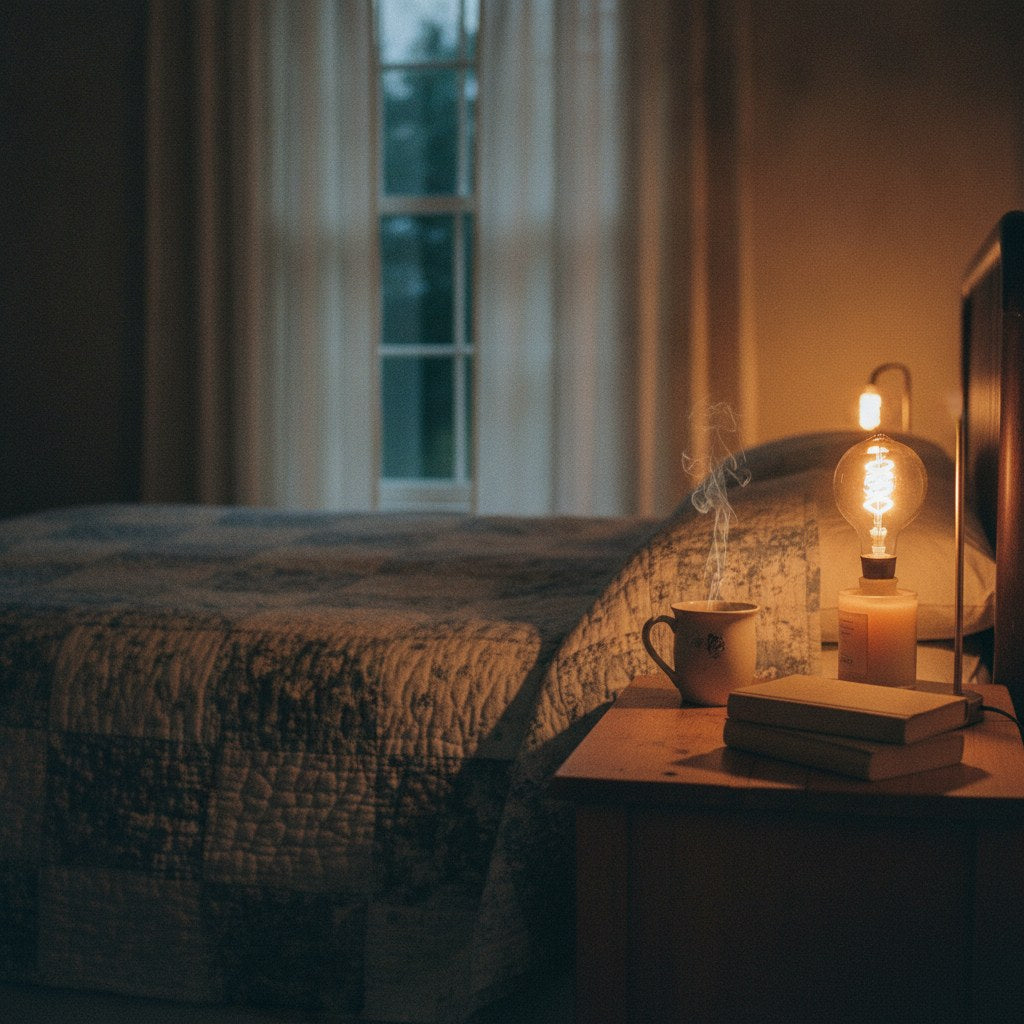
The Wind Down Routine for Sleep You're Probably Not Doing Right
You are tired. You have been tired since approximately 2 p.m. You told yourself at dinner that you'd be in bed by ten. It is now eleven-forty, and you are lying in the dark watching a video about a man who restores antique typewriters, fully awake, wondering why you can't sleep. The answer is that you don't have a real wind down routine for sleep — you have a collapse routine, which is different, and which explains a lot. A collapse routine is when your body just gives up mid-scroll and goes limp. A wind down routine is something you actually design. One of them works. The other one is what you've been doing.

Why Your Wind Down Routine Starts 90 Minutes Before You Think It Does
Here's the part nobody tells you: the wind down routine doesn't begin when you brush your teeth. It begins about ninety minutes before you want to be asleep, because that's roughly how long it takes your core body temperature to drop enough for deep sleep to actually happen. Your brain needs a long runway. It is not a fighter jet. It is a fully loaded cargo plane, and it needs the whole length of the strip.
What you do in that ninety-minute window either helps or fights that process. Bright overhead lights tell your brain it's noon. Screens — phones, tablets, the laptop you brought to bed because you were just going to check one thing — emit light in the blue spectrum, which is exactly the frequency your brain uses to decide whether it's daytime. You are essentially shining a small sun into your own face and then wondering why you feel alert.
The fix isn't complicated. Dim the lights around nine if you want to be asleep by ten-thirty. Switch from overhead fixtures to lamps. Put the phone across the room — not face-down on the nightstand, across the room, where you have to physically stand up to reach it. This is not a radical act. It just feels like one because we've decided that being reachable at all hours is a personality trait.
The Wind Down Routine Step Most People Skip Entirely
There's a step that almost everyone who can't sleep skips — and it's not the melatonin gummy or the white noise machine or the weighted blanket that cost you eighty-five dollars. It's the mental offload.
Your brain, bless it, is still running through the day when you close your eyes. It's replaying the conversation you had at two o'clock, rehearsing what you should have said, building a case. It's also previewing tomorrow — the meeting, the errand you forgot, the thing you promised someone. It does this because it genuinely believes it's helping. It is not helping. It is the worst possible time for this.
The fix is a paper notebook and about five minutes. Before you start any other part of your wind down routine, write down everything that's unresolved. Not in a journaling way — not feelings, not reflections — just a flat list. The thing you need to do tomorrow. The thing you're worried about. The grocery item. The name you keep forgetting to text back. Once it's on paper, your brain can stop holding it. It has been handed off. The notebook is now responsible, and the notebook doesn't lie awake.
This sounds too simple to work. It works.
◆ From the Workshop: When you're selecting a board for a chair seat or any piece that needs to stay flat under stress, look for medullary rays on the face — those subtle, silky ribbons or flecks that run perpendicular to the growth rings. They're not just decorative: the rays are sheets of structural tissue that stitch the annual rings together laterally, and a quartersawn board with prominent rays visible on its face is resisting cross-grain movement from the inside out. Old chairmakers called a ray-flecked board 'silver grain,' and they sought it out the same way a tailor seeks a tightly woven cloth — the structure you can see on the surface tells you exactly what's holding together underneath.
Frequently Asked Questions
How long before bed should I actually start winding down?
Most sleep researchers point to 90 minutes as the useful window — not because the rituals themselves take that long, but because your core body temperature needs time to drop before you can fall into deep sleep. Starting at 60 minutes works for most people; 30 minutes is usually not enough if you've had a stimulating evening.
Does it matter what order I do my wind-down steps in?
Order matters more than most people realize. Light-reducing steps (dimming screens, switching to lamps) should come first because they trigger melatonin production. Relaxing activities like reading or stretching work best in the middle. Anything that requires active thinking — tomorrow's to-do list, a quick email check — should be cut entirely, not just moved to last.
Can the physical environment of my bedroom actually affect how fast I fall asleep?
Yes, and the research on this is fairly consistent. Your brain uses environmental cues — temperature, light level, even familiar objects — to decide whether a space is safe enough to let its guard down. A bedroom that looks and feels like a workspace or a second living room keeps your nervous system slightly elevated. Small, deliberate changes to how a room looks and feels at night can shift that association over time.

What the Research Actually Says (Without Making It Weird)
The Sleep Foundation has written at length about sleep hygiene, and the consistent finding isn't that you need a seventeen-step ritual involving lavender oil and a sound bath. It's that consistency matters more than complexity. A short, predictable sequence — the same things, in roughly the same order, every night — trains your nervous system to recognize that sleep is coming. Your body starts preparing before you've even done anything, because it's learned the pattern.
That's the whole game. Not optimization. Pattern recognition. Your brain is extremely good at learning sequences, and you can use that to your advantage instead of fighting it every night with a different strategy you found on the internet at midnight.
A functional wind down routine looks something like this:
- Dim lights and put screens away 60-90 minutes before bed
- Do the paper offload — the flat list, five minutes, done
- Do something genuinely low-stakes: read a physical book, stretch on the floor, take a warm shower (the temperature drop afterward actually helps)
- Keep the bedroom cool — somewhere in the 65-68°F range is where most people sleep best
- Get in bed at the same time, including weekends, which is the rule everyone hates and the one that matters most
That's it. That's the whole thing. The reason it feels insufficient is that we've been sold the idea that sleep problems require sleep products. Mostly they require stopping the things that are in the way.
The Room Itself Is Doing Something to You
There's a concept in environmental psychology sometimes called behavioral affordance — the idea that spaces tell you what to do in them. A kitchen says eat. A gym says move. A bedroom that has a TV, a laptop, three chargers, a stack of unread mail, and the ambient glow of seven different indicator lights on various devices is saying something, and it's not saying sleep.
The physical space of your bedroom is part of your wind down routine whether you've thought about it that way or not. A room that feels settled, quiet, and intentional does a small but real amount of the work for you before you've done anything else. A room that looks like a staging area for tomorrow's chaos does the opposite.
This doesn't mean you need to redecorate. It means making small, deliberate decisions about what the room communicates at night. Cover the indicator lights. Move the work bag to the hallway. Put something on the wall that says the thing you want to feel when you walk in — something warm, something that belongs to you and whoever you share the space with. Our bedroom signs collection is full of exactly that kind of thing, if you want to see what other people are putting up. We make them out of hardwood, carved here in Kentucky, and they hold up better than a framed print from a big-box store.
One specific sign that people keep putting in their bedrooms: this carved nap roulette sign — which is funny, yes, but also does the thing a good bedroom sign should do, which is make the room feel like it belongs to a person rather than a hotel. The farmhouse bedroom wall decor post on the blog goes deeper on how to style the whole wall if you're thinking about it.
The last thing I'll say is this: most people treat sleep like a problem to solve at the end of the day, after they've given everything else their best attention. The wind down routine — the real one, the one that actually works — is just the decision to treat the last hour of the day like it matters. Which it does. Probably more than whatever you were doing on your phone.
Share:
Quotes About Wildlife and What's Actually Moving in the Southern Outdoors by Season
Hangover Quotes Funny Enough to Make You Feel Better: The History of Every Cure Humanity Ever Tried | Bluegrass Gifts