

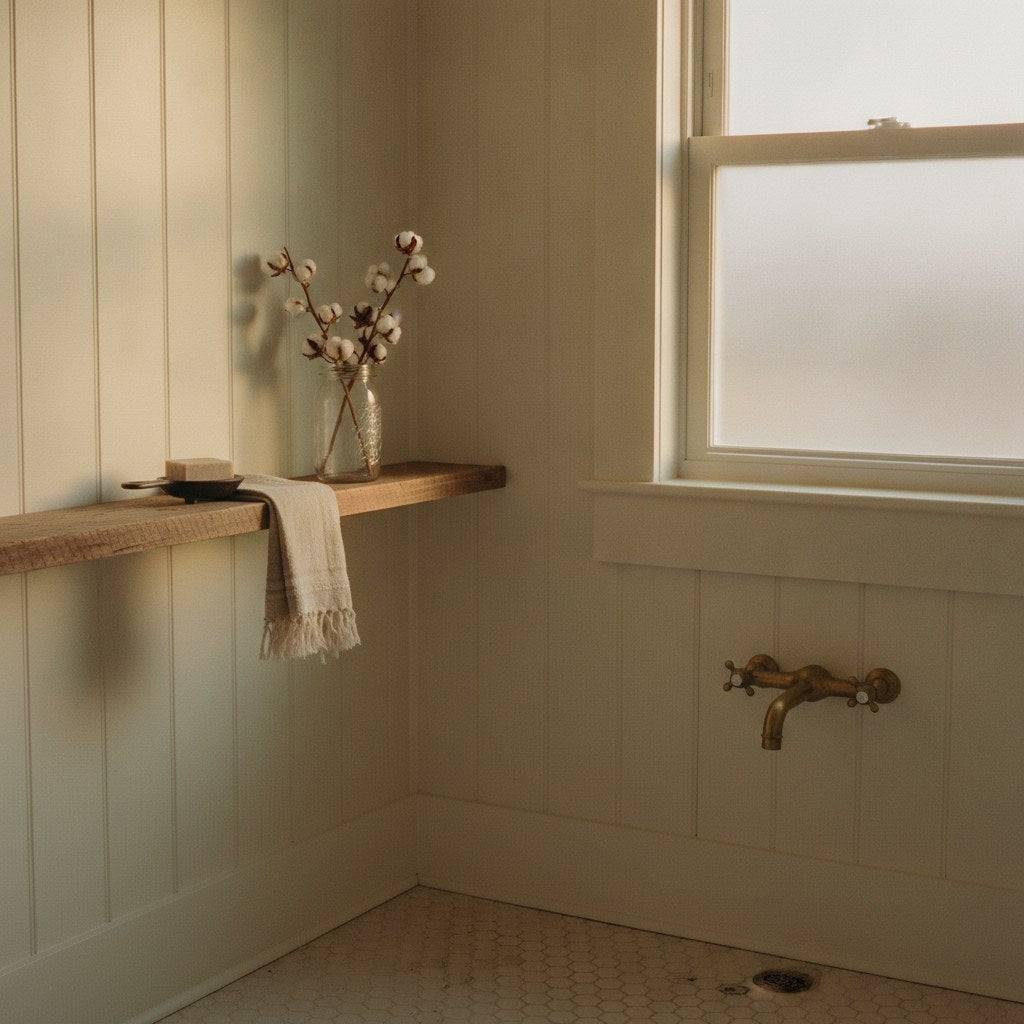
The Layout for Small Bathroom Spaces Nobody Warned You About
You walk in, do what you came to do, and walk out. That's the whole relationship most people have with their bathroom. It's the one room in the house that gets the leftover budget, the leftover attention, and whatever towels were on clearance. And somehow it's also the room every single guest uses. The layout for small bathroom spaces is a puzzle most of us never actually sit down to solve — we just accept whatever the builder left us and call it done.
It doesn't have to be that way. A small bathroom can have a real personality. Not a Pinterest personality that requires a contractor and a second mortgage, but an actual one — the kind that makes someone pause for a second and think, whoever lives here is interesting. The kind you can pull off on a Saturday with a few deliberate choices and maybe forty dollars.
Here's how to do it.

Stop Decorating the Small Bathroom Like It's an Afterthought
The first problem is usually psychological. People treat the bathroom as a utility room and decorate accordingly — a generic print from a big-box store, a soap dispenser that matches nothing, a rug that came in a three-pack. The result is a room that feels like it belongs to no one.
The fix isn't spending more money. It's making a single decision: this room has a point of view. Pick one. Dry humor. Farmhouse calm. Moody and dark. Bright and botanical. It doesn't matter which one, as long as you pick one and stick to it. A room with a committed aesthetic always reads better than a room with expensive things that don't agree with each other.
A few ways to establish that point of view fast:
- Paint is the highest-return move in any small space. A deep green, a warm charcoal, or even a saturated navy can make a tiny bathroom feel intentional rather than cramped.
- Swap the hardware. New cabinet pulls and a new towel bar in a consistent finish — matte black, unlacquered brass, brushed nickel — cost under twenty dollars and quietly unify the whole room.
- Edit ruthlessly. Three things on the counter read as picked. Eight things read as clutter. Put the extras under the sink.
None of that requires a contractor. All of it requires a decision.
How to Work the Walls in a Small Bathroom
Wall space in a small bathroom is precious, which means every inch of it is an opportunity. The mistake most people make is leaving it blank because they're not sure what to do, or filling it with something generic because it was easy. Both are a waste.
The wall above the toilet is the most underused real estate in American homes. It's at eye level when you're seated, which means it's the most-read surface in the room. Put something worth reading there. A framed print, a small shelf with two or three objects, or a carved wood sign with something that actually sounds like you.
That last option is one we know a little about — we make CNC-carved hardwood signs in Kentucky, and the bathroom collection gets more repeat customers than almost anything else we sell. People buy one, hang it, and then come back for the guest bath. There's a reason for that: a well-chosen sign in a bathroom does something a framed print rarely does. It makes people laugh, or nod, or feel like they know the person who lives there. That's personality. That's the whole goal.
If you want something that threads the needle between funny and actually handsome on the wall, this rustic farmhouse bathroom sign earns its wall space — it's the kind of line that lands without trying too hard.
A few other wall principles worth keeping:
- One larger piece reads better than a cluster of small ones in a tight space. Scale up when in doubt.
- Hang things lower than you think. Eye level seated is lower than eye level standing.
- Mirrors count as wall decor. An interesting mirror shape does more work than a plain rectangle.
◆ From the Workshop: When you're flattening a twisted board with winding sticks, the traditional pair is made from two different woods — one light, one dark — so the contrast between the top edges reads clearly from across the bench. It sounds minor until you're squinting down a six-foot plank in low shop light and the difference between flat and close enough is a sixteenth of an inch. Old timber framers used the same two scraps for decades, because familiarity with your own tools is half the accuracy. Knowing your space that well — its proportions, its light, its quirks — works the same way in decorating.
Frequently Asked Questions
What paint finish works best in a small bathroom with poor ventilation?
Semi-gloss is the standard answer, but satin is worth considering if you want less shine — it still resists moisture and wipes clean, but it's more forgiving on walls that aren't perfectly smooth. Flat or eggshell finishes hold moisture and will eventually bubble or peel in a humid bathroom, so skip those regardless of how good they look on the swatch.
How do you hang things on tile without drilling holes?
Adhesive picture-hanging strips rated for tile (the kind with a pull-tab release) work reliably for lightweight items under about five pounds. For anything heavier — like a solid hardwood sign — look for adhesive hooks designed specifically for wet or humid surfaces, and make sure the tile is completely clean and dry before you press them on. Let them cure 24 hours before hanging anything.
Does a dark paint color really make a small bathroom feel smaller, or is that a myth?
Mostly a myth, and designers have been saying so for years. A dark color on all four walls actually removes the visual boundary between surfaces, which can make a small room feel more like a deliberate, enveloping space rather than a cramped one. The trick is committing fully — one dark accent wall in a white room tends to just highlight how small the room is, while painting everything the same deep tone creates cohesion.

Small Bathroom Lighting Is Doing More Than You Think
Lighting in a small bathroom is almost always an afterthought, and it shows. The builder-grade fixture above the vanity casts a single flat wash of light that makes everyone look like they're being processed for a mugshot. It's not flattering. It's not interesting. And it's one of the easiest things to change.
Vanity lighting that comes from the sides — flanking the mirror rather than sitting above it — is the single biggest upgrade you can make to how a bathroom feels and how you look in it. It's also not a complicated swap. Most side-mount sconces use the same wiring as the fixture you already have.
If rewiring isn't in the cards, there are battery-powered options now that are genuinely good. Plug-in sconces with a cord cover painted to match the wall are nearly invisible. A small lamp on a shelf adds warmth. Candles — real ones, if you're careful — do something that no electric light can fully replicate.
The other lighting move that costs nothing: clean the existing fixture. Dust on a light bulb reduces output noticeably. A frosted globe with a year of dust on it is working at maybe sixty percent. Wipe it down and you'll be surprised.
Texture and Smell: The Two Things Photographs Can't Capture
Here's something interior design content rarely says out loud: a room that photographs well and a room that feels good are not the same thing. A small bathroom can look perfectly styled in a photo and still feel cold and clinical when you're actually standing in it. Texture and scent are the reason.
Texture is what makes a room feel lived-in rather than staged. A linen hand towel instead of a flat cotton one. A small wooden tray to hold the soap and a candle. A woven basket under the sink instead of a plastic bin. A bath mat with some weight to it. None of these are expensive. All of them change how the room feels underfoot and in the hand.
Scent is the most powerful and most overlooked tool in the room. A bathroom that smells good — not aggressively perfumed, but clean and faintly pleasant — registers as cared-for in a way that no amount of decor can fake. A reed diffuser on the back of the toilet tank, a bar of good soap left unwrapped, a small sachet in the cabinet. These are five-dollar decisions that punch well above their weight.
If you want to go deeper on the rustic-meets-real-life decorating approach, the rustic bathroom decor ideas post on our blog covers the aesthetic in more detail — useful if you're trying to land a specific look rather than just improve what you have.
The One Rule That Ties a Small Bathroom Together
Repeat something. That's it. That's the rule.
Repetition is what separates a room that looks designed from a room that looks assembled. Pick one color, one material, or one finish and let it appear in at least three places. Brass in the hardware, brass in the mirror frame, brass in the light fixture. Green in the paint, green in a plant, green in a small print. Wood in a sign, wood in a tray, wood in a shelf bracket.
The brain reads repetition as intention. And intention is what personality is made of.
You don't need a designer. You don't need a renovation. You need a point of view, a few deliberate choices, and the willingness to edit out the things that don't belong. A small bathroom that knows what it is will always feel better than a large one that doesn't.
If you're still figuring out what your bathroom wants to say, our bathroom signs collection is a good place to start — not because a sign fixes everything, but because choosing one forces you to decide what tone the room is going for. That decision, made once, makes every other choice easier.
And if you want to see how the same principles apply room by room, the farmhouse home decor room-by-room guide walks through the whole house with the same practical approach — no renovation required.
Share:
Trusting God in Hard Times: What 'Let Go and Let God' Really Means | Bluegrass Gifts
Top 10 Gifts for Bourbon Lovers (That Aren't Another Bottle)