

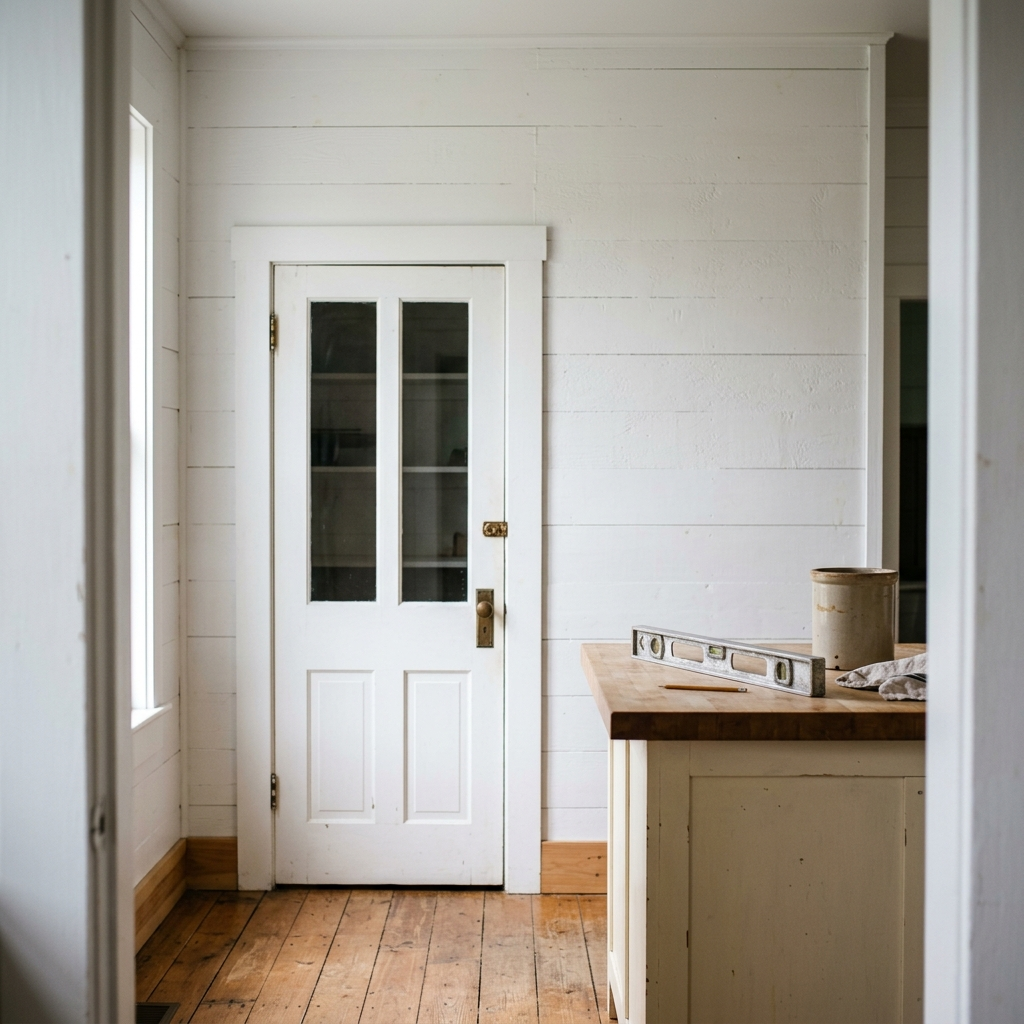
The Pantry Sign That Spent Six Months Leaning on the Counter
Here is how it usually goes. The sign arrives, it looks right, and you set it on the counter by the pantry door "for now" while you figure out how to hang a pantry sign without putting a hole in the wrong spot. Then a bag of flour gets set in front of it. Then a stack of mail. By the time you notice it again, the counter has quietly absorbed it, and the door it was meant for is still bare. Most signs that never get hung didn't fail on the wall. They failed on the counter, waiting on a decision about height and hardware that takes about four minutes once you know what you're deciding.
To hang a pantry sign, center it on the wall above the door trim with roughly two inches of air between the trim and the bottom edge of the sign, or center it on the door itself at about sixty inches from the floor. A sawtooth hanger on one finish nail, driven in at a slight upward angle so the head hooks the teeth, holds a carved pine sign of this size on drywall with no anchor needed.
The rest of this is the part nobody tells you: which of the three spots is right for your kitchen, and what to do about the surfaces that push back.

Above the Door: Where to Hang a Pantry Sign in Most Kitchens
Above the door trim is where a pantry sign wants to live in most kitchens, and the reason is plain geometry. On a standard eight-foot ceiling, a standard eighty-inch door with its jamb and casing tops out around eighty-three to eighty-four inches, which leaves a strip of wall about a foot tall that nothing else is ever going to use. A sign there reads from across the room, it never gets bumped by a grocery bag, and it does the job a label is supposed to do, which is tell the person standing at the island where the crackers are without anyone opening a door.
The sizing rule that keeps it from looking like an afterthought: on a thirty-inch or wider door, the sign should run somewhere between half and two-thirds the width of the door. Most single pantry doors run twenty-four to thirty-six inches, and on the narrow twenty-four-inch door the sixteen-inch sign is the one. A thirty-inch door takes a sixteen- or twenty-four-inch sign comfortably, and a thirty-six-inch door carries a twenty-four-inch board without crowding the trim. Leave about two inches of wall showing between the top of the casing and the bottom of the sign. Tighter than that and it looks like it's sitting on the trim; looser and it drifts toward the ceiling. We carve a pine pantry sign that hangs above a door in three widths for exactly this reason, and the twenty-four-inch one is the size that goes above the most doors.
Hanging it is the easy part once the height is settled. Hold the sign up, mark the wall at the center of its top edge, then measure down to where the sawtooth hanger sits on the back, usually an inch or so below the top, and mark again. One finish nail driven into that second mark at a slight upward angle, so the head catches the teeth, is all a sign this light needs. We wrote a whole piece on the right hardware for every weight and wall if you're hanging something heavier, but a pantry sign is not the heavy case.
◆ From the Workshop: People ask why we bother with a sawtooth hanger on a board this light, and the honest answer is that light is lighter than they think. A twenty-four by five-and-a-half inch pine sign at three-quarters thick is ninety-nine cubic inches of wood, about a seventeenth of a cubic foot, and pine runs in the mid-twenties of pounds per cubic foot, so the finished board weighs about a pound and a half. That's why one finish nail is enough and why we don't ship anchors with them. We set the hanger dead center and about a half inch down from the top edge, which keeps the board flat against the wall instead of tipping forward at the top, and the teeth give you enough travel side to side to level it by hand after the nail is already in.
On the Door Itself: When to Hang a Pantry Sign Lower Than You Think
Some kitchens don't have that strip of wall above the door. A cabinet run ends right at the casing, or the pantry sits under a soffit, or the door is in a hallway with a low ceiling. In those kitchens the sign goes on the door, and the number to remember is sixty. Sixty inches from the floor to the center of the sign puts it at the eye level of most adults, which is the same rule galleries use for hanging pictures and the reason a sign at that height looks settled and a sign at seventy looks like it's trying to escape.
Center it side to side on the door panel, not on the whole door, if the door has a raised panel. A sign centered on the panel reads as intentional; a sign centered on the door but off the panel reads as a measuring mistake, even when it isn't. On a flat slab door, center on the door and stop thinking about it.
Hollow-core doors are the one surface that changes the hardware. Most interior doors are hollow, with a thin skin over a honeycomb of cardboard, and a nail in the skin holds about as well as a nail in a cereal box. Two things work: a short screw with a coarse thread that bites the skin, or the adhesive strips from the FAQ above. We've hung a sixteen-inch sign on a hollow door with one strip pair and it was still there two years later when the family moved.
Leaned on a Shelf: The Sign That Doesn't Need a Nail at All
Not every pantry sign is going on a door. The sixteen-inch size is short enough to lean on an open shelf, tuck behind a row of jars on a countertop, or sit on top of the fridge cabinet where a label for the whole corner makes sense. This is the answer for renters who can't put a hole in anything, and for the pantry that isn't really a pantry, just the cabinet where the cereal lives.
Leaning has its own rule: put the sign behind something, not in front. A sign leaned in front of the jars gets knocked over every time someone reaches for the oats. A sign leaned against the back of the shelf, with the jars in front of its lower third, stays put and looks like it grew there. On a deep shelf, a small rubber bumper under the bottom edge keeps it from sliding on a painted surface.
The thing to know about placement in general is that a sign only earns its keep if people walk past it. We made that argument at length in where to hang a grandma sign so it gets seen every day, and a pantry sign is the same math. The pantry door gets opened forty times a day in a house with kids. That's where the sign goes, one way or another.

The Spot That Looks Right in Photos and Wrong in Your Kitchen
The one placement that sounds sensible and quietly fails is the wall beside the pantry door, at shoulder height, next to the light switch. It photographs well because the camera stands back. In real life you stand eighteen inches from it every time you reach for the switch, and at that distance a sixteen-inch sign reads as a wall of letters, not a word. Signs are meant to be read from across a room. The closer the reader stands, the smaller the sign should be, and nobody puts a tiny sign next to a light switch.
The second quiet failure is hanging it too high above the door. There's a temptation to split the difference between the trim and the ceiling, which on an eight-foot ceiling puts the sign's center around eighty-eight inches. From across the kitchen that reads fine; from the doorway you have to tilt your head back to see it, and a sign you have to look up at stops being a label and starts being a decoration. Two inches off the trim is the number. If your ceilings are nine or ten feet, hold at two inches anyway and let the extra wall stay empty above it.
If the goal is a kitchen that feels finished rather than labeled, the sign is usually the last piece, not the first. It goes up after the shelves are styled and the counter is cleared, because it's the one thing on the wall that tells a visitor the room is done. If you're hunting for one, the kitchen signs are all here, and the size listed on each one tells you which board fits the door you've got. And if the pantry is where the family gets fed, the hangry sign we wrote about belongs about six feet away.
The sign on the counter wasn't waiting on you to become a carpenter. It was waiting on one number and one nail, and now you have both.
Frequently Asked Questions
How do I hang a wooden sign on the wall?
We hang a wooden sign on one finish nail through the sawtooth hanger on the back, tapping the nail in at a slight upward angle so the head hooks the teeth, and we put the nail where the hanger actually sits rather than at the top edge of the sign. A sign under about five to ten pounds hangs fine on a single nail straight into drywall with no stud behind it; anything heavier, we look for a stud or use a proper drywall anchor. We start by marking the top center of the sign on the wall, then measure down to the hanger and drive the nail there. Once it's up, we check it with a level, since the sawtooth's teeth let us nudge the sign side to side to straighten it.
How do you hang a sign with no hooks?
Without hooks or nails, we hang a sign with a pair of removable adhesive strips rated for its weight, pressing them onto a clean, dry, painted wall and letting them set for a full hour before the sign goes up. The large strips are rated for about fifteen pounds a pair, so a pound-and-a-half pantry sign is well inside that limit. We wipe the wall with rubbing alcohol first, press each strip firmly for thirty seconds, and give a freshly painted wall a full week to cure before sticking anything to it. Adhesive strips also solve the hollow-door problem, where a nail has nothing solid to bite into.
What size pantry sign fits above a standard door?
Most single pantry doors run twenty-four to thirty-six inches wide, so there's no single standard size; above a typical door a sixteen-inch or twenty-four-inch sign sits over the trim without crowding it, and the thirty-inch works better over a double door or a long stretch of open wall. Ours come in three sizes: sixteen by three and a half, twenty-four by five and a half, and thirty by seven and a quarter inches. We carve them from pine if you want stain or poplar if you want paint, with twenty finishes on the site, and the carved letters are always left as bare wood grain rather than painted. A sawtooth hanger is already on the back, and it ships free in the U.S. in five to seven days.
Share:
Funny Hunting Quotes for the Cabin Wall (When the Bear Sign Is Already Taken)