

The candle is not a bad gift. It's just not a decision.
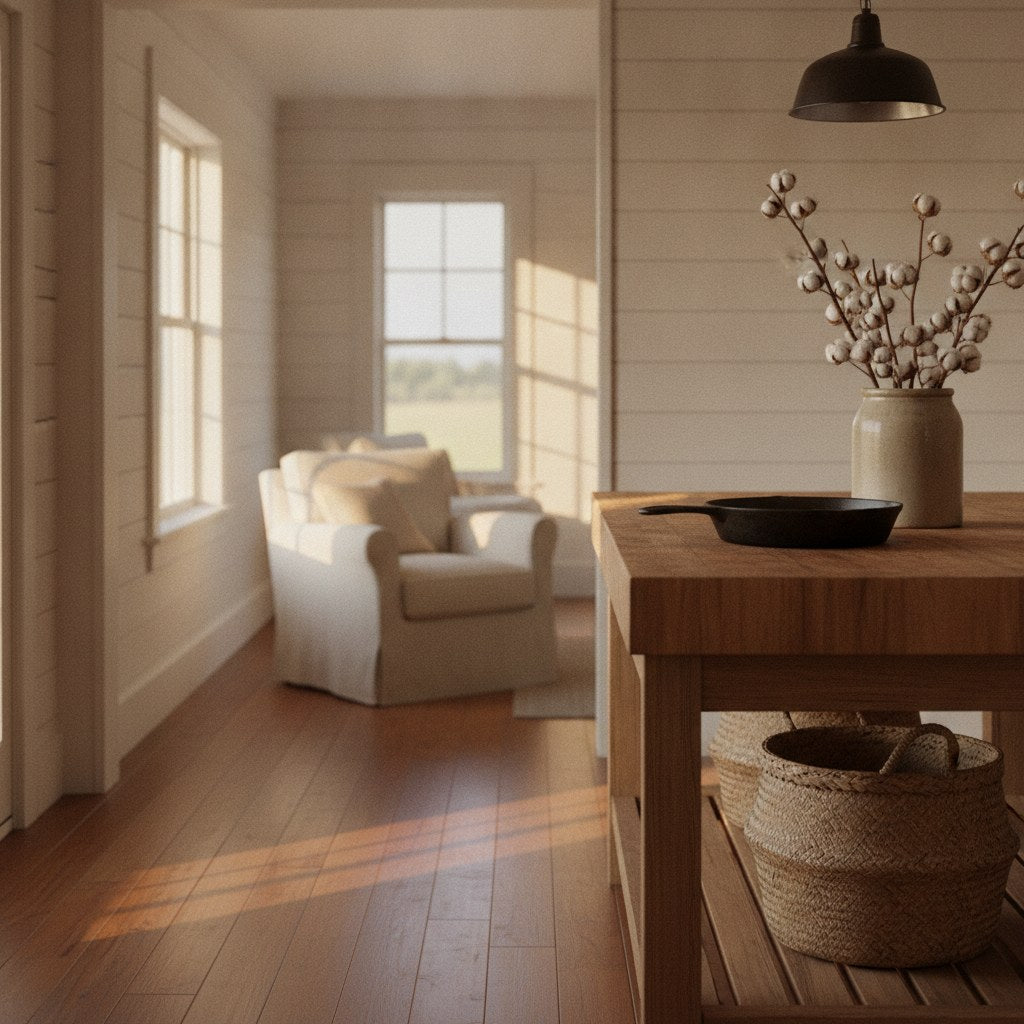
Someone who treats their open concept kitchen living room as the actual center of their home — the place where dinner happens and then nobody leaves for three hours — that person has thought hard about that space. They've made choices about what goes on the walls, what sits on the counter, what the room says when people walk in. Showing up with a candle in a kraft box tells them you thought about them for about forty-five seconds in the checkout line. It's fine. It's just not a gift that reflects the room they've built.
A carved wood sign is a different kind of thing. Not because it costs more or looks fancier, but because it has a point of view. It says something. And in a kitchen living room, where the wall above the range and the open shelving and the space between the island and the sofa all have to do double duty — decorative and functional at once — something that actually says something earns its place.
That's the claim. Here's the honest case against it, and why I don't think it holds.

The real counterargument: a sign is more personal, which means it can miss harder
This is the legitimate objection. A candle can't be wrong. Vanilla and cedar is a safe call for almost any home. A wood sign, though — get the tone wrong and it sits in the back of a closet by February. Go too sentimental for someone who runs a dry-humor household, and it's awkward every time they look at it. Go too jokey for someone whose kitchen is genuinely their sanctuary, and it reads as dismissive of something they care about.
That's real. I'm not going to pretend otherwise.
But here's where the counterargument falls apart: the same thing that makes a sign risky also makes it right, if you pay attention for thirty seconds. You already know this person. You've been in their kitchen living room. You know whether they dance while they cook or whether they run a quiet, focused operation. You know if they're the kind of host who makes a speech before dinner or the kind who just refills your glass without being asked. That knowledge is the whole advantage you have over a candle. Use it.
A sign that matches who they actually are isn't a gamble. It's a portrait. And a portrait, even a small carved one hung above the coffee station, is worth more than a hundred safe choices.
What actually works in a kitchen living room — and what gets lost
The open concept kitchen living room is a specific design challenge that most gift-givers don't think about. The space has to read from a distance. Whoever is sitting on the sofa is looking at the kitchen wall. Whoever is standing at the island is looking back at the living area. Nothing in that room gets to be small and precious — it either holds the wall or it disappears.
That's why a candle, even a beautiful one, doesn't register as decor in this kind of space. It's a surface object. It works on a side table or a bathroom shelf where someone is close enough to smell it. In a kitchen living room with twelve feet of sightline between the seating area and the range wall, a candle is invisible as a design choice.
A wood sign — something with real dimension, real grain, real carved letters — holds. The texture catches light differently at different times of day. The wood itself warms or cools with the light in the room. It's not competing with the kitchen; it's part of it. A sign like this carved kitchen gathering sign does exactly that: it says what the room already means to the people in it, out loud, in a material that belongs there.
Size matters more than most people think. In a kitchen living room, anything under about fourteen inches wide reads as an afterthought from across the room. Something in the sixteen-to-twenty-four inch range holds the wall without overwhelming it. If you're not sure of the exact wall space, err wider — a sign that fills the space looks intentional, and one that's too small looks like it wandered in from somewhere else.
◆ From the Workshop: When you're choosing wood for a wooden spoon blank and you split it from the log rather than sawing it, cut the blank so the handle runs parallel to the pith — not across it. That orientation puts the strongest, most flexible fibers running the full length of the handle, so it bends under load instead of snapping. Old country carvers called a well-oriented blank 'a spoon that already knows its shape,' because the tree's own structure had been doing that job long before the knife got involved.
Frequently Asked Questions
What size wood sign works best above a range hood or on a kitchen island wall?
In an open concept kitchen living room, the wall above a range hood or beside an island is usually seen from across the room — sometimes fifteen feet away. At that distance, a sign under twelve inches wide tends to disappear. Something in the sixteen-to-twenty-four inch range reads clearly without competing with the hood itself. If the wall runs uninterrupted from kitchen into living space, you can go wider, but keep the sign's height modest so it doesn't fight the vertical line of the hood or cabinetry.
How do I know if the recipient's walls can support a heavier wood sign?
Most interior drywall can support a standard picture hook for a lightweight sign, but a thicker wood piece — especially a wide one — may need a stud mount or a higher-capacity anchor. The easiest thing to tell the recipient: check the anchor packaging, which will state the rated load, and compare it to the sign's weight before committing to a spot. If they're unsure, a stud is always the safest answer and a stud finder costs less than a drywall repair.
Can a wood sign be personalized after I give it, or does the text have to be decided before it ships?
For CNC-carved wood signs, the text is carved into the wood during production — it can't be changed after the fact the way you'd swap out a label. So the wording needs to be decided before it ships. That said, many hostess gifts work beautifully with a fixed phrase ('Good Food, Good Friends, Good Times' reads as personal without requiring a name), so personalization isn't always necessary. If you want the recipient's family name or a specific phrase, just have that ready when you order.

How to pick the right sign for the kitchen living room you're shopping for
Start with tone, not text. Before you look at a single product, decide whether this person's kitchen is a warm-and-sentimental space or a dry-and-funny one. Those are genuinely different rooms, even if they look similar from the outside. The host who has a chalkboard menu on the fridge and cloth napkins at every dinner is not the same host who has a sign above the sink that says the dishes can wait. Both are real, both are good, and the sign that works for one would be wrong for the other.
For the sentimental kitchen — the one where Sunday dinners are a tradition and the smell of something in the oven is a deliberate act of hospitality — lean toward something that names what the room does. "Kitchens bring families together" isn't a cliché in a house where it's literally true every weekend. It's a fact, carved in wood, hung where everyone can see it. We wrote about this kind of kitchen on the blog — the idea that the kitchen is the heart of the home isn't sentiment so much as a description of how certain people actually live.
For the funny kitchen — the one where the host has opinions about your cooking technique and isn't shy about sharing them — lean into it. A sign that says "Your opinion is not part of the recipe" works in a kitchen living room where the cook has a sense of humor about being the cook. It's not mean. It's accurate. And it'll get read by every guest who comes through that door for the next ten years.
On mounting: if you're giving this as a gift and you won't be there to hang it, include a note about what works. Most interior walls can support a standard picture hook for a lightweight wood sign, but heavier signs may need a higher-capacity anchor or stud mount. If the recipient's home has tile backsplash in the area you're imagining, adhesive strips rated for the sign's weight can work, but only if the tile surface is smooth, flat, and free of grout lines or texture where the strip will sit — test on an inconspicuous spot first. Neither of those is complicated, but knowing it in advance saves a Sunday afternoon of second-guessing.
If you want a deeper look at the mechanics, we put together a full guide on how to hang a wood sign that covers walls, tile, and the situations where a stud finder is worth the ten minutes it takes to use one.
The thing a candle can't do
A candle burns down. That's not a criticism — it's what candles are for. They're consumable comfort, and there's real value in that. But a hostess who has built a kitchen living room that people don't want to leave hasn't done that with consumable things. She's done it with choices that stay. The table that seats two more than it should. The open shelving that shows the good dishes every day, not just for company. The light above the island that makes everything look like it's worth lingering over.
A carved wood sign belongs in that category. It's a choice that stays. And if you get the tone right — if you pick something that sounds like her, in a room that already sounds like her — it'll be the gift she points at when someone asks where it came from. That's the whole game.
Our kitchen signs collection is the place to start if you're ready to look — everything there is CNC-carved from real wood, and most of them ship fast enough to make it to the dinner party.
Share:
Where to Hang a Grandma Sign So It Gets Seen Every Day — Not Just on Visit Days | Bluegrass Gifts
What to Get Your Boss for Christmas When You Can't Tell If They Have a Sense of Humor | Bluegrass Gifts