

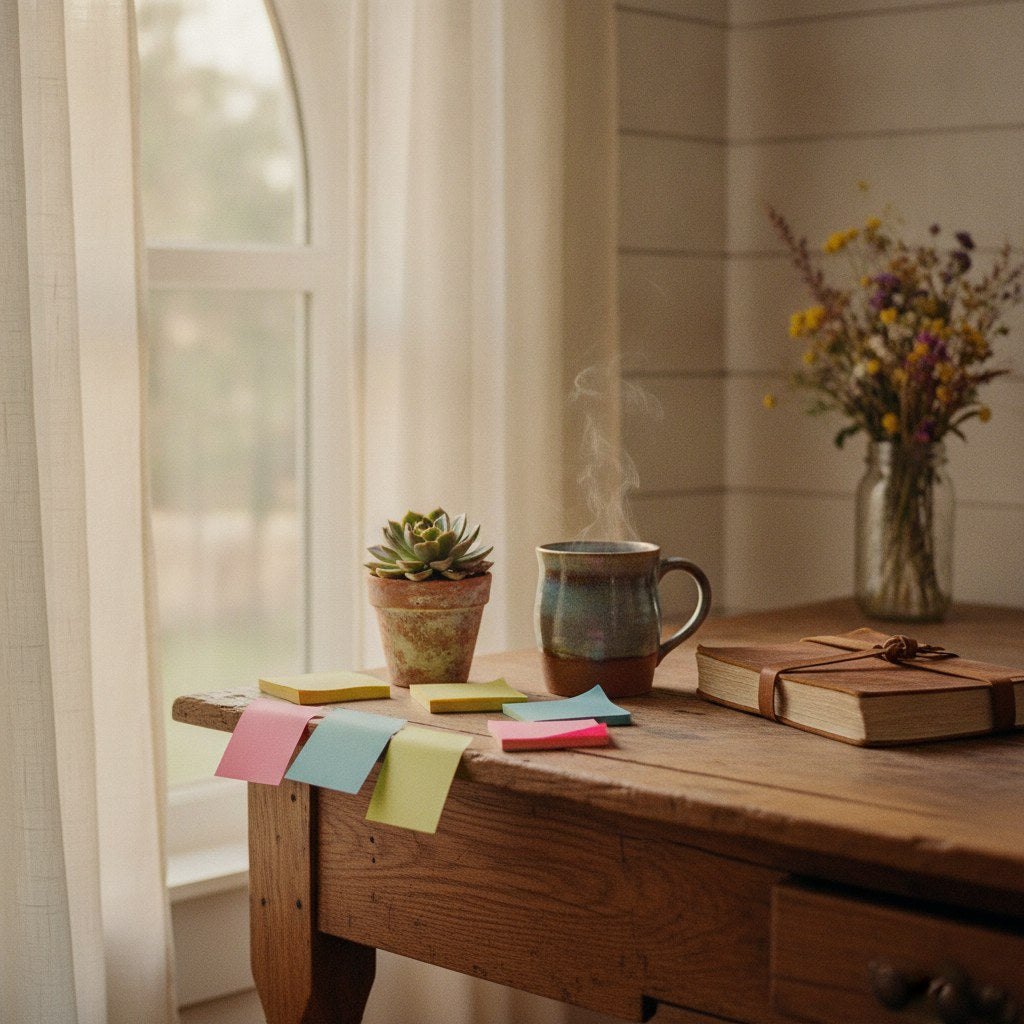
The Workplace Personality Test Your Desk Has Been Running Since Day One
The moment you pushed that rolling chair back, taped up that first sticky note, and plugged in your third monitor, you started broadcasting. Not on purpose. Nobody sat down and thought, I will now communicate my deepest personality traits through office supplies. But your coworkers read the desk anyway — the same way people read a front porch, or a car's back seat, or the ratio of actual books to decorative books on a shelf. The workplace personality test is informal, unscored, and absolutely merciless. The good news is you've probably been reading everyone else the whole time too, and you didn't even know it had a name.
This isn't pseudoscience dressed up as fun. It's observation — the kind you do automatically, the kind that tells you within thirty seconds whether someone's the person to ask about a deadline extension or the person who will CC your manager before you finish the sentence. Desks are evidence. Let's look at the evidence.

The Five Desk Archetypes That Show Up in Every Office (A Workplace Personality Test in Plain Sight)
These aren't the only types. They're the ones I've seen enough times to name with confidence.
- The Minimalist. One monitor. One notebook — always the same brand. A single pen that is never a free conference pen. No personal photos, or exactly one, facing slightly away from visitors. This person has opinions about cable management. They are either the most efficient person in the building or the most anxious, and you won't know which until a deadline hits.
- The Archivist. Every piece of paper that has ever crossed their desk is still on it, in a system that looks like chaos and functions like a card catalog. They will find the email from 2019 in under four minutes. Do not throw anything away near them. They will notice.
- The Nester. Photos, a small plant (alive), a candle that may or may not violate building policy, a blanket draped over the chair back, a mug that has a whole backstory. This desk feels like a room. This person is probably the one who remembered your birthday and the one who noticed when you seemed off last Tuesday.
- The Collector. Bobbleheads. A novelty keyboard. A specific sports team represented in at least four different objects. Stickers on the laptop that tell a complete autobiography. This person is easy to buy a gift for and impossible to surprise.
- The Transient. Laptop, charger, water bottle. That's it. Either they're fully remote and this is a hot desk, or they have psychologically already left this job and are just waiting on an offer letter.
Most people are a blend of two. The Archivist-Nester is the most dangerous combination — deeply sentimental AND impossible to declutter. You know who you are.
What the Mug Says (It Always Says Something)
The mug is the single most loaded object on any desk, and I'll stand behind that. It's small enough that people don't think twice about putting it out, which means it's one of the least filtered signals in the whole setup. Nobody agonizes over their mug the way they agonize over their LinkedIn photo. The mug just appears, and then it tells the truth.
A plain mug from home means this person separates work from identity. A branded company mug means they either genuinely like the company or they forgot to bring one from home in 2021 and never corrected it. A mug with a phrase on it — that's where it gets interesting. The phrase they chose, and whether they chose it for themselves or received it as a gift they actually use, says something different. A mug that says something self-deprecating about Mondays means they're fine. A mug that says something pointed about management means they've been somewhere that earned it.
There's actually a whole quiet history behind novelty mugs as a form of low-stakes self-expression at work — if you want to go down that particular rabbit hole, the history of funny mugs and novelty drinking vessels is genuinely more interesting than it sounds. Turns out people have been using cups to say things they wouldn't say out loud for a long time.
The office-and-coworker magic mugs we carry are exactly this kind of thing — the ones people pick for themselves or hand to someone who will actually get it. If you're shopping for a coworker whose desk has already told you everything about them, the office and coworker magic mug collection is worth a look — these are the mugs that earn a permanent spot on the desk instead of the back of a cabinet.

◆ From the Workshop: When you're jointing a board on a hand plane and the wood smells faintly sweet and almost fruity mid-pass, you've likely hit a pocket of tension wood — reaction wood the tree grew on its leaning side to pull itself upright. It looks normal, cuts with a slightly spongy resistance, and will move dramatically after you release it from the surrounding fiber, sometimes springing a freshly jointed edge out of flat within the hour. Old millmen called it compression side wood and treated any board from a visibly leaning tree as suspect until it proved itself stable overnight on the stickers. Wood, like people, doesn't always show you its stress until you give it a little room to move.
Frequently Asked Questions
Can the way someone decorates a shared or hybrid workspace reveal as much as a permanent desk setup?
Arguably more. When someone only has a drawer and a laptop bag to work with, what they choose to bring in on office days is highly deliberate — a single framed photo, a specific mug, one small plant. The editing process strips away the clutter and leaves only the things that actually matter to them. Permanent desk dwellers accumulate; hybrid workers curate by necessity, which makes every object a louder signal.
Is there a desk type that tends to get promoted more often, or is that just a myth?
There's no reliable research linking desk aesthetics to promotion rates — anyone who tells you otherwise is selling a productivity course. What does seem to matter, based on organizational psychology work on impression management, is consistency between how you present yourself and how you actually perform. A chaotic desk owned by someone who never misses a deadline reads as quirky. The same desk owned by someone who misses every deadline reads as a warning sign. The desk doesn't make the case; your work does.
What's the least offensive way to tell a coworker their desk smell is becoming a problem?
This is genuinely one of the hardest workplace conversations because it sits at the intersection of personal hygiene, food culture, and professional boundaries. Most workplace etiquette advisors suggest routing it through a manager rather than peer-to-peer, framing it as a shared-space issue rather than a personal one. If you're close enough with the person to say something directly, lead with the space, not the person — 'the area around the desks has been a little rough lately' lands softer than any sentence that starts with 'your.' If you want to read more on navigating the unspoken rules that offices run on, we wrote a whole piece on the unwritten office etiquette rules nobody teaches you.
The Workplace Personality Test Gets Complicated When People Work From Home
Remote work threw a wrench in the whole system. When your desk is in your bedroom, or in a corner of the kitchen, or in what used to be a dining room and is now optimistically called a home office, the signals get layered. Now you're broadcasting your work personality AND your home personality simultaneously, through a webcam, to people who are trying to read your background while pretending they're listening to your quarterly update.
The background on a video call is its own version of the workplace personality test, and everyone knows it. The curated bookshelf — organized by color or spine-out for mystery — means something different than the honest bookshelf where a library book is overdue and there's a dog toy on the third shelf. The people with a plain virtual background are either protecting their privacy or living somewhere they'd rather not explain. Both are valid. Neither is neutral.
What's interesting is that the home-office desk tends to be more honest than the office desk, because nobody is watching it accumulate. The objects that end up there are the ones that genuinely help or genuinely comfort — the good lamp, the specific notebook, the mug that's been in the family since before you can remember. There's less performance in it. If you're thinking about how that space actually functions and feels, we wrote something on working from home without losing your mind that gets into the practical side of it.
The Object That Stays After Everything Else Gets Packed Up
Here's what I actually think the desk-as-personality-test is measuring, underneath all the archetypes and mug analysis: it's measuring what a person needs to feel like themselves in a place that wasn't designed for them personally. The office was built for the company. The desk is the square footage you claimed back.
The photo of the dog. The small carved sign someone gave you as a joke that turned out to be accurate. The plant that has survived three office moves and a pandemic. These things aren't decorating — they're anchoring. They're the difference between a workspace and a place where you happen to work.
We make carved hardwood signs out of a Kentucky workshop, and the ones that end up on office desks and cubicle walls are almost never the generic ones. They're the ones someone picked because it said the thing they'd been thinking but hadn't said out loud yet. That's what a good desk object does. It says the thing for you, quietly, to everyone who walks past.
If your desk is telling a story you're happy with, good. If it's telling a story that's mostly about the company and not much about you, maybe it's time to add one true thing. Something like a carved office sign that's honest about the whole situation — the kind of thing that makes a coworker stop, read it, and say yes, that's exactly right. Those are the objects that stay after everything else gets packed into a box.
Share:
Sample Wedding Vows: Why We Still Say 'Forever' and Put It on the Wall | Bluegrass Gifts
The Unwritten Rules of the Family Nickname: Where They Come From, Why They Stick, and What They Actually Mean | Bluegrass Gifts