

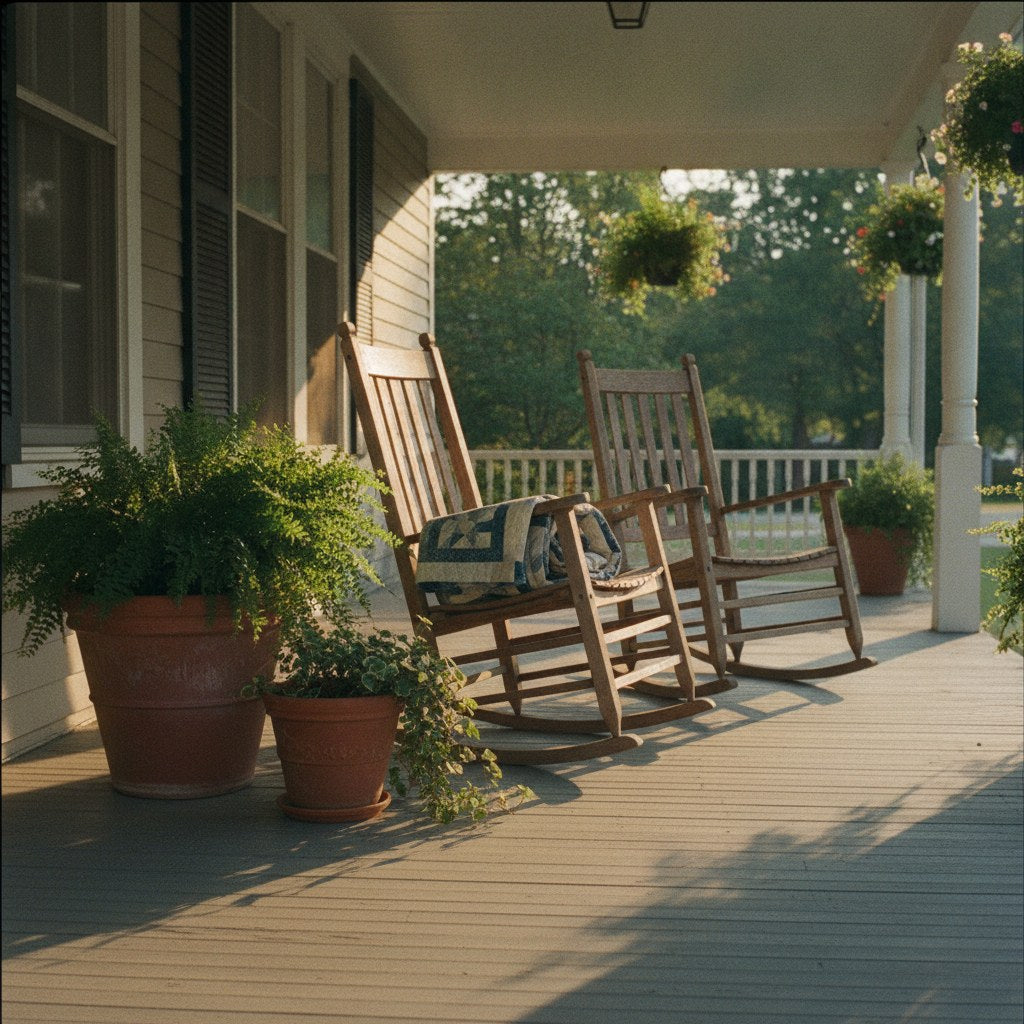
Designing a Front Porch That Actually Feels Like Somebody Lives There
You have driven past a thousand houses with perfectly decorated front porches that somehow felt like nobody was home. Matching planters, a seasonal wreath, maybe a little chalkboard sign with a leaf on it. Technically correct. Completely lifeless. Designing a front porch that actually feels like a place — not a staging photo — is a different project entirely, and it follows rules nobody writes down because most people figure them out by accident, if they figure them out at all.
The front porch is the one part of your house that does two jobs at once. It has to say something to the street and something to the people walking up to your door. Those are not always the same message. Get both right and your porch becomes the kind of place people slow down near. Get it wrong and you have an expensive welcome mat nobody notices.

The Front Porch Rule Nobody Talks About: Scale Before Style
Before you buy a single fern or a rocking chair or a doormat with a clever saying on it, stand at the street and look at your porch the way a stranger does. Most decorating mistakes happen because people are standing too close. They see the porch in pieces — this corner, that wall — and they fill those pieces without ever asking whether the whole thing holds together at thirty feet.
Scale is the thing. A six-foot porch with two full-size rocking chairs and a bistro table and three hanging baskets is not cozy. It is a traffic problem. A twelve-foot porch with one small chair and a single pot of mums looks like someone gave up halfway through. The rule is simple enough once you see it: your seating should occupy roughly a third of your usable floor space, your plants should frame rather than fill, and you should always be able to walk from the steps to the door without turning sideways.
- Measure your porch floor before you buy furniture — porch chairs look smaller in a store parking lot than they do wedged between your columns.
- Odd numbers of plants almost always look better than even numbers. Two pots flank a door; three pots tell a story.
- Hang anything on the wall at eye level, not at the top of the wall. People look straight ahead, not up.
- If your porch has a ceiling, paint it haze blue or soft sage. It reads cooler in summer and it is one of those details that makes people say they like your porch without knowing why.
The goal is not to fill the space. The goal is to make the space feel considered. There is a difference, and your neighbors can feel it even if they cannot name it.
What Your Front Porch Says Before You Open the Door
A porch communicates. Not in a metaphorical way — in a very literal, neurological way. People form an impression of a house within seconds of approaching it, and that impression is built almost entirely from texture, color, and what looks lived-in versus what looks maintained-for-appearances. Researchers at the University of Kentucky Cooperative Extension have documented how landscape and entry presentation affect perceived property value, but the more interesting finding is simpler: people trust a home that looks like someone actually enjoys it.
Enjoyed looks different from decorated. Enjoyed is a worn spot on the arm of a rocking chair. It is a dog water bowl near the door. It is a doormat that has clearly been stepped on. Decorated is everything matching, nothing out of place, and a seasonal wreath that got swapped out on the exact first day of fall. One of these makes a guest feel welcome. The other makes them feel like they might track something in.
This is where a well-chosen sign earns its keep. Not a generic farmhouse print, but something with a voice — the kind of thing that tells you who lives here before the door ever opens. We wrote a piece on how a farmhouse entryway sign sets the tone for your whole house, and the short version is this: the words you put near your door are the first sentence of a longer conversation with everyone who walks up.
If you want something that leans into the humor of Southern hospitality — the kind that says we are glad you are here but we also have opinions — a carved wooden sign that cuts right to it does the job without requiring you to explain yourself. That is the whole point of a good entryway sign. It speaks so you do not have to.
◆ From the Workshop: There is a sound test for a truly sharp drawknife that old green-wood chairmakers swore by: slice a thin curl off a piece of pine scrap and listen. A sharp edge makes a clean, papery whisper. A dull one drags and tears with a raspy scrape you can hear across the shop. Those chairmakers sharpened before every session — not every few sessions — because a blade that was sharp yesterday has already been working. The sound test costs you one shaving and thirty seconds; a dull drawknife costs you a split blank and half an afternoon.
Frequently Asked Questions
What size rug works best on a covered front porch?
For a standard six-to-eight-foot covered porch, an outdoor rug in the five-by-eight range gives you enough coverage to anchor seating without crowding the walking path. The front legs of your chairs should sit on the rug — that's the rule that keeps it from looking like you just dropped a mat in the middle of nowhere. If your porch is narrower, a runner down the center works better than forcing a wide rug that curls up the wall edges.
How do you keep front porch plants alive through a Kentucky summer?
The two killers are heat reflection off concrete and inconsistent watering. Grouping pots together slows moisture loss because the plants shade each other's soil. For south-facing porches, swap out sun-lovers like petunias for heat-tolerant caladiums or sweet potato vine by mid-July — they thrive in brutal humidity where other plants give up. A self-watering planter insert is not cheating; it is just physics working for you.
Is it worth putting outdoor lighting on a small front porch?
Yes, and arguably more so than on a large one. A small porch with good lighting feels intentional and warm; the same small porch in the dark just looks like nobody's home. Solar-powered string lights along the roofline or a single plug-in lantern beside the door cost almost nothing and completely change how the space reads after sunset. The goal is a warm amber glow, not stadium brightness — anything over 2700 Kelvin color temperature will make your porch look like a parking garage.

The Layering Method: How to Add Warmth Without Adding Clutter
The difference between a porch that feels warm and one that feels busy is layering done right. Layering is not about adding more things. It is about adding things at different heights, in different textures, with enough breathing room between them that each one registers separately.
Start at the ground. An outdoor rug defines the seating area the way a living room rug defines a conversation space — it tells people where to stand and where to sit, without anyone saying a word. From there, work up: a small side table, then the back of a chair, then a hanging basket or a wall piece, then whatever is above the door. Each layer should have one thing on it. Not one category of things. One thing.
- Ground layer: outdoor rug, welcome mat, or both if your porch is deep enough to separate the entry zone from the sitting zone.
- Furniture layer: chairs or a bench, a side table if there is room — keep the legs light and open so the floor reads as bigger than it is.
- Plant layer: one or two hanging baskets or a tall potted plant that reaches between the furniture and the ceiling — this is the layer most people skip, and it is the one that makes a porch feel lush.
- Wall layer: one sign, one wreath, or one lantern — not all three on the same wall.
Texture matters as much as color here. A jute rug under painted wood chairs under a galvanized metal lantern gives you three different textures in the same neutral palette, and that variety is what reads as warmth rather than monotony. Color can be anything, but texture is what your hand wants to touch, and that is the thing that makes a space feel real.
The Seasonal Swap: Do Less Than You Think You Should
Here is the thing about seasonal decorating on a front porch: most people overdo it. They go full autumn in September — pumpkins, corn stalks, mums in three colors, a scarecrow, a banner, a wreath with a burlap bow the size of a small dog. And then it all comes down in November and the porch looks naked for two weeks until the Christmas stuff goes up.
The better approach is a permanent base with seasonal accents. Your chairs stay. Your rug stays. Your sign stays. What changes is one or two things: a pot of seasonal flowers, a wreath swap, maybe a throw blanket on the chair in October. The porch always looks like itself. It just has a different outfit on.
If you want to go deeper on this idea — specifically what works for fall — we put together a whole guide on front door fall decorating ideas that actually hold up, including which plants survive a Kentucky October and which ones look great at the nursery and dead on your steps by the third week of the month.
The permanent base is also where you invest your money. A good set of rocking chairs will outlast a hundred seasonal wreaths. A carved hardwood sign — the kind we make here in Kentucky from Amish-sourced lumber — will still be on your porch when the chair cushions have been replaced twice. Buy the lasting things once and buy them well. Rotate the cheap things with the seasons.
The One Thing That Makes a Porch Feel Like Home Every Single Time
People. Or the evidence of them.
A porch that feels like home has signs of use. A book left on the side table. A pair of boots near the door. A dog bowl. A chair that is not perfectly centered because someone moved it to catch the afternoon shade and never moved it back. These things cannot be purchased or staged. They accumulate when people actually use the space.
So the real answer to what to put on your front porch is this: put things that invite you to use it. A comfortable chair you will actually sit in. A table the right height for a glass of sweet tea. A light that comes on at dusk so the porch is usable after dinner. If you build a porch you want to sit on, the lived-in feeling takes care of itself. The decorating is just the invitation.
There is a whole meditation on this idea — on what it means to actually slow down and use a porch instead of just maintaining one — in our piece on the lost art of porch sitting and why doing nothing is harder than it sounds. Worth a quiet read on a Sunday morning, ideally from an actual porch.
If you are starting from scratch or refreshing what you have, our entryway, porch, and yard sign collection is where we keep the pieces built specifically for that first impression — the ones that say something before you open the door, and keep saying it every time someone walks up.
Share:
The Dad's Workshop: Every Funny Happy Fathers Day Meme Gets It Right | Bluegrass Gifts
The Badass Boss: Women Leadership Quotes That Prove You Were Right All Along | Bluegrass Gifts