

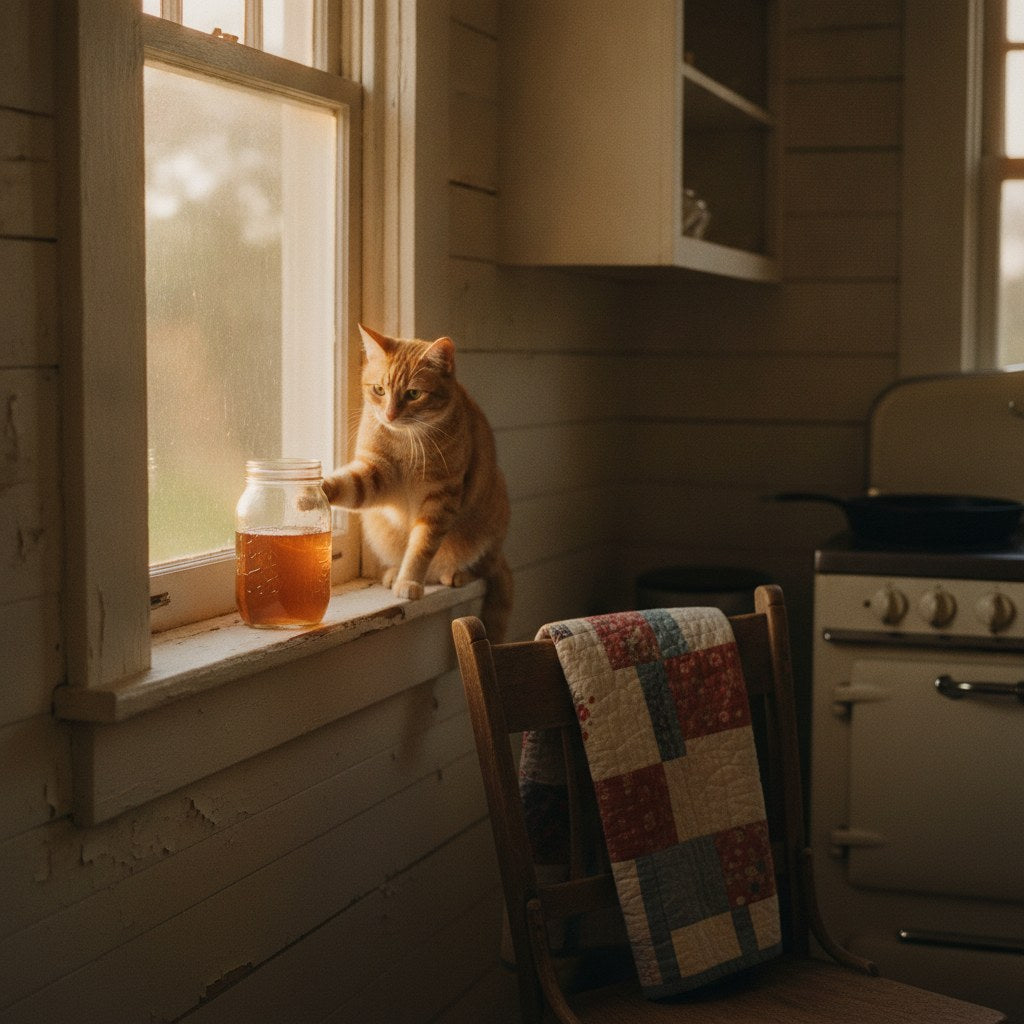
Cats Behaviours Explained: Why Your Cat Is Basically a Tiny, Smug Scientist
Your cat looked you dead in the eye and pushed your phone off the nightstand. Didn't flinch. Didn't look away. Just held your gaze the whole way down. If you've ever owned a cat, you've lived that moment, and you've probably wondered whether the animal is malicious, bored, or simply broken. The good news is that cats behaviours explained through actual science is a lot more interesting than any of those options. The answer involves predator instincts, attention economics, and a brain that is running software roughly sixty million years old.
None of this will stop your cat from doing it. But at least you'll understand what you're dealing with.

The Predator Brain That Never Clocked Out
Cats are obligate carnivores who spent the vast majority of their evolutionary history hunting small, fast, unpredictable prey. Mice. Lizards. Insects. Things that dart, flutter, and behave erratically. The cat's nervous system is tuned to detect and respond to that kind of movement — it's not a choice, it's hardware.
When a cat bats at an object on a table, it is running a prey-assessment routine. The paw tap is a test. Is this thing alive? Will it move? Does it twitch when I touch it? A pen that rolls is interesting. A glass of water that wobbles is very interesting. Your reading glasses that slide right off the edge and clatter on the floor? Jackpot. The cat isn't being destructive on purpose. It's doing exactly what its brain was built to do — it just happens to be doing it on your kitchen counter instead of a riverbank.
Researchers at the journal Animal Behaviour have documented that domestic cats retain nearly identical predatory motor sequences to their wild counterparts. The stalk, the tap, the follow-through — it's all there, just aimed at your chapstick instead of a vole.
Cats Behaviours Explained Through Attention — and Who's Really in Charge
Here's where it gets a little uncomfortable for cat owners. Part of the table-knocking behavior is learned. Not instinctive — learned. Your cat knocked something over once, you reacted, and the cat filed that information away with the precision of a very small, very smug accountant.
Cats are not pack animals. They did not evolve to read social hierarchies the way dogs did. What they did evolve is an acute sensitivity to cause and effect. If behavior A produces outcome B reliably, cats will repeat behavior A. It doesn't matter whether outcome B is a treat, a belly rub, or you leaping off the couch yelling. A reaction is a reaction. Attention is attention.
This is why scolding a cat for knocking things over tends to make the problem worse rather than better. You've just confirmed that the behavior works. The cat wasn't trying to make you angry. It was trying to make you move, look up, engage. And you did. Every time.
- Cats who get less interactive play time knock things over more often — they're manufacturing stimulation.
- Cats who are fed on a schedule often ramp up the behavior right before mealtimes — it's an alarm clock.
- Cats who live alone with working owners are statistically more likely to develop repetitive attention-seeking habits, including this one.
- The behavior peaks in cats between one and three years old, when the hunting drive is at full strength.
◆ From the Workshop: Old turners had a trick for finishing dense hardwoods like cherry or apple without reaching for sandpaper: they'd take a handful of shavings from the same piece and burnish the surface by hand. The friction generates just enough heat to partially melt and compress the outermost wood fibers into a natural polish — warm, almost waxy, and it actually bonds to a finish coat better than sanded wood does. Takes about thirty seconds. Costs you nothing but the shavings you were going to sweep up anyway. They called it burning the surface smooth, and the results speak for themselves.
Frequently Asked Questions
Can you actually train a cat to stop knocking things off surfaces?
You can reduce the behavior, but 'stop completely' is optimistic. The most effective approach is environmental management: clear surfaces of objects the cat fixates on, provide dedicated puzzle feeders and batting toys that scratch the same itch, and make sure the cat gets at least two solid play sessions a day. Punishment does not work — cats do not connect a scolding delivered thirty seconds after the act to the act itself. Redirect, don't correct.
Why does my cat only knock certain things off — like pens and glasses — but ignores others?
Weight, shape, and the sound of the landing all factor in. Cats are drawn to objects that roll unpredictably, make a satisfying noise when they hit the floor, or wobble before they fall — all of which mimic the erratic movement of small prey. A heavy ceramic bowl that just thuds and sits there offers no payoff. A pen that skitters across hardwood? That's basically a toy. If your cat has a specific target, that object is probably hitting at least two of those triggers.
Is table-knocking more common in certain breeds or ages?
High-energy, intelligent breeds — Bengals, Siamese, Abyssinians — do it more often and more deliberately, because they need more mental stimulation and will manufacture their own when bored. Age matters too: cats between one and three years old are in peak hunting-drive territory and tend to be the worst offenders. Senior cats usually mellow out, though a sudden uptick in any repetitive behavior in an older cat is worth a vet conversation, since cognitive changes can sometimes look like mischief.

The Sensory Angle: Cats Are Gathering Data, Not Just Causing Chaos
A cat's paws are extraordinary instruments. The pads and the area around them are packed with mechanoreceptors — nerve endings that detect texture, temperature, vibration, and pressure with a sensitivity that makes human fingertips look clumsy. When a cat pats at an object, it's not just testing whether the thing moves. It's running a full tactile analysis.
This is the same reason cats knead soft surfaces, drag their cheeks along doorframes, and spend an unreasonable amount of time investigating a paper bag. They're reading the world through their paws and their face in ways we don't have the hardware to replicate. The table-knocking behavior, viewed through this lens, is less about destruction and more about curiosity. Your cat is a naturalist. An extremely inconvenient naturalist who just knocked your water glass into your laptop.
There's also a spatial awareness component. Cats have difficulty judging the exact position of stationary objects — their vision is optimized for detecting motion, not for precise depth perception at close range. Nudging something is a way of confirming where it actually is. They're not being careless. They're compensating for a genuine visual limitation.
What You Can Actually Do About It (Without Becoming a Hermit)
You are not going to eliminate this behavior. Let's be honest about that upfront. But you can redirect it, reduce it, and protect the things that actually matter. Cats behaviours explained through science gives you a real roadmap here — if the behavior is driven by predator instinct and attention-seeking, the solution is to give both of those things a legitimate outlet.
- Play before the problem window. If your cat starts knocking things over at 6 a.m., do a ten-minute wand-toy session at 5:45. Drain the tank before the behavior starts.
- Puzzle feeders over food bowls. Make the cat work for its food using a puzzle feeder or a snuffle mat. That hunting energy goes somewhere constructive.
- Clear the high-value targets. If the cat has a specific obsession — your reading glasses, your keys, a particular candle — move them somewhere inaccessible. You won't win the battle of wills. Relocate the battlefield.
- Give them a designated knocking zone. A shallow box with a few lightweight objects the cat is allowed to bat around gives the behavior a legal address.
- Don't react dramatically. Boring reactions starve the attention-seeking loop. Walk away, reset the object, say nothing. It takes weeks, but it works.
We wrote a piece a while back about what it actually means to share a home with a cat — the honest, unsentimental version — and if you've ever called yourself a cat person with a mixture of pride and resignation, the honest cat person's field guide is the one to read. We also touched on cats and Halloween over here, which gets into some of the same territorial and sensory behavior from a different angle — why cats take over Halloween is a good companion piece if you want more cats behaviours explained in plain language.
The Cat Is Not Sorry, and That's Fine
Here's the thing about cats behaviours explained through biology: none of it is personal. Your cat does not knock your things over because it dislikes you. In fact, research suggests the opposite — cats are more likely to engage in attention-seeking behaviors with people they're attached to. Indifference would look like your cat sleeping in another room and ignoring you entirely. The table-knocking is, in its own aggravating way, a sign of affection. Or at least investment.
Cats are not dogs. They did not spend ten thousand years selecting for people-pleasing. They are semi-domesticated predators who have decided, on their own terms, that living with humans is a reasonable arrangement. They bring their whole wild brain into that arrangement. The knocking, the staring, the inexplicable 3 a.m. sprints — all of it is just the ancient operating system running in a modern apartment.
If you've made peace with that, and most cat people eventually do, you might as well lean into it. The pet signs collection has a way of putting the whole chaotic, fur-covered situation into words — the kind of thing that makes a cat owner laugh in recognition rather than despair. And if you want something specific for the wall, the carved cat hair welcome sign is the sort of thing that says everything about who lives in your house without requiring any explanation. Your cat will probably ignore it. That's also fine.
Share:
The Psychology of Office Boundaries: Quotes About Work Life Balance That Actually Hold Up | Bluegrass Gifts
What Kitchen Dancing Actually Does to a Marriage (It's Not Just a Cute Thing to Say)