

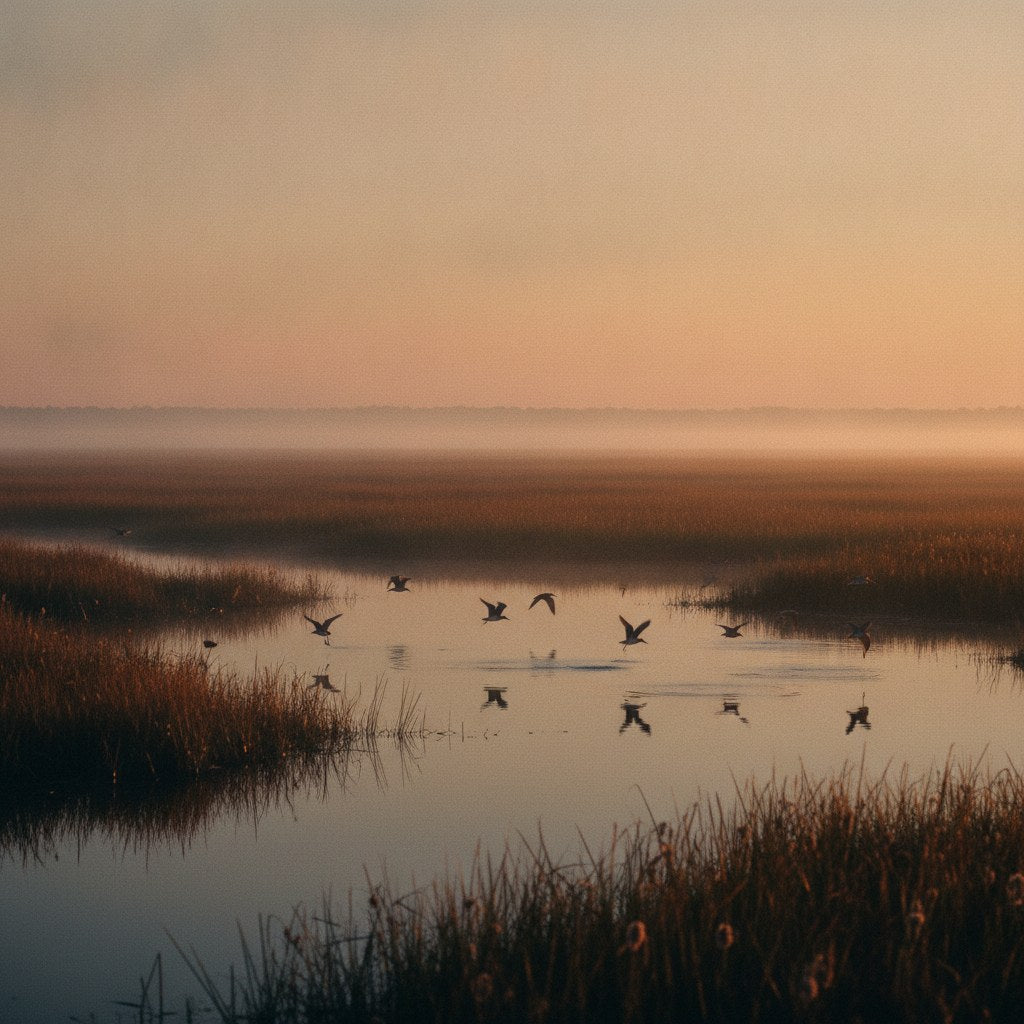
Birds of the Marsh at Sunrise: Why the Birds Marsh Hunters Love Are the Most Alive Thing on Earth
The birds of the marsh don't ease into the morning. One minute it's dark and quiet enough to hear your own breathing, and the next the red-winged blackbirds are going, then the wood ducks, then something you can't name yet is calling from the cattails thirty yards to your left. The birds marsh hunters have been waking up at four in the morning to find aren't performing for anyone — they're just living, loudly, in the one kind of place that makes that possible. If you've stood in a blind at first light and felt that wall of sound hit you, you already know what I'm trying to describe. If you haven't, I'm not sure words quite get there, but I'll try.

What Makes a Marsh Different From Every Other Habitat
A wetland sits at the edge of two worlds — terrestrial and aquatic — and that boundary is where biological productivity goes through the roof. The standing water filters nutrients from surrounding land. Emergent plants like cattails and bulrush create vertical structure: open water at the base, dense stems mid-level, seed heads at the top. Each layer supports different species doing different things, which is why a single acre of marsh can hold more individual animals than ten acres of upland forest.
The numbers that ecologists cite for wetland productivity are genuinely hard to believe. According to the U.S. Fish and Wildlife Service's National Wetlands Inventory, wetlands cover less than six percent of the Earth's land surface but support roughly a third of all threatened and endangered species in the United States. That's not an accident of geography. It's what happens when you stack food, water, shelter, and nesting cover on top of each other in the same square foot of ground.
Hunters understood this intuitively before the science caught up. You don't put a blind in a marsh because it's pretty. You put it there because that's where everything is.
The Birds Marsh Mornings Actually Belong To
Most people think of ducks when they think of wetland birds — mallards, teal, wood ducks, the species that end up on decals and carved signs and the tailgate of every serious waterfowler's truck. And ducks are remarkable. A mallard hen will return to within a few miles of where she hatched to nest, navigating hundreds of miles of featureless landscape to find a specific patch of water she hasn't seen in a year. That's worth sitting with for a second.
But the birds marsh mornings actually belong to are stranger and less celebrated:
- American bittern — stands motionless with its bill pointed skyward, striped breast blending into reed stems so perfectly that you can look directly at one and not register it as a bird
- Sora rail — sounds like a horse whinnying, weighs less than two ounces, migrates thousands of miles, and spends most of its life invisible in vegetation six inches from open water
- Great blue heron — prehistoric in silhouette, patient beyond what seems reasonable, capable of standing still for twenty minutes before striking with a speed the eye can barely follow
- Marsh wren — builds multiple nests, uses only one, sings through the night during breeding season with the kind of commitment that makes you feel like you're not trying hard enough at anything
- Common snipe — the bird that gave us the word "sniper," because hitting one on the wing requires a level of shooting that separates the serious from the optimistic
Each of these species is doing something specific in that marsh, filling a niche so precisely that removing them would leave a gap nothing else quite fills. That's not sentiment. That's ecology.
◆ From the Workshop: When you're turning a piece of wood on the lathe and it suddenly starts to vibrate badly at a speed that was smooth just minutes ago, you've hit a resonant frequency — the same physics that can shatter a wine glass with a sustained note. Speed up or slow down past that band and the vibration disappears completely; the wood hasn't changed, just the relationship between its mass and the motor's rhythm. Old turners called it 'finding the dead spot,' and they learned to pass through it quickly rather than try to work in it. A marsh works something like that — every species tuned to a specific frequency of light, temperature, and water level, and the whole system only hums when those relationships hold.
Frequently Asked Questions
What time of year are marsh birds most active and easiest to observe?
Migration windows — roughly March through May in spring and September through November in fall — stack multiple species in the same wetland at once, which makes those weeks genuinely different from any other time. But resident species like great blue herons, red-winged blackbirds, and marsh wrens are active year-round, and winter mornings in a frozen marsh have their own strange quality: fewer species, but the ones present are working harder and easier to spot against bare vegetation.
Do you need a boat or waders to get close to marsh birds, or can you observe from shore?
Most productive marsh edges can be worked from dry ground if you arrive before first light and stay still. Birds that flush easily at midday — rails, bitterns, most shorebirds — are far more tolerant of a stationary observer at dawn. A low folding seat, dark clothing, and patience will get you closer than any amount of expensive gear. If you do wade, neoprene waders in a size that lets you move quietly matter more than waterproof boots that squeak with every step.
How do wetland birds navigate and find the same marsh year after year during migration?
The short answer is that researchers are still working on this. Magnetoreception — the ability to sense Earth's magnetic field — is well-documented in several migratory species, and the Cornell Lab of Ornithology has tracked individual birds returning to within meters of their previous year's territory. Celestial navigation, polarized light patterns at dusk, and even smell all appear to play roles depending on the species. What's clear is that the marsh itself — its particular smell of decomposing vegetation, open water, and specific plant communities — functions as a landmark these birds recognize from altitude.

Why Hunters Were the First Conservationists (And Nobody Gives Them Credit)
There's a version of this conversation that turns into an argument, and I'm not interested in that version. What I'll say is this: the Federal Duck Stamp program, which has funded the purchase and protection of more than six million acres of wetland habitat since 1934, was built by hunters and paid for by hunters. Every waterfowler who buys a stamp is writing a check to preserve the exact habitat that makes the birds marsh mornings possible — for everyone, not just the people in the blinds.
That's a complicated legacy to hold, and most hunters hold it without making a speech about it. They just keep buying the stamp.
The relationship between hunting culture and wetland ecology runs deeper than policy, though. Hunters are often the first people to notice when a marsh is degrading — when the duck numbers are down, when the vegetation is changing, when the water table has dropped. They're out there before dawn in October and they remember what it looked like ten years ago. That kind of longitudinal, embodied knowledge is genuinely hard to replicate in a laboratory.
We wrote about duck hunting dogs and the science behind what they do over on the blog — the retrieve instinct and how it actually works is a stranger and more interesting story than most people expect.
The Birds Marsh Birders and Hunters Both Watch — And What That Shared Attention Means
I've stood in a marsh at sunrise next to a man with a shotgun and a man with a spotting scope, and they were both completely absorbed by the same great blue heron working the shallows forty yards out. Neither of them said anything for a long time. That's the marsh doing what it does — pulling your attention out of your head and into the present tense with a force that's hard to manufacture anywhere else.
There's something about birds marsh habitat specifically that does this. It's the combination of scale and intimacy — you're in a vast open system, sky going forever in every direction, but the action is happening close, in the reeds, at water level, at eye height if you're low enough. You're inside it rather than looking at it from a distance. That's rare in the natural world, and it's why people keep going back.
The tailgate tradition piece we put together — dogs, ducks, and the Kentucky marsh — gets at some of this from the hunting side, if that's your angle.
If you spend enough mornings in a wetland, you start to understand why people want to carry a piece of it home. Not a trophy, exactly — more like an artifact of attention. Something that says I was there, and I paid attention, and it mattered. The nature and wildlife magic mugs we carry are the closest thing we make to that feeling — the kind of image you want to hold in your hands on a cold morning before the rest of the world wakes up. And if you want something for the wall of a cabin or a blind-room or a mudroom that smells like neoprene and dog, this marsh madness duck hunting sign is the one I'd point you toward.
How to Actually See What's Happening Out There
Most people walk into a marsh and see a flat, wet, unremarkable place. The ones who keep going back learned to look differently. Here's what changed their experience:
- Arrive before shooting light. The hour before sunrise is when most marsh birds are most active and least wary. If you're arriving at dawn, you're already late.
- Stay still longer than feels reasonable. Most wildlife retreats when you move and returns when you stop. Ten minutes of stillness will show you more than an hour of walking.
- Listen before you look. Rails, bitterns, and wrens will announce themselves audibly long before you'd ever spot them visually. Learn three or four marsh bird calls and you'll suddenly realize how many birds are around you that you were walking past.
- Watch the edges. The transition zone between open water and emergent vegetation is where feeding happens. That's where the heron is standing. That's where the teal are working.
- Come back in different seasons. A marsh in April migration looks nothing like the same marsh in August, which looks nothing like it in November. Each visit is a different place.
The marsh doesn't ask much of you. Just show up early, stay quiet, and pay attention. It'll do the rest.
Share:
How Do Color Changing Mugs Actually Work? The Science Behind the Coffee Mug Humor Reveal | Bluegrass Gifts
How to Let Go of the Past: What Therapists, Preachers, and Your Grandmother All Agree On | Bluegrass Gifts