

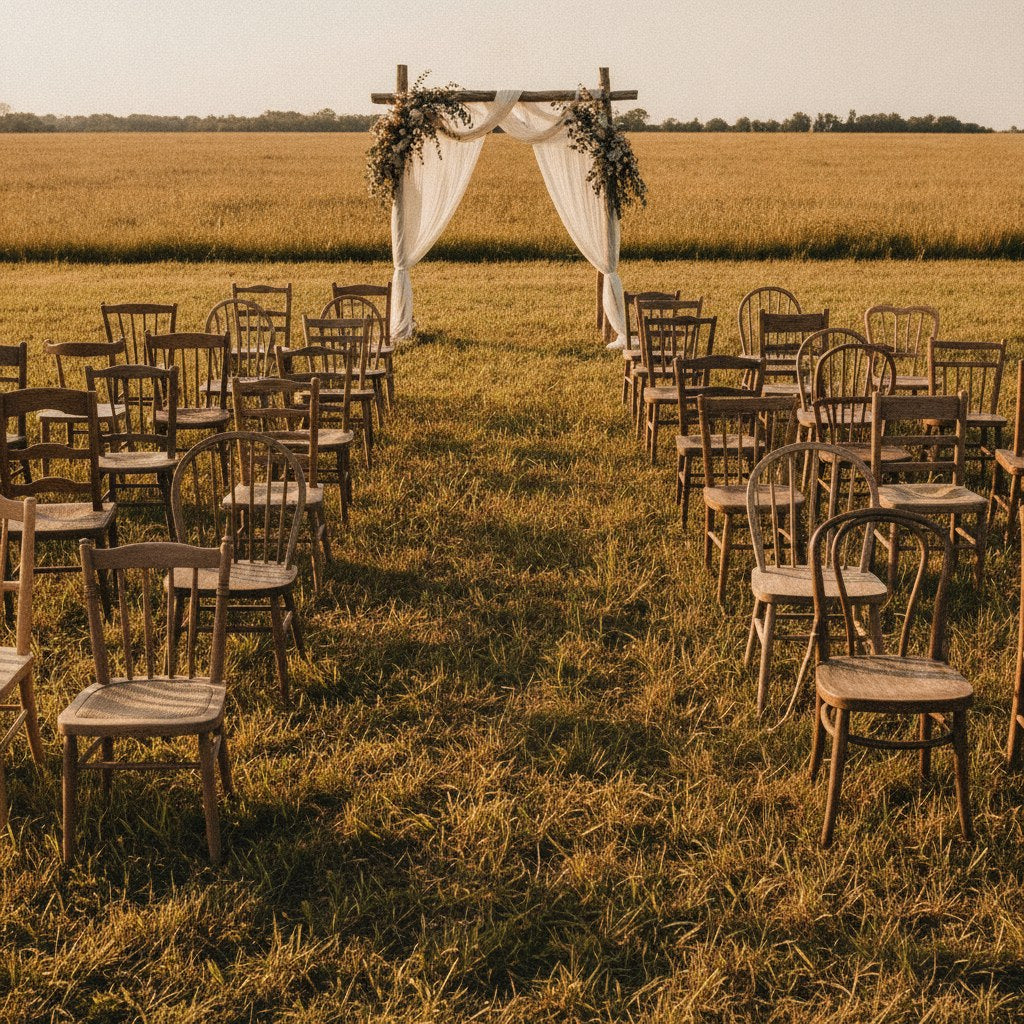
The Sign That Quietly Rewrote the Wedding Ceremony Seating Script
Somewhere in the last ten or fifteen years, a small wooden sign started showing up at the entrance of wedding venues across the country. It said, simply: Pick a seat, not a side — we're all family once the knot is tied. No usher handing you a program and steering you left or right. No unspoken obligation to sit behind whoever you showed up to support. Just a gentle instruction to sit down, get comfortable, and stop treating the aisle like a geopolitical border. It's one of those non traditional wedding ceremony ideas that looks effortless now but had to start somewhere.
The origin isn't pinned to one couple or one planner. It spread the way most good ideas spread — somebody tried it, it felt right, someone else saw a photo, and the thing took on a life of its own. By the time wedding blogs were cataloguing it as a trend, it had already been quietly running for years in church fellowship halls and barn venues and outdoor ceremonies with hay bales for pews. That's usually how the best traditions work. Nobody votes them in.

Why the Old System Stopped Making Sense for the Modern Wedding Ceremony
The bride's side, groom's side arrangement has practical roots. In an era when a wedding was largely a community event — two families from the same town, the same congregation, the same social circle — it made sense to cluster people with their people. You knew your half of the room. You'd be talking to them at the reception anyway.
But the modern wedding ceremony doesn't always look like that. Couples meet in college, at work, through apps, across state lines. The bride's best friend from childhood might be closer to the groom than anyone on his side. Blended families make the math genuinely confusing — where does a stepparent sit? A half-sibling? A close family friend who's been around since before either family existed as a unit? The traditional seating chart assumes clean lines that a lot of real families don't have.
Add to that the rise of smaller, more intimate ceremonies, and the side-by-side arrangement starts to feel less like a tradition and more like an artifact. When you've got eighty people in a room instead of three hundred, splitting them down the middle just makes the room look emptier on whichever side has fewer guests. Mixed seating fills the space and, more importantly, fills the silence before the processional with actual conversation between people who might not have met yet.
That's not a small thing. A wedding ceremony that starts with two groups of strangers staring at each other across an aisle is a different emotional experience than one that starts with a room of people who've already introduced themselves.
◆ From the Workshop: When you're chopping into the face of a board with a mallet and chisel, the sound the wood makes tells you exactly what's happening beneath the surface — a clean, sharp 'tock' means the edge is shearing fibers properly, while a dull, compressed 'thud' means the chisel is dull and crushing them instead of cutting. You can close your eyes and diagnose your edge by ear alone. Old joiners called a sharp chisel 'one that speaks,' and once you've heard the difference, you can't unhear it. A good sign starts with a board that's been worked honestly — and you know it before you've finished the first pass.
Frequently Asked Questions
Where exactly should a 'Pick a Seat, Not a Side' sign be placed at the venue?
Most couples place it at the venue entrance or the start of the aisle — somewhere guests encounter it before they even think about where to sit. A sign on an easel near the door works well for outdoor ceremonies; for indoor venues, a smaller sign propped on a welcome table or tied to a shepherd's hook at the aisle entrance is common. The goal is to catch guests before the instinct to sort themselves kicks in.
Does the 'Pick a Seat, Not a Side' setup work for ceremonies where the families genuinely don't know each other?
It actually works better in that case. When two families have little overlap, the traditional side-by-side seating just creates two strangers-facing-strangers blocks. Mixed seating forces introductions before the processional even starts, and by the time the couple says their vows, the room already feels like one group rather than two delegations eyeing each other across an aisle.
Are there situations where keeping traditional bride-and-groom sides still makes more sense?
A few, yes. Very large ceremonies — think 300-plus guests in a formal cathedral — can be logistically easier with designated sides, since ushers can seat people in waves without bottlenecks. Some religious traditions also assign seating as part of the liturgy itself, so it's worth checking with your officiant before scrapping it entirely. And if one family is significantly larger than the other, mixed seating can prevent an awkward visual imbalance in photos, which traditional side assignments would have naturally corrected.

How the Wedding Ceremony Sign Became the Messenger
Here's what I find interesting about the way this particular idea travels: it's almost always carried by an object. Not a program note. Not a verbal announcement from the officiant. A sign. Usually wood, usually at the entrance, usually handwritten or carved in a font that looks like someone meant it.
That's not accidental. A sign does something a spoken instruction can't — it greets guests before the ceremony begins, before they've found their seat, before the whole emotional machinery of the day has started running. It sets a tone without requiring anyone to say anything out loud. The couple isn't there yet. The officiant hasn't started. But the sign is already doing the work of telling everyone what kind of room this is going to be.
There's a reason this particular phrase — pick a seat, not a side — stuck while a hundred other clever wedding sayings didn't. It rhymes, which helps. But more than that, it makes a statement about the couple's values without being preachy about it. It doesn't announce that the families are complicated or that the couple is progressive or that they've thought deeply about the politics of seating arrangements. It just says: sit wherever. We're one group now. And somehow that lands harder than a paragraph would.
We carve versions of this in hardwood here in Kentucky, and the couples who order it aren't all the same. Some have blended families. Some just think the old system is silly. Some are doing a small backyard ceremony and the logistics of assigned sides don't make any sense. But they all want the same thing — a room that feels unified from the first moment, not sorted.
If you want to see what that looks like in carved wood, this hardwood ceremony seating sign is the one we make for exactly that moment at the door.
What Couples Who Choose Non Traditional Wedding Ceremony Ideas Are Actually Saying
The seating sign is a small decision, but small decisions at a wedding ceremony tend to say something larger. Couples who skip the unity candle, write their own vows, seat guests in the round, or put a sign at the door instead of posting ushers — they're not rejecting tradition for the sake of it. They're choosing the parts of tradition that still mean something and quietly setting aside the parts that don't fit their actual lives.
That's a reasonable thing to do. Marriage is old. The specific choreography of how we celebrate it is not nearly as fixed as it feels. Vows have changed. Music has changed. The guest list has changed. The idea that the seating arrangement is somehow sacred when everything else is negotiable doesn't hold up to much scrutiny.
What does hold up is the underlying intention — that a wedding ceremony is a moment when two families become one, and the room should feel that way. The 'Pick a Seat, Not a Side' sign just makes that intention visible before anyone's said a word.
We wrote about how couples navigate the long road after that first day — the humor that keeps a marriage functional — and that one on hilarious anniversary gift ideas for real marriages is worth the read if you're in the planning stage and already thinking twenty years out. And if you're looking at the full picture of what goes on a wall after the ceremony, our wedding and anniversary signs collection is where those pieces live — the kind of words that stay on the wall long after the flowers have dried.
The Object That Stays After the Wedding Ceremony Ends
Most of what happens at a wedding is gone by Sunday morning. The flowers. The food. The specific feeling of standing in that room while someone says something true about love in front of everyone you know. You can't keep any of that. But the sign at the door — if it's made to last — goes home with somebody.
A lot of couples keep theirs. It ends up in the entryway of the first house, or leaned against a bookshelf in the living room, or eventually passed along to a kid who's planning their own ceremony and wants to borrow the idea. That's how traditions actually form. Not by committee. Not by a wedding magazine declaring something official. By one object moving from one home to the next and carrying its meaning with it.
The sign that told your guests to pick a seat, not a side, is still telling anyone who walks through your door the same thing it said on the wedding day. That you're one family. That the sides don't matter. That everyone's welcome to sit wherever they'd like.
That's a pretty good thing to have on the wall. We also wrote about why custom wood signs have become the new wedding heirloom — the thinking behind why carved wood outlasts almost everything else couples bring home from that day.
Share:
How to Care for Wood Furniture So It Lasts 100 Years: Ash Wood Characteristics and What Antique Dealers Know | Bluegrass Gifts
Happiness From Inside Out: What Psychologists and Preachers Have Both Been Saying All Along | Bluegrass Gifts