

Personalized Family Gifts and the Closet Problem
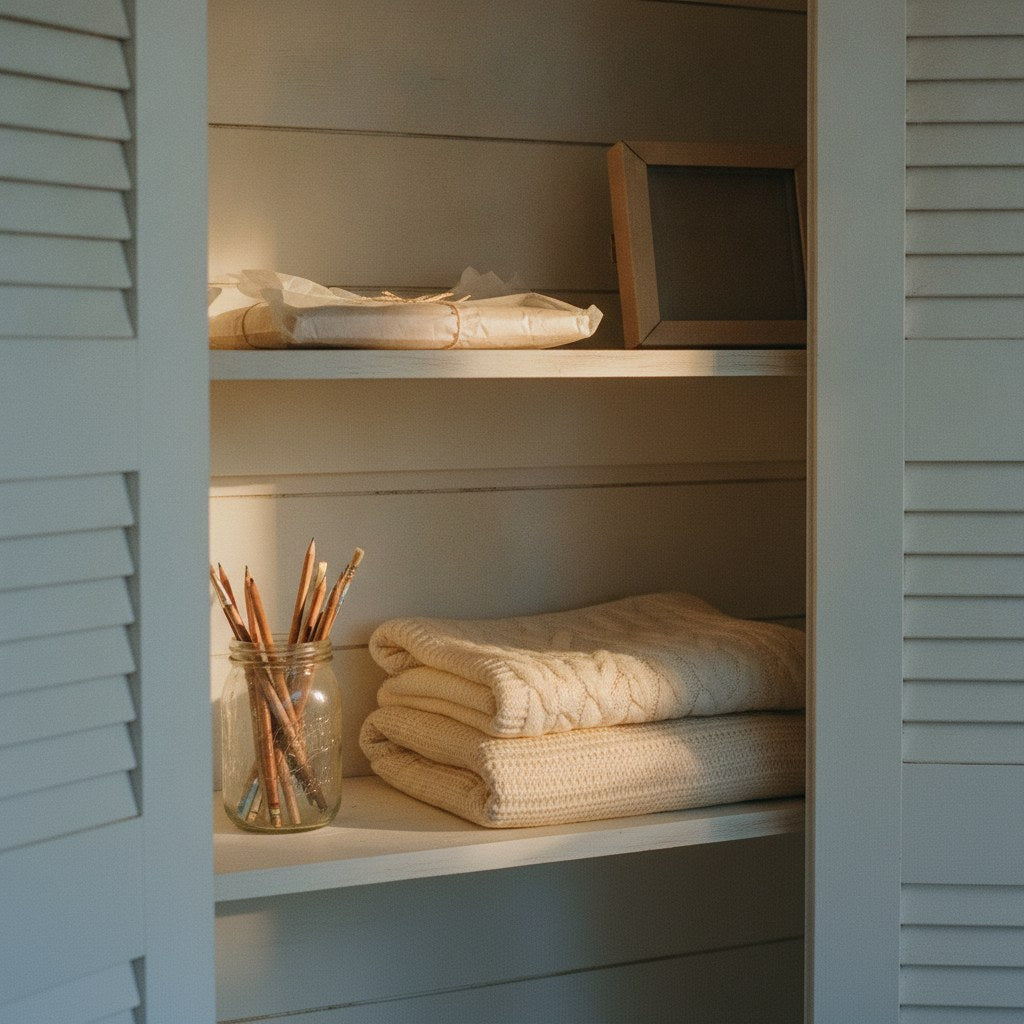
My aunt has a shelf in her guest room closet that I think of as the Museum of Good Intentions. Monogrammed picture frames still in the tissue paper. A throw blanket with the family name misspelled by one letter. A shadow box kit that was never assembled. Every item on that shelf was a personalized family gift from someone who meant well. None of them made it to a wall.
I've thought about that shelf a lot since I started making things out of wood. Not because I want to avoid it — though I do — but because it raises a real question: what's the difference between the gift that gets hung up the same week it arrives and the one that gets quietly relocated to the guest room closet? The answer isn't sentiment. Every gift on that shelf had sentiment. The answer is something more specific than that.
Most personalized family gifts fail the same way. They're personal in name only — a last name stamped on something generic, a date added to something that would've been forgettable without it. The name is the decoration, not the point. And people can feel that. They appreciate it, they say thank you, and then they find somewhere to put it that isn't the living room wall.

The Detail That Makes a Personalized Family Gift Feel Like It Was Actually Thought About
There's a version of personalization that's just fill-in-the-blank. You pick the product, type in the name, and it ships. That's fine. It's convenient. But the gifts that actually get kept tend to have one more layer — something that tells the recipient you were thinking about them specifically, not just their last name.
A few things that move a gift from the closet shelf to the wall:
- A founding year that means something. Not just when the couple got married, but the year they moved into the house, the year the family started a tradition, the year everything changed. The specificity signals that you know their story, not just their name.
- A phrase that sounds like them. Generic inspirational language reads as generic. Something that captures how this particular family actually talks — a running joke, a real value they live by, a word they use — reads as a portrait.
- A format that fits where they actually live. A large horizontal sign is useless in an apartment with one free wall. A delicate piece goes wrong in a house with three kids and a dog. The gift has to fit the life, not just the sentiment.
- Material that ages well. Things that look cheaper in five years get moved to the closet in two. Things that look better with a little age tend to stay put.
None of this is complicated. It just requires knowing the person well enough to make one specific choice instead of the default one. That's the whole job.
◆ From the Workshop: When you're laying out joinery with a mortise gauge — the version with two pins instead of one — old-timers always set the gauge to the chisel itself, not to a ruler. Drop the chisel between the pins, nudge them until they just grip the blade, lock it, and your mortise is automatically sized to the tool that's going to cut it. No measuring, no math, and the fit is perfect by definition. Personalization works the same way: size it to the actual person, not to a standard template, and the fit takes care of itself.
Frequently Asked Questions
How do I choose between a personalized sign and a personalized glass as a family gift?
Think about where the recipient actually spends time. A sign lives on a wall and works for people who take pride in their home decor — kitchens, entryways, living rooms. A personalized glass lands better for someone who entertains, hosts holidays, or has a home bar setup. If you're genuinely unsure, the glass tends to travel better as a gift because it doesn't require the recipient to commit to a nail in the wall.
Is it worth personalizing a gift for someone who moves frequently?
Yes, with one adjustment: lean toward the name or the relationship rather than a specific address or city. A glass engraved with a family name and a founding year works in any apartment in any state. A sign that says '123 Maple Street' becomes a relic the day they sign a new lease. The sentiment is portable even when the address isn't.
What's the difference between engraved and printed personalization on wood or glass, and does it matter for longevity?
It matters a lot. Printed or vinyl-applied text on wood can peel, fade, or bubble over time — especially in kitchens or bathrooms where humidity fluctuates. CNC-carved or laser-engraved text is cut into the material itself, so there's nothing to peel. On glassware, deep engraving holds up through dishwasher cycles in ways that surface etching or decals simply don't. If you want something kept for twenty years, the method of personalization is as important as the design.
Why Personalized Family Gifts on Hard Surfaces Outlast Everything Else
Fabric fades. Paper yellows. Candles burn down. The personalized gifts that end up in the thirty-year photos on someone's wall are almost always made of something that doesn't apologize for existing — wood, glass, ceramic, metal. There's a reason for that beyond aesthetics.
Hard surfaces hold their shape through the moves, the remodels, the phases. A carved hardwood sign doesn't care that you repainted the kitchen. An engraved glass doesn't fade when it gets washed. These things become part of the background of a family's life in a way that softer, more temporary objects can't quite manage. They're still there when the kids come home for Thanksgiving fifteen years from now, and they look roughly the same as they did the day they arrived.
I make carved signs in Kentucky, and the thing I notice most when people send photos is that the pieces almost always end up in the rooms where the family actually gathers — kitchens, entryways, the wall above the couch. Not the guest room. Not the closet. The room where people sit together and don't think about decor at all, because the room just feels right. That's the target. That's what you're aiming for when you choose something that's going to last.
If you want to see what that looks like in a different format, the piece we wrote on why family-themed decor lands differently than generic decor gets into the psychology of it in a way that's worth the ten minutes.

Personalized Family Gifts for People Who Already Have Everything
The hardest gift recipient is the one who buys what they want when they want it. They don't have a wish list. They don't have obvious gaps. They have a full house and a full life, and you're standing there trying to think of something that won't get returned or quietly donated.
The honest answer is that you can't out-shop someone who shops for themselves. But you can give them something they wouldn't buy for themselves — not because it's too expensive, but because people rarely personalize their own things. They buy the plain version. They tell themselves they'll do something special later. They don't.
A personalized gift does the thing they kept meaning to do. It takes the generic object they already own — a wine glass, a sign, a set of something — and makes it specific to them in a way they'd never quite get around to on their own. That's the actual value. Not the object. The decision someone else made on their behalf.
For that person, an engraved stemless wine glass with the family name and founding year tends to land well — it's something they use every week, it's specific enough to feel intentional, and it's the kind of object that sits on the counter rather than in a cabinet. If you want to browse the wider range of what's possible in that direction, the personalized wine glasses collection covers a lot of ground for different family personalities.
There's also a version of this problem that involves parents or grandparents, and the post we wrote specifically about gifts for the person who has everything approaches it from a different angle that might be useful if you're stuck.
The Object as the Record of the Moment
Here's what I actually think, stripped of any gift-giving strategy: the personalized family gifts that get kept are the ones that function as records. Not decorations. Records.
The sign on the wall that says the family name and the year they moved in isn't just decor. It's a marker. It says: this is when we started. This is who we were. Every time someone walks past it, they're not consciously reading it — but it's there, doing its quiet work, holding the shape of the family's story in a room where the family lives.
That's a different thing than a gift. That's an artifact. And the difference between a gift that becomes an artifact and one that ends up in a closet is almost always the same thing: someone made one specific, deliberate choice about this particular family, instead of the comfortable generic one.
That choice is the gift. The object is just how it gets delivered.
Share:
Gifts for Golfers Women Actually Want | Bluegrass Gifts
Personalized Aunt Gifts for the Woman Fully in Her Auntie Era | Bluegrass Gifts